On this page
- 01Short answer
- 02What counts as the cost?
- 03How do you attribute revenue?
- 04What does the calculation look like?
- 05What if you cannot attribute anything?
- 06What are the honest limits of social media ROI?
- 07What does this look like in practice?
- 08How do you compare social against your other channels?
- 09Next step
- 10Sources and further reading
- 11Frequently asked questions
Short answer
Social media return on investment (ROI) is revenue attributable to social, minus the full cost of producing it, divided by that cost. The difficulty is never the formula. It is counting the cost honestly, including your own hours, and accepting that attribution will always be partial.
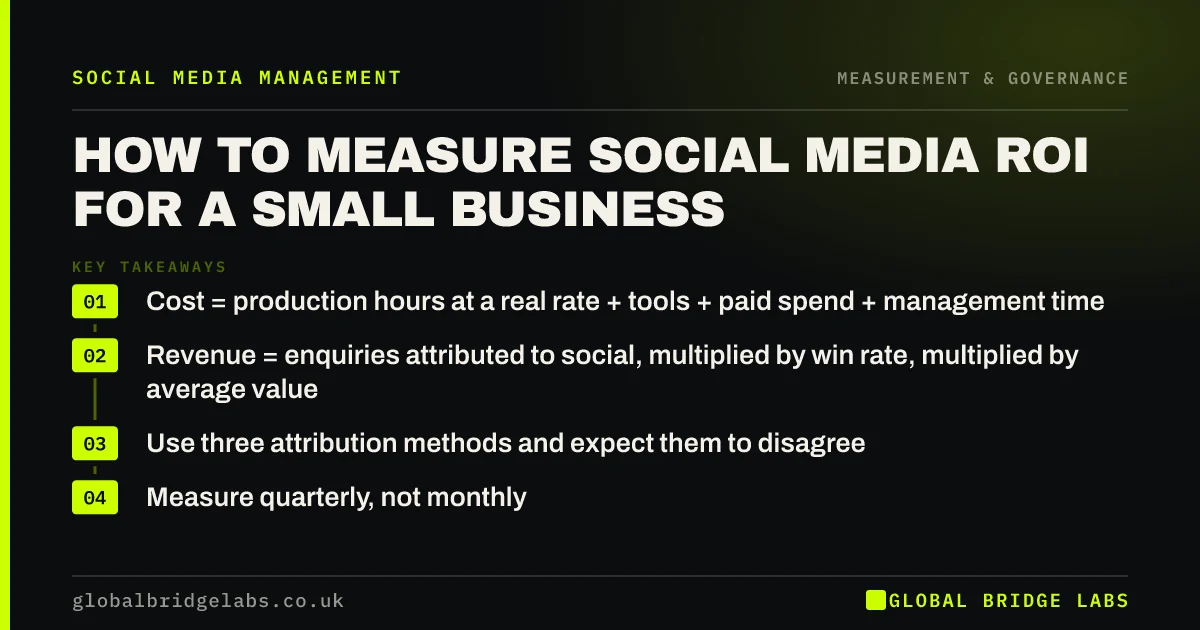
- Cost = production hours at a real rate + tools + paid spend + management time.
- Revenue = enquiries attributed to social, multiplied by win rate, multiplied by average value.
- Use three attribution methods and expect them to disagree.
- Measure quarterly, not monthly. Social influences purchases that complete weeks later.
- If you cannot attribute anything, measure cost per conversation instead. It is an honest proxy.
Want your actual social media ROI calculated? Send us your numbers on WhatsApp.
Chat on WhatsApp →What counts as the cost?
Everything, including the hours nobody invoices for. The most common error in small business ROI calculations is counting only the paid spend and the tools, which makes social look either free or impossibly efficient.
Cost the owner's or marketing lead's hours at a real rate. Six hours a week at £40 an hour is roughly £960 a month, which usually dwarfs the tool subscriptions and often exceeds the ad budget.
- Production hours at a realistic internal rate.
- Community management and response time.
- Tools and subscriptions.
- Paid media spend.
- Agency or freelancer fees.
- Management and approval time.
How do you attribute revenue?
Three methods, used together, because each sees a different part of the picture.
Analytics with UTM tags captures click-through traffic. A source field on your enquiry form captures what people say. And a CRM note captures conversations that started in direct messages, which analytics never sees.
Expect self-reported attribution to credit social more generously than analytics does. That gap is not an error; it reflects the fact that much of social media's influence happens before someone searches your name directly.
What does the calculation look like?
Work it through concretely. Suppose a quarter costs £4,500 in total: £2,880 of internal time, £120 of tools, and £1,500 of paid spend.
In the same quarter, 22 enquiries are attributed to social. You quote 18 of them and win 6. Average job value is £1,900, so attributed revenue is £11,400. ROI is (11,400 minus 4,500) divided by 4,500, which is roughly 1.5, or 150%.
Then apply your gross margin, because revenue is not profit. At 40% margin, the contribution is £4,560 against £4,500 of cost, which is close to break-even and a very different conclusion from the headline ROI figure.
We will run this calculation with your real numbers in 30 minutes. Message us on WhatsApp.
Chat on WhatsApp →What if you cannot attribute anything?
Measure cost per conversation as an interim proxy. Total cost divided by the number of genuine two-way conversations started with people who were not already customers.
It is not ROI, and you should not present it as such, but it is comparable over time and it moves for the right reasons. Most small businesses that claim social media is unmeasurable have simply never set up the enquiry source field, which takes ten minutes.
What are the honest limits of social media ROI?
Three, and stating them makes the number more useful rather than less.
First, brand effects are real and unmeasurable in this framework. Second, last-click attribution systematically undercredits social, because people see you on social and then search your name. Third, small sample sizes produce unstable numbers, so a single quarter is a weak basis for a decision.
Use ROI as one input to a judgement, not as a verdict. A channel at break-even that is producing a growing audience is a different proposition from a channel at break-even that has been flat for two years.
What does this look like in practice?
A pattern behind most social media does not pay conclusions: analytics shows very little converting traffic, so the channel is judged a failure. Adding a single required field to the enquiry form frequently changes the picture, because a significant share of enquiries name a social channel analytics never saw, the conversations having started in direct messages.
In those cases the spend was justified all along. What was missing was ten minutes of form configuration, which is more often the problem than the marketing is.
How do you compare social against your other channels?
On cost per enquiry and on enquiry quality, calculated the same way for each channel, which is the part that usually goes wrong.
Most small businesses cost their paid channels fully and their organic channels at zero, which makes organic look free and paid look expensive. Apply the same rule to all of them: every channel carries its full production and management time, or none of them do.
Then compare quality, not just cost. An enquiry from search that converts at one in three is worth more than a social enquiry converting at one in eight, even at the same cost. Track conversion rate by source and the comparison becomes straightforward.
- Cost every channel the same way, including internal time.
- Compare cost per enquiry and conversion rate by source.
- A cheaper enquiry that converts worse is not cheaper.
- Review the comparison quarterly, not monthly.
Next step
If you cannot currently state what social media returns, the fix is usually measurement setup rather than a change of strategy.
Message us on WhatsApp and we will set up social media attribution and calculate your real return.
Chat on WhatsApp →Sources and further reading
- URL builders: collect campaign data with custom URLs · Google Analytics Help
- Employee earnings in the UK (Annual Survey of Hours and Earnings) · Office for National Statistics
Frequently asked questions
How do you calculate social media ROI?
Attributed revenue minus total cost, divided by total cost. Total cost must include internal hours at a realistic rate, tools, paid spend and management time. Then apply your gross margin, since revenue ROI and profit contribution are very different figures.
What is a good ROI for social media?
It depends on margin and on what else you could do with the money. Compare social against your next best channel rather than against an abstract target, and judge over quarters rather than months, since social influences purchases that complete weeks later.
Why does analytics show fewer social leads than customers report?
Because much of social media's influence happens before a click. People see you on social, then search your name directly, which analytics records as organic search. Direct message enquiries are invisible to analytics entirely, which is why a source field on your form matters.
How long before social media shows a return?
Six to nine months for organic social in most UK small businesses. Paid social produces readable data within 60 days. Judging organic at 90 days tells you whether the mechanics are working, not yet whether the investment pays.
Written by

Global Bridge Labs (GBL) is a UK–Sri Lanka partner for social media, websites and BPO. Everything here comes from client delivery, not theory.