On this page
Key takeaways
Buyers trust businesses on social media when they see evidence of reliability: recent activity, real work, real people and replies to questions. Consistency supplies that evidence week after week. Reach alone does not, because a stranger seeing one viral post learns nothing about whether you deliver.
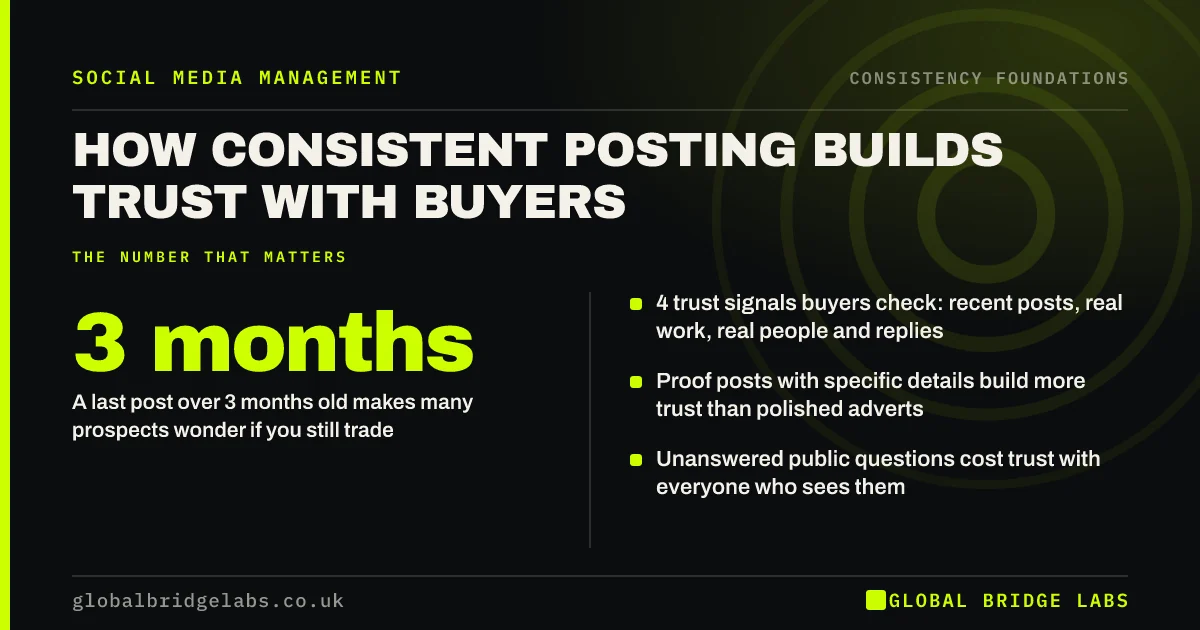
- 4 trust signals buyers check: recent posts, real work, real people and replies.
- A last post over 3 months old makes many prospects wonder if you still trade.
- Proof posts with specific details build more trust than polished adverts.
- Unanswered public questions cost trust with everyone who sees them.
- Trust builds through repetition. It cannot be earned in one post.
Want your profile checked through a buyer's eyes? Send us the link on WhatsApp.
Chat on WhatsApp →Why does consistency build trust?
Consistency builds trust because it is itself evidence of reliability. A business that turns up on social media every week, in the same style, answering questions, is showing the behaviour a buyer wants from a supplier. A business that posts in bursts and goes quiet is showing the opposite, whatever the posts say.
Buyers rarely think this through consciously. They form a quick impression from what they see when they check your profile, often just before calling or after receiving a quote.
What do buyers check on your profile?
Most buyers spend under a minute on a supplier's social profile. In that time they look for four things.
- Recency: when was the last post? Recent activity suggests an active, functioning business.
- Real work: are there photos or stories of actual jobs, products or clients?
- Real people: can they see who runs the business or who they would deal with?
- Responsiveness: are comments and questions answered, and how politely?
Which posts build the most trust?
Specific posts build more trust than general ones. A post that shows a finished job, the problem it solved, the timescale and a quote from the customer is far more persuasive than a polished brand graphic.
- Finished work with details: location area, timescale, what was involved.
- Customer reviews shared with permission, and in line with CMA guidance on reviews.
- Answers to common questions, including prices or typical ranges where you can.
- Team introductions, so buyers know who they will deal with.
- Honest posts about what you do not do, which make everything else more credible.
Want a set of trust-building post templates for your business? Message us on WhatsApp.
Chat on WhatsApp →What damages trust on social media?
Silence, unanswered complaints and claims that look too good. A long gap in posting, a public question with no answer, or a series of posts full of superlatives with no evidence all make buyers more cautious.
Misleading claims also carry regulatory risk. The ASA's CAP Code applies to marketing on your own social media accounts, and the CMA has published guidance on handling consumer reviews. Trust and compliance point in the same direction: be specific, be honest and show evidence.
What does this look like in practice?
A UK electrical contractor won most of its work from quotes, and prospects often went quiet after receiving one. When asked, several said they had checked the company's Facebook page and found nothing posted since the previous year.
The firm started posting two finished jobs a week with the area, the scope and the timescale, plus a monthly post introducing a member of the team. Within three months, the office noticed that prospects who had seen the page were more likely to accept quotes, and some mentioned specific jobs they had seen.
Next step
Look at your profile as a prospect would, for 60 seconds, and ask whether it proves you are active, real and responsive. Then plan a steady rhythm of specific proof posts and replies to fill the gaps.
Message us on WhatsApp and we will run a 60-second buyer check on your profile and send you what to fix.
Chat on WhatsApp →Sources and further reading
- Recognising ads: social media and influencer marketing · ASA / CAP
- Publishing consumer reviews and complying with consumer protection law · Competition and Markets Authority
- Meta Business Help Centre · Meta
Frequently asked questions
How do you build trust on social media as a business?
Post consistently, show real work with specific details, introduce the people behind the business and reply to comments and messages promptly. Buyers look for evidence of reliability, and a steady, responsive profile provides it. Avoid vague claims and superlatives without proof.
Does an inactive social media page put customers off?
Often, yes. When a prospect checks a profile and sees no posts for months, many wonder whether the business is still trading or still cares. A short, steady posting routine is enough to remove that doubt, even if the posts are simple.
What content builds the most credibility?
Specific proof: finished jobs with details, customer reviews shared with permission, answers to real questions and honest information about prices or timescales. Specific content is more believable than polished general marketing because it shows what the buyer will actually get.
Should businesses reply to every comment?
Reply to every genuine question and complaint, ideally within one working day. Public replies are seen by everyone who visits later, so they build trust with future customers as well as the person asking. Obvious spam can be hidden or removed.
Written by

Global Bridge Labs (GBL) is a UK–Sri Lanka partner for social media, websites and BPO. Everything here comes from client delivery, not theory.