On this page
- 01Key takeaways
- 02Why ask at all?
- 03How should you word the question?
- 04When and where should you ask?
- 05How do you record the answers?
- 06How reliable are the answers?
- 07What do you do with 'Google'?
- 08How does this change spending decisions?
- 09What are the data protection points?
- 10What does this look like in practice?
- 11Checklist
- 12Next step
- 13Sources and further reading
- 14Frequently asked questions
Key takeaways
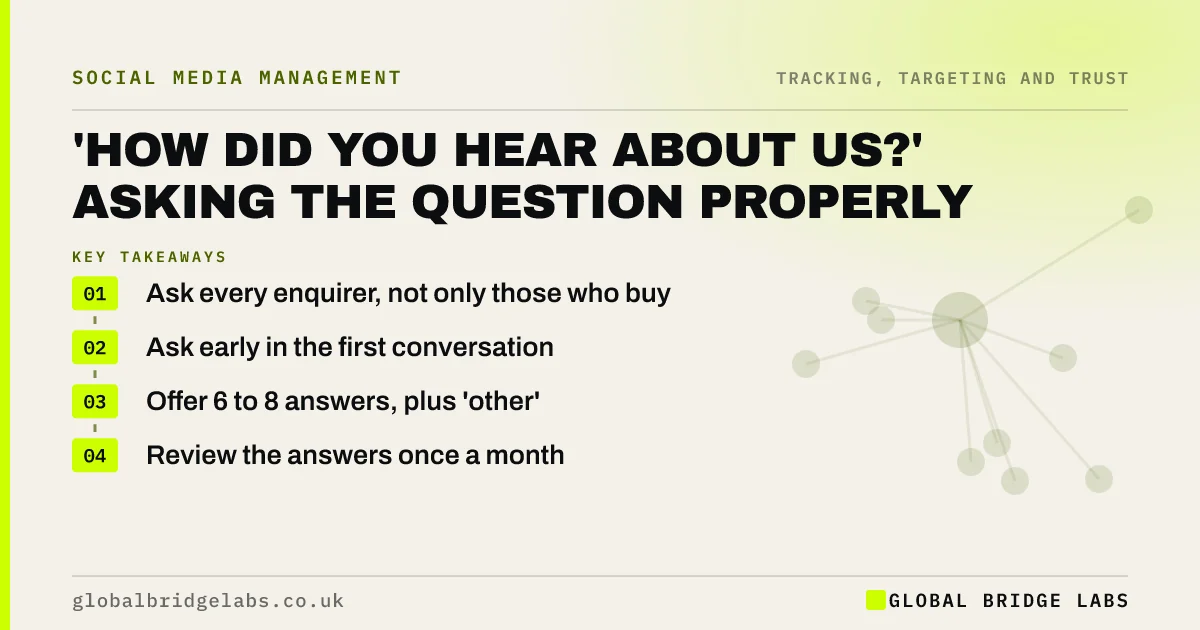
'How did you hear about us?' is the cheapest tracking tool a small business has, and the only one that covers social media and traditional advertising alike. It works when everyone asks it, at the same moment, and writes the answer down.
- Ask every enquirer, not only those who buy.
- Ask early in the first conversation.
- Offer 6 to 8 answers, plus 'other'.
- Review the answers once a month.
Want the question built into your enquiry forms? Message us on WhatsApp.
Chat on WhatsApp →Why ask at all?
Ask because software cannot see offline life. Analytics can show that someone arrived from a search. It cannot show that they searched because a neighbour recommended you, or because they pass your van every morning. The customer is the only person who knows.
How should you word the question?
Ask 'Where did you first hear about us?' in a friendly, ordinary voice. 'First' matters, because people often name the last place they saw you. On a form, give a short list of choices instead of an empty box, because empty boxes collect answers such as 'online'.
- Recommendation from someone.
- Google search or maps.
- Facebook or Instagram.
- Leaflet through the door.
- Saw our van or sign.
- Local magazine or paper.
- Other, please say.
When and where should you ask?
Ask at first contact, while memory is fresh, and in every place enquiries arrive: on the phone, on the website form, in messages and at the counter. Asking only customers who buy hides the channels that bring enquiries which do not convert.
How do you record the answers?
Record answers in one log with the date, the source and what happened next. Use the same category names every time, or 'FB', 'Facebook' and 'social' will become three sources. Add a second column for anything else mentioned, since many people name two places.
How reliable are the answers?
The answers are reliable in aggregate and unreliable one by one. People forget, guess or name the most recent thing. Over 50 enquiries, the pattern is still informative. Treat it as one source of evidence beside codes, dedicated numbers and platform reports.
What do you do with 'Google'?
Follow 'Google' with one more question: 'What made you search for us?' Search is often the last step, not the first. The honest answer may be a leaflet, a post or a recommendation. Without the follow-up, search takes the credit for every other channel.
How does this change spending decisions?
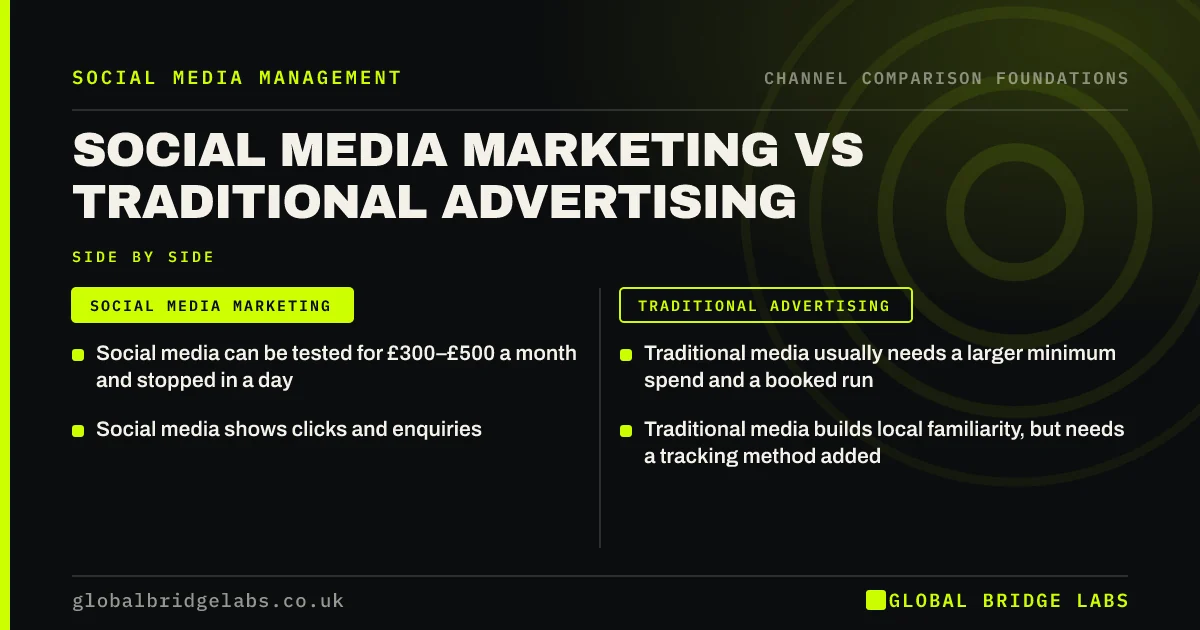
A month of answers shows which channels are named and which never are. Divide each channel's cost by the enquiries that named it. Paid social starts at £300–£500 a month and a leaflet drop at £300 to £750, so even a small shift guided by real answers is worth having.
- How to compare advertising ROI across online and offline
- How to split a marketing budget between traditional and digital
Want your first month of answers turned into a budget view? Message us on WhatsApp and we will discuss your requirements.
Chat on WhatsApp →What are the data protection points?
The answer to this question is ordinary business information, and recording it against an enquiry is normally covered by the same lawful basis as handling the enquiry. Keep it with the customer record, do not collect more than you need and mention marketing analysis in your privacy information.
What does this look like in practice?
A pattern we see when the question is introduced: for the first fortnight, half the team forget to ask. Adding it as a required field on the job sheet or enquiry form fixes that. By the second month the firm has its first real picture of where work comes from.
Checklist
- One wording, used by everyone.
- A fixed list of sources.
- Asked at first contact, on every route.
- Logged the same day.
- Reviewed monthly against spend.
Next step
Add 'Where did you first hear about us?' to your enquiry form and phone script today, with a fixed list of answers.
Message us on WhatsApp for a ready-made answer list for your sector, or book a 30-minute consultation.
Chat on WhatsApp →Sources and further reading
- Question pages pattern · GOV.UK Design System
- Lawful basis for processing personal data · Information Commissioner's Office
- Get started with attribution · Google Analytics Help
Frequently asked questions
What are good options for 'how did you hear about us?'
Keep to six to eight options that match where you actually appear: recommendation, Google search, each social platform you use, leaflet, vehicle or sign, local publication and other. Remove any channel you do not use so the list stays short.
Should 'how did you hear about us' be a required field?
For a phone or counter script, yes, because it takes five seconds. On a website form, make it a short optional or required drop-down depending on how long the form already is. A long form loses enquiries, so keep everything else brief.
How accurate is asking customers how they found you?
Individual answers can be wrong, since people forget or name the last thing they saw. Across a few dozen enquiries the pattern is useful. Combine it with codes, dedicated numbers and analytics for a fuller picture.
What if customers say they found us on Google?
Ask what prompted the search. Many people search for a name they met elsewhere, such as on a leaflet, a van or social media. Recording the prompt as well as the search stops search engines taking credit for other channels.
Written by

Global Bridge Labs (GBL) is a UK–Sri Lanka partner for social media, websites and BPO. Everything here comes from client delivery, not theory.