On this page
- 01Key takeaways
- 02What counts as traditional advertising?
- 03What are the main types of traditional advertising?
- 04How is traditional advertising bought?
- 05How is the audience measured?
- 06How does it differ from social media marketing?
- 07What does traditional advertising cost?
- 08What rules apply?
- 09When is traditional advertising the wrong choice?
- 10What does this look like in practice?
- 11Traditional advertising checklist
- 12Next step
- 13Sources and further reading
- 14Frequently asked questions
Key takeaways
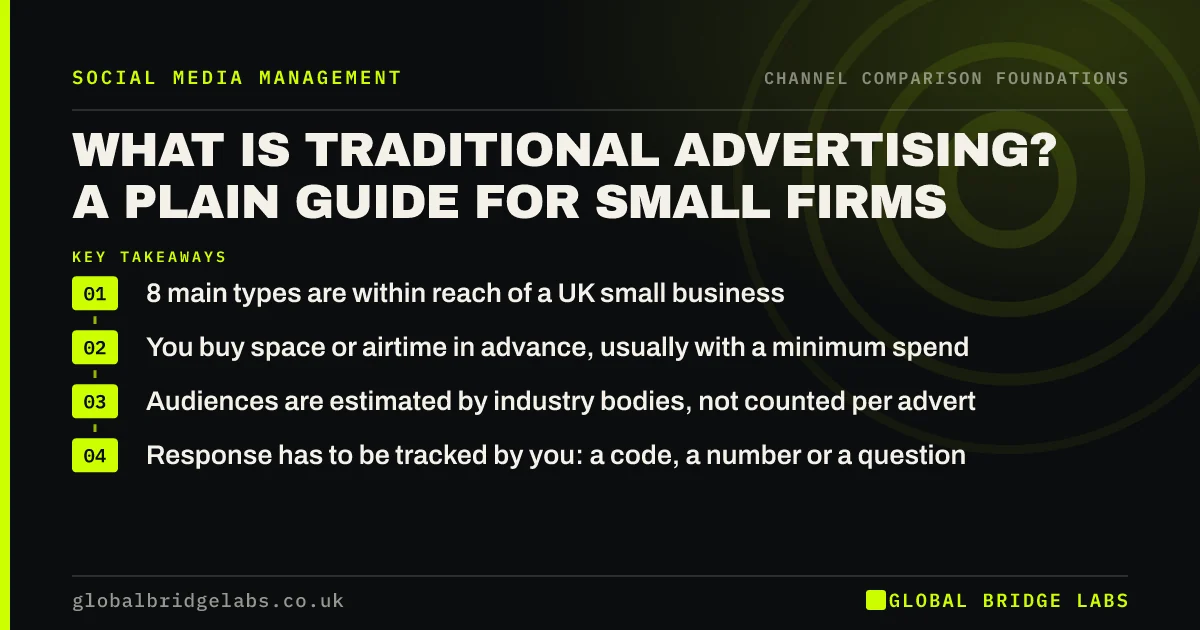
Traditional advertising is paid promotion in media that existed before the internet, such as print, radio, television, mail, outdoor posters and events. It is bought as a fixed space or slot, seen by everyone the medium reaches, and cannot be changed once it has run.
- 8 main types are within reach of a UK small business.
- You buy space or airtime in advance, usually with a minimum spend.
- Audiences are estimated by industry bodies, not counted per advert.
- Response has to be tracked by you: a code, a number or a question.
Not sure which of these suits your business? Message us on WhatsApp and we will talk it through.
Chat on WhatsApp →What counts as traditional advertising?
Traditional advertising, also called offline advertising, covers any paid message carried by print, broadcast, post or a physical site. The common thread is that the advertiser rents attention from a publisher, a broadcaster or a site owner, and the message travels one way. The audience cannot reply, share or click.
What are the main types of traditional advertising?
A small business can realistically buy eight types. Each has a different job, and most firms only ever need one or two of them.
- Print: local newspapers, magazines and trade titles.
- Radio: spot adverts and sponsorship on local stations.
- Television: regional or addressable campaigns.
- Door drops: unaddressed leaflets delivered to households.
- Direct mail: addressed letters and postcards.
- Outdoor: billboards, bus sides, shelters and signs.
- Directories: printed and listed directories of suppliers.
- Events and sponsorship: shows, fairs and local clubs.
How is traditional advertising bought?
Traditional advertising is bought from a rate card, in advance, for a set size, length or number of deliveries. You pay for the space and separately for making the advert. Rate cards are a starting price, not a fixed one, and late or repeat bookings are often discounted. Expect a minimum order in most media.
How is the audience measured?
Audiences are estimated by industry measurement bodies, not counted for your advert. RAJAR measures radio listening, BARB measures television viewing and JICMAIL measures how people handle mail and door drops. These figures tell you roughly how many people could see or hear an advert. They do not tell you how many noticed yours.
How does it differ from social media marketing?
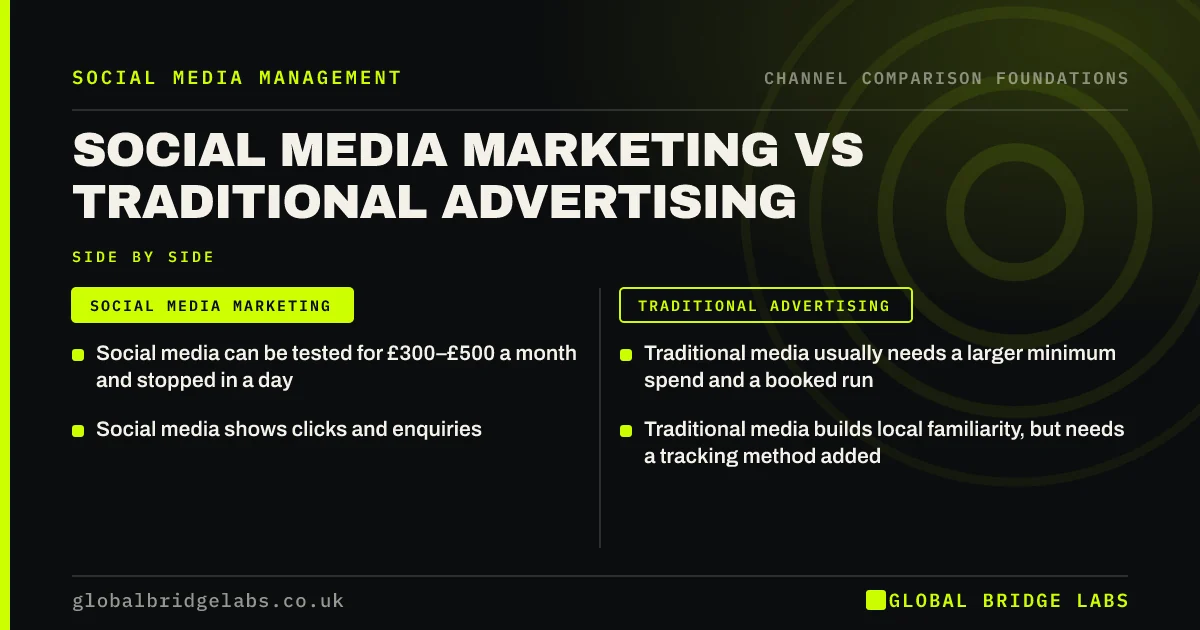
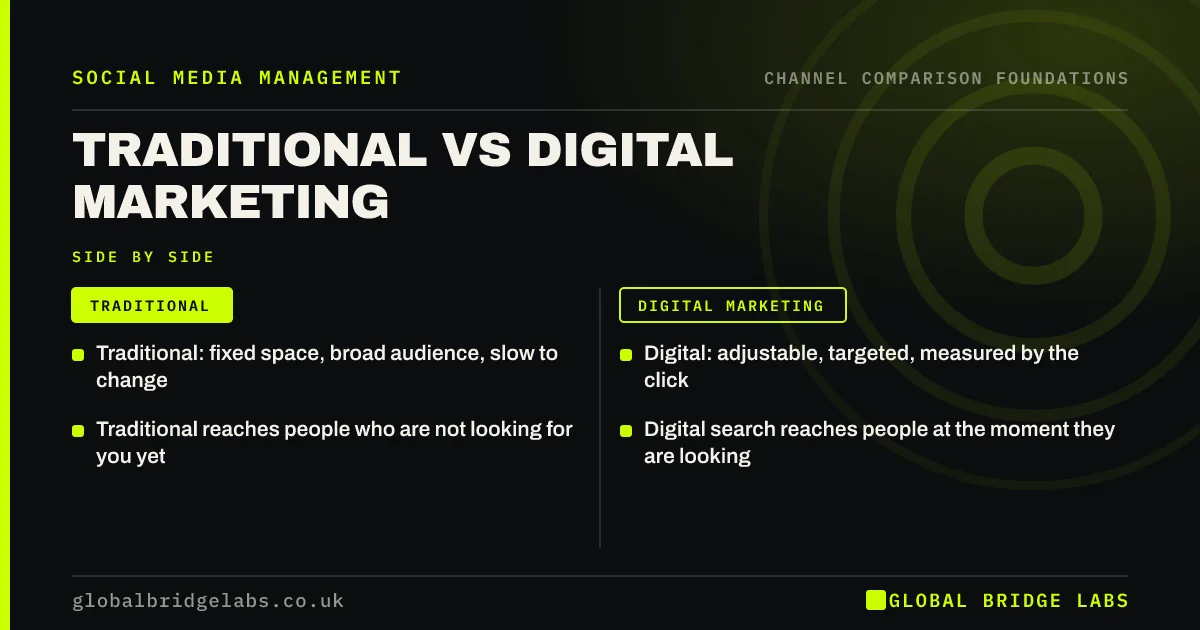
Traditional advertising is fixed, broad and one-way. Social media marketing is adjustable, targeted and two-way. A printed advert cannot be corrected after it runs, while a post can be edited in a minute. On the other hand, a printed advert is not competing with a friend's holiday photos one swipe away.
- Traditional: booked in advance, fixed once run.
- Social: started and stopped the same day.
- Traditional: audience defined by place or title.
- Social: audience defined by location, age and interests.
What does traditional advertising cost?
Costs run from under £100 for a small local advert to many thousands for television. As indicative UK ranges, a leaflet drop costs roughly 6p to 15p per household, a local newspaper advert £150 to £1,000 an insertion and a week of local radio £500 to £2,500 plus production. Prices depend on area, season and how late you book, so ask for three quotes.
Want help comparing a quote against a social media test? Message us on WhatsApp.
Chat on WhatsApp →What rules apply?
All UK advertising must be legal, decent, honest and truthful. Print, posters, leaflets and mail fall under the CAP Code, and television and radio under the BCAP Code, both enforced by the Advertising Standards Authority. Broadcast adverts are checked before they air. Outdoor signs can need consent from the council.
When is traditional advertising the wrong choice?
It is the wrong choice when you can only afford to run it once, because most traditional media work through repetition. It is also a poor fit when your buyers are spread thinly across the country, or when you have no method of tracking who responded. In those cases a small, measurable test elsewhere will teach you more.
What does this look like in practice?
A pattern we see with established local firms: the word advertising means the three things the business has always bought. When each is written down with its yearly cost and the enquiries it can be shown to have produced, one usually stands out as worth keeping and one as worth replacing. The exercise takes an afternoon.
Traditional advertising checklist
- Name the audience and the area before choosing a medium.
- Ask for the audience figures and who measured them.
- Get the total cost, including design or production.
- Check you can afford at least three appearances.
- Add a tracking code, number or web address.
- Set a date to review the response.
Next step
Write down every traditional advert you paid for in the last year and its total cost. Beside each, note whether you could prove a single enquiry came from it.
Message us on WhatsApp with that list and we will help you decide what to keep, or book a 30-minute consultation.
Chat on WhatsApp →Sources and further reading
- UK Code of Non-broadcast Advertising and Direct & Promotional Marketing (CAP Code) · ASA / CAP
- UK Code of Broadcast Advertising (BCAP Code) · ASA / BCAP
- Radio Joint Audience Research: UK radio listening figures · RAJAR
- Joint Industry Committee for Mail: audience measurement for mail and door drops · JICMAIL
Frequently asked questions
What is traditional advertising in simple terms?
It is paid promotion through media that existed before the internet: newspapers, magazines, radio, television, leaflets, letters, posters, directories and events. You pay for a set space or slot, the same message reaches everyone who sees it, and the audience cannot respond through the advert itself.
What are examples of traditional advertising?
Common examples are a quarter-page advert in a local paper, a 30-second spot on a local radio station, a leaflet delivered to every home in a postcode, a letter sent to past customers, a poster at a bus stop and a stand at a trade show.
Is traditional advertising the same as offline advertising?
In everyday use, yes. Both terms describe advertising that does not rely on the internet. Some people use offline more widely to include signs, vehicle livery and printed materials you hand out yourself, which are owned rather than bought from a media owner.
Do small businesses still use traditional advertising?
Yes. Leaflets, local magazines, radio, vehicle signs and sponsorship remain common among UK small businesses, particularly trades, hospitality and local services. The firms that get value from them tend to repeat the advert, keep the area tight and record where each enquiry came from.
Written by

Global Bridge Labs (GBL) is a UK–Sri Lanka partner for social media, websites and BPO. Everything here comes from client delivery, not theory.