On this page
- 01Key takeaways
- 02What do B2B and B2C mean?
- 03How do the buyers differ?
- 04Which social platforms suit each?
- 05Which traditional channels suit each?
- 06How does the message differ?
- 07How do the costs and timescales differ?
- 08Are the rules different?
- 09What if you sell to both?
- 10What does this look like in practice?
- 11Next step
- 12Sources and further reading
- 13Frequently asked questions
Key takeaways
B2B vs B2C advertising differs in who decides, how long it takes and how many buyers there are. Selling to businesses means a small, named audience and a long decision. Selling to consumers means a wide audience and a quick one. The channel mix follows from that.
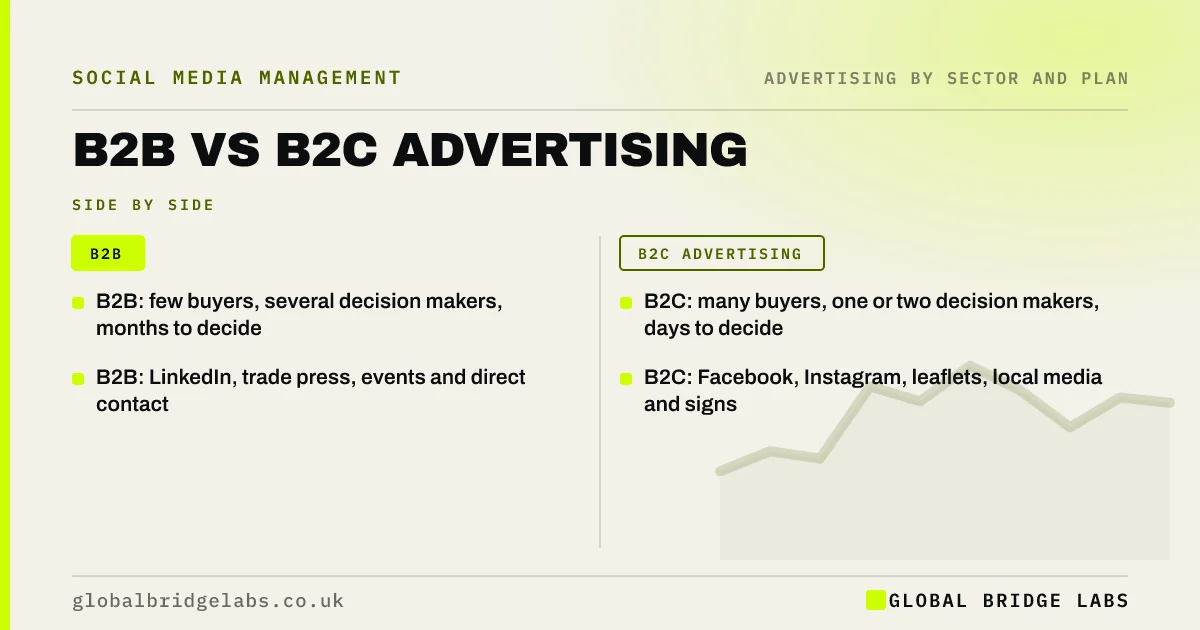
- B2B: few buyers, several decision makers, months to decide.
- B2C: many buyers, one or two decision makers, days to decide.
- B2B: LinkedIn, trade press, events and direct contact.
- B2C: Facebook, Instagram, leaflets, local media and signs.
Sell to both and unsure how to split effort? Message us on WhatsApp.
Chat on WhatsApp →What do B2B and B2C mean?
Business-to-business (B2B) means selling to other organisations. Business-to-consumer (B2C) means selling to individuals and households. Many small firms do both, such as an electrician who serves homeowners and landlords, and need to treat them as two audiences.
How do the buyers differ?
Business buyers purchase on behalf of an organisation, justify the choice to colleagues and fear making a mistake. Consumers buy for themselves, with their own money and more emotion. The LinkedIn B2B Institute estimates only about 5% of business buyers are in the market at any time, so most B2B advertising is read by people who will buy later.
Which social platforms suit each?
LinkedIn is the main platform for reaching people in their working role. Facebook and Instagram reach people as householders and consumers, and TikTok and YouTube reach both through video. Ofcom's 2026 research found 89% of adult internet users use at least one social platform.
Which traditional channels suit each?
Traditional channels divide along the same line.
- B2B: trade press, trade shows, addressed mail, the telephone.
- B2C: leaflets, local print, radio, outdoor and signs.
- Both: vehicle livery, sponsorship and referrals.
How does the message differ?
B2B messages lead with risk, reliability and evidence: case studies, figures and accreditations. B2C messages lead with the result for the person: time saved, a home improved, a meal enjoyed. Both need proof, and both fail when written about the seller instead of the buyer.
How do the costs and timescales differ?
B2B costs more per contact and pays back more per sale. A trade show stand at £3,000 to £10,000 makes sense when one contract is worth ten times that. B2C relies on volume at low cost per contact: leaflets at 6p to 15p a home, paid social from £300–£500 a month.
- How much does advertising cost a UK small business?
- Advertising payback period: how long until it pays for itself?
Want the mix costed for your type of customer? Message us on WhatsApp and we will discuss your requirements.
Chat on WhatsApp →Are the rules different?
Partly. Marketing emails to individuals, including sole traders, generally need consent or the soft opt-in under PECR, while emails to corporate bodies do not need consent but must identify the sender and offer an opt-out. Marketing calls must respect the TPS for individuals and the Corporate TPS for companies. The advertising codes apply to both.
What if you sell to both?
Run two plans that share one identity. Give each audience its own channel, message and measure, and decide the split of effort in advance. One social account trying to speak to landlords and homeowners in the same post usually persuades neither.
What does this look like in practice?
A pattern we see with firms serving both markets: consumer habits are applied to business buyers, with discount offers and Facebook adverts aimed at people who make decisions in committee over months. Splitting the plan in two usually helps the business side most.
Next step
Work out what share of last year's profit came from businesses and what share from consumers. Split your advertising effort in roughly the same proportion, then plan each half separately.
Message us on WhatsApp with the two shares and we will suggest a channel for each, or book a 30-minute consultation.
Chat on WhatsApp →Sources and further reading
- The 95-5 rule: most B2B buyers are out of market · LinkedIn B2B Institute
- Adults' media use and attitudes · Ofcom
- Electronic and telephone marketing under PECR · Information Commissioner's Office
- Telephone Preference Service and Corporate TPS · Telephone Preference Service
Frequently asked questions
What is the difference between B2B and B2C advertising?
B2B advertising targets people buying for an organisation, where several people decide over weeks or months. B2C advertising targets individuals buying for themselves, usually quickly. B2B relies on evidence and relationships, B2C on reach and appeal.
Which advertising channels work best for B2B?
LinkedIn, trade press, industry events, addressed mail and direct contact with a defined list of prospects. All work better when the firm's website and people show clear evidence of similar work. Expect a long gap between first contact and an order, and plan to stay in view throughout.
Which advertising channels work best for B2C?
For local consumer businesses: a Google Business Profile, Facebook and Instagram, leaflets, signs and local media. For online consumer brands: paid social, search adverts and email. The right mix depends on area and audience. Test two of them with the same offer before settling on a lead channel.
Can one business advertise to both B2B and B2C customers?
Yes, but with separate plans. Give each audience its own channel, message and measure while keeping one name and look. Trying to address both in the same advert usually weakens it for each. Decide in advance what share of time and budget each audience receives.
Written by

Global Bridge Labs (GBL) is a UK–Sri Lanka partner for social media, websites and BPO. Everything here comes from client delivery, not theory.