On this page
- 01Key takeaways
- 02What is cost per lead?
- 03How do you calculate it?
- 04What does a worked comparison look like?
- 05Why is the lowest cost per lead not always the winner?
- 06What costs do people forget?
- 07How do you trace enquiries to a channel?
- 08How many leads do you need before deciding?
- 09Where does cost per lead mislead?
- 10What does this look like in practice?
- 11Next step
- 12Sources and further reading
- 13Frequently asked questions
Key takeaways
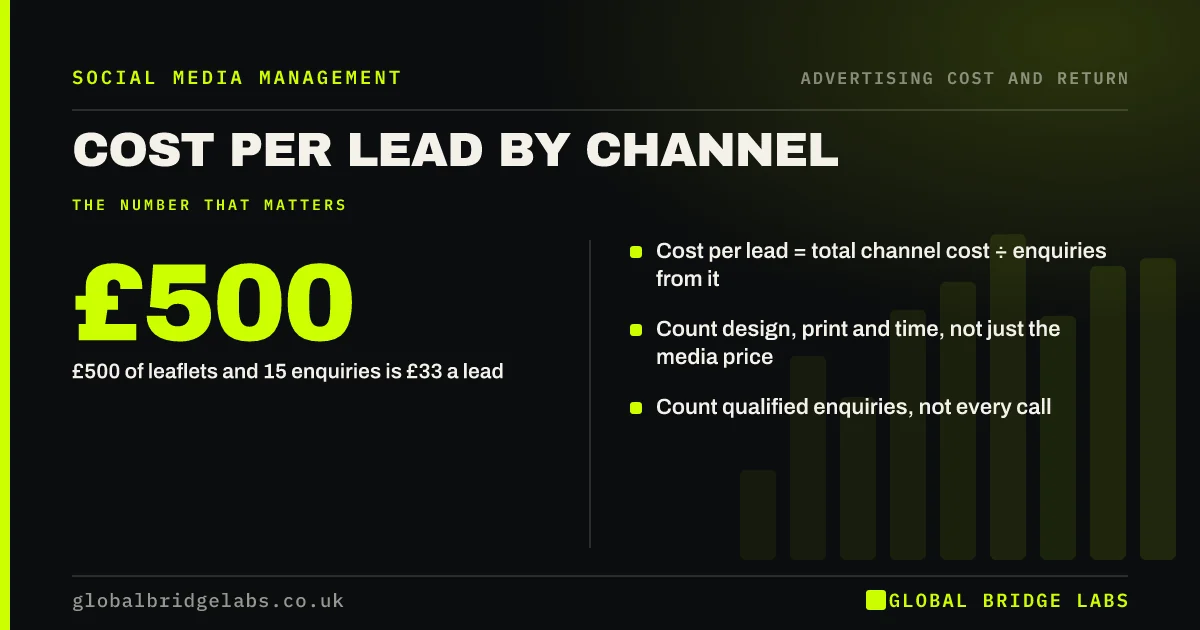
Cost per lead by channel is the total cost of a channel divided by the enquiries it produced in the same period. It is the fairest way to compare social media with traditional advertising, provided you count all the costs and only the enquiries worth having.
- Cost per lead = total channel cost ÷ enquiries from it.
- £500 of leaflets and 15 enquiries is £33 a lead.
- Count design, print and time, not just the media price.
- Count qualified enquiries, not every call.
Want your channels compared on cost per lead? Message us on WhatsApp.
Chat on WhatsApp →What is cost per lead?
Cost per lead (CPL) is what you pay, on average, for one enquiry from a given source. A lead here means a person who asked about buying: a call, a form, a message or a visit. It turns very different channels into one comparable number.
How do you calculate it?
Add up everything the channel cost in a period and divide by the enquiries you can trace to it in that period.
- 1. Choose a period, such as eight weeks.
- 2. Add media, production and time for the channel.
- 3. Count the enquiries traced to it.
- 4. Divide cost by enquiries.
What does a worked comparison look like?
Here is an illustrative comparison for a local service firm over eight weeks. The figures are invented to show the method, not market data.
- Leaflets: £500 ÷ 15 enquiries = £33.
- Paid social: £800 ÷ 32 enquiries = £25.
- Local magazine: £450 ÷ 6 enquiries = £75.
- Directory: £300 ÷ 10 enquiries = £30.
Why is the lowest cost per lead not always the winner?
The lowest cost per lead can hide poor quality. If social media brings 32 enquiries and four become jobs, while the magazine brings six and three become jobs, the magazine's cost per customer is lower. Always take the sum one step further, to cost per sale.
- Paid social: £800 ÷ 4 jobs = £200 a customer.
- Local magazine: £450 ÷ 3 jobs = £150 a customer.
What costs do people forget?
People forget their own time, design and production, and the cost of answering enquiries that go nowhere. At the April 2026 National Living Wage an hour costs about £16.27 with employer costs. Ten hours a month spent on a channel adds roughly £163 to its real cost.
How do you trace enquiries to a channel?
Use a mixture of methods, because none is complete. Platforms report social media enquiries. Offline adverts need a code, a dedicated number or a short web address. Above all, ask every enquirer how they heard of you and write down the answer.
How many leads do you need before deciding?
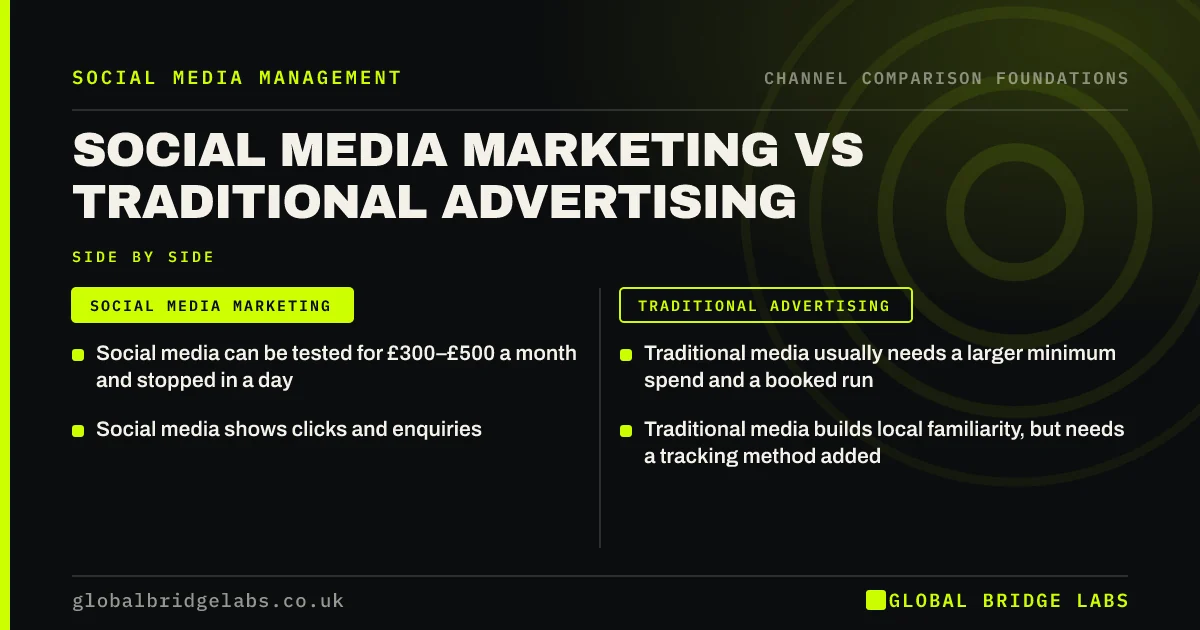
As a working rule, wait for at least 20 enquiries or six weeks, whichever comes later, before judging a channel. With five enquiries, one extra call changes the figure by a fifth. Paid social can be tested from £300–£500 a month, which is usually enough to reach a readable number.
- How to test an advertising channel in six weeks
- The minimum budget to test an advertising channel properly
Want a tracked test designed for you? Message us on WhatsApp and we will discuss your requirements.
Chat on WhatsApp →Where does cost per lead mislead?
Cost per lead misleads when a buyer saw several channels before calling and only the last gets the credit. It also undervalues slow, brand-building activity. Use it to compare response channels, and judge awareness activity over a longer period.
What does this look like in practice?
A pattern we see with firms that start counting: the channel that produces the most enquiries is assumed to be the best, until the jobs won are counted. Quite often a quieter channel is supplying the customers who actually go ahead.
Next step
Set up one simple sheet with a row per enquiry: date, source, and whether it became a sale. Eight weeks of rows will answer most budget questions.
Message us on WhatsApp for a ready-made enquiry log, or book a 30-minute consultation.
Chat on WhatsApp →Sources and further reading
- National Minimum Wage and National Living Wage rates · GOV.UK
- Rates and thresholds for employers 2026 to 2027 · HM Revenue & Customs
- URL builders: collect campaign data with custom URLs · Google Analytics Help
- About key events · Google Analytics Help
Frequently asked questions
How do I calculate cost per lead?
Add up everything a channel cost in a set period, including media, production and time, then divide by the number of enquiries traced to that channel in the same period. For example, £500 spent and 20 enquiries gives a cost per lead of £25.
What is a good cost per lead for a small business?
It depends on what a customer is worth. A £50 lead is cheap for a £5,000 kitchen and ruinous for a £40 service. Work out the profit from an average customer and your conversion rate, then set the most you can pay.
Is cost per lead lower on social media than in print?
Often, but not always. Social media usually produces more enquiries per pound, and some are weaker. Print can produce fewer, more serious enquiries. Compare cost per customer as well as cost per lead before moving budget.
What is the difference between cost per lead and cost per acquisition?
Cost per lead is the cost of one enquiry. Cost per acquisition is the cost of one paying customer. The second is always higher, because not every enquiry buys, and it is the better figure for deciding where to spend.
Written by

Global Bridge Labs (GBL) is a UK–Sri Lanka partner for social media, websites and BPO. Everything here comes from client delivery, not theory.