On this page
- 01Short answer
- 02What does outsourcing readiness mean?
- 031. Is the process stable?
- 042. Is it documented?
- 053. Can the team access your systems securely?
- 064. Is the data protection paperwork ready?
- 075. Does someone own the relationship?
- 086. Do you have a baseline?
- 09What if you are not ready yet?
- 10What does this look like in practice?
- 11The readiness checklist
- 12Next step
- 13Sources and further reading
- 14Frequently asked questions
Short answer
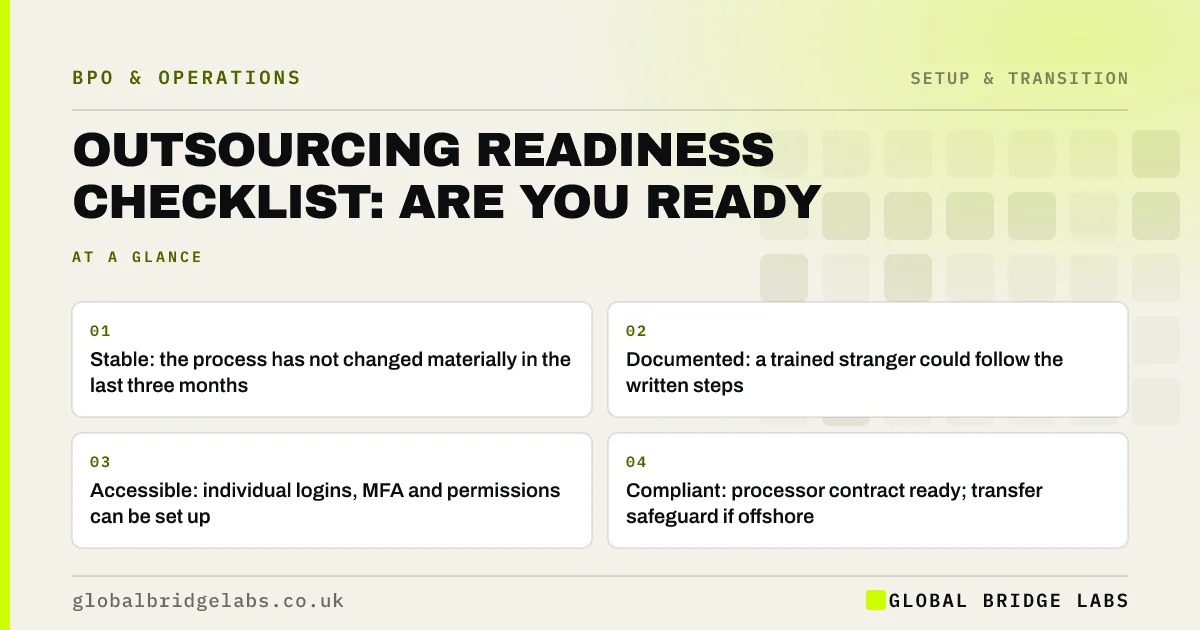
An outsourcing readiness checklist tests six things: the process is stable, it is documented, the team can access your systems securely, the data protection paperwork is ready, someone internal owns the relationship, and you have a baseline to measure against. Fail two or more and outsourcing will be harder than it needs to be.
- Stable: the process has not changed materially in the last three months.
- Documented: a trained stranger could follow the written steps.
- Accessible: individual logins, MFA and permissions can be set up.
- Compliant: processor contract ready; transfer safeguard if offshore.
- Owned and measured: a named owner and a baseline of a few weeks.
Want to score your business against this checklist? Message us on WhatsApp and ask for the readiness scorecard.
Chat on WhatsApp →What does outsourcing readiness mean?
Outsourcing readiness means your business and the process you want to hand over are in a state where an external team can take it on without a drop in quality. It is not about company size; a five-person business can be more ready than a fifty-person one.
Readiness matters because business process outsourcing (BPO) amplifies whatever it is given. A clear, stable process becomes more reliable and cheaper. A messy one becomes a messy one run by someone else.
1. Is the process stable?
A stable process follows the same rules week to week. If you are still changing how refunds, quotes or bookings work every fortnight, an outsourced team will spend its time catching up. As a guide, the process should not have changed materially in the last three months.
Stability does not mean perfection. You can improve a process after outsourcing it; you just cannot keep reinventing it.
2. Is it documented?
The test is simple: could a trained person who has never worked for you follow the written steps and get it right most of the time? If the answer is no, document it first. Include the common scenarios, the exceptions and who decides them.
3. Can the team access your systems securely?
The team should work inside your systems with individual logins, least-privilege permissions, multi-factor authentication and activity logs. If your tools do not support separate users, or everyone shares one password, fix that first. Shared credentials make both security and accountability impossible.
Check licence costs too: per-user pricing for your helpdesk, CRM or phone system will add to the cost.
4. Is the data protection paperwork ready?
If the team will handle personal data, UK GDPR requires a written controller-processor contract with the terms the ICO specifies. If the team is outside the UK in a country without adequacy regulations, you need a transfer safeguard such as the International Data Transfer Agreement and a transfer risk assessment. Update your privacy notice to reflect the use of a processor.
5. Does someone own the relationship?
Every successful outsourcing engagement has a named internal owner who answers questions, makes decisions, reviews early work and attends weekly reviews. Budget two to four hours a week for them in the first three months. If nobody has that time, wait until someone does.
6. Do you have a baseline?
Measure the process for two to four weeks before handing it over: volume, time spent, response times, error rates and cost. Without a baseline, you cannot show whether outsourcing worked, and every discussion about performance becomes opinion.
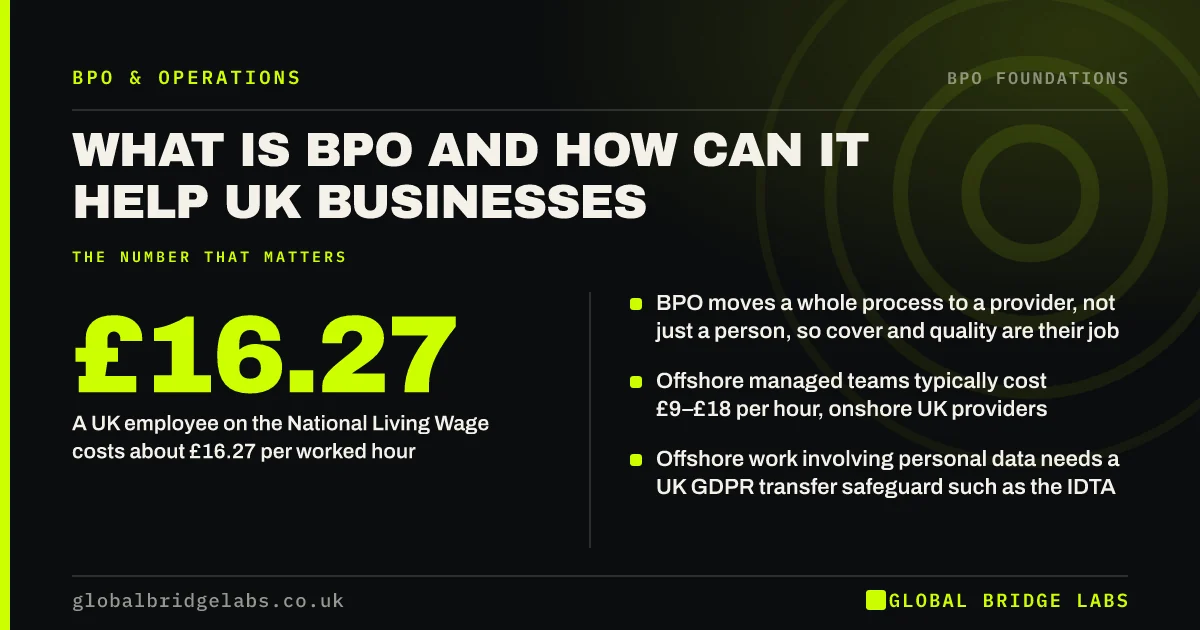
Include cost. A UK employee on the April 2026 National Living Wage costs about £16.27 per worked hour after employer National Insurance, pension and holiday, before overheads; if the owner does the work, value their hour higher.
Want help setting a baseline and a costed plan? Send us the process on WhatsApp and we will discuss your requirements.
Chat on WhatsApp →What if you are not ready yet?
Not being ready is common and fixable. Most gaps take weeks, not months: write the process down, set up proper user accounts, prepare the contracts, and measure for a fortnight. A good provider will help with documentation and tell you honestly if a process should wait.
What does this look like in practice?
A pattern we see: a business wants to outsource everything at once, but only two of its five processes pass the checklist. Starting with those two, while documenting the other three, gets results sooner and builds the confidence to add the rest later.
The readiness checklist
Score one point for each yes. Five or six: ready. Three or four: close. Below three: fix first.
- The process has been stable for three months.
- It is documented well enough for a stranger to follow.
- Individual, secure logins can be set up in every system.
- The processor contract and any transfer safeguard are ready.
- A named internal owner has time for the first 90 days.
- You have a two to four week baseline.
Next step
Score your process against the checklist and send us the result. We will tell you what to fix first, and whether the process is ready to outsource now. 30 minutes, no pitch.
Message us on WhatsApp for the readiness scorecard, or book a 30-minute consultation.
Chat on WhatsApp →Sources and further reading
- Contracts and liabilities between controllers and processors · Information Commissioner's Office
- International transfers of personal data · Information Commissioner's Office
- Small Business Guide: cyber security · National Cyber Security Centre
Frequently asked questions
How do I know if my business is ready to outsource?
Check six things: the process is stable, documented, accessible securely, covered by data protection paperwork, owned by a named person with time, and measured against a baseline. If five or six are true, you are ready. If fewer, fix the gaps first, which usually takes weeks rather than months.
What should I do before outsourcing?
Document the process, set up individual system accounts with multi-factor authentication, prepare the processor contract and any transfer safeguard, name an internal owner, and measure the process for two to four weeks. Then send providers the same written scope.
Can a small business be ready to outsource?
Yes. Size does not decide readiness. A small business with one stable, documented process and an owner who can spare a few hours a week is more ready than a large one with undocumented processes and no clear owner.
What if my process is not documented?
Document it before or during setup. Record the current expert doing the task, write the steps from the recording, list common scenarios and exceptions, and test it with someone unfamiliar. Many providers help with this as part of onboarding.
Written by

Global Bridge Labs (GBL) is a UK–Sri Lanka partner for social media, websites and BPO. Everything here comes from client delivery, not theory.