On this page
- 01Key takeaways
- 02What counts as a website lead?
- 03How do you diagnose why leads are not coming?
- 04What if the traffic is the wrong traffic?
- 05What if visitors arrive but do not act?
- 06What does a lead generating website produce?
- 07When is the website not the problem?
- 08What does this look like in practice?
- 09Lead diagnosis checklist
- 10Next step
- 11Sources and further reading
- 12Frequently asked questions
Key takeaways
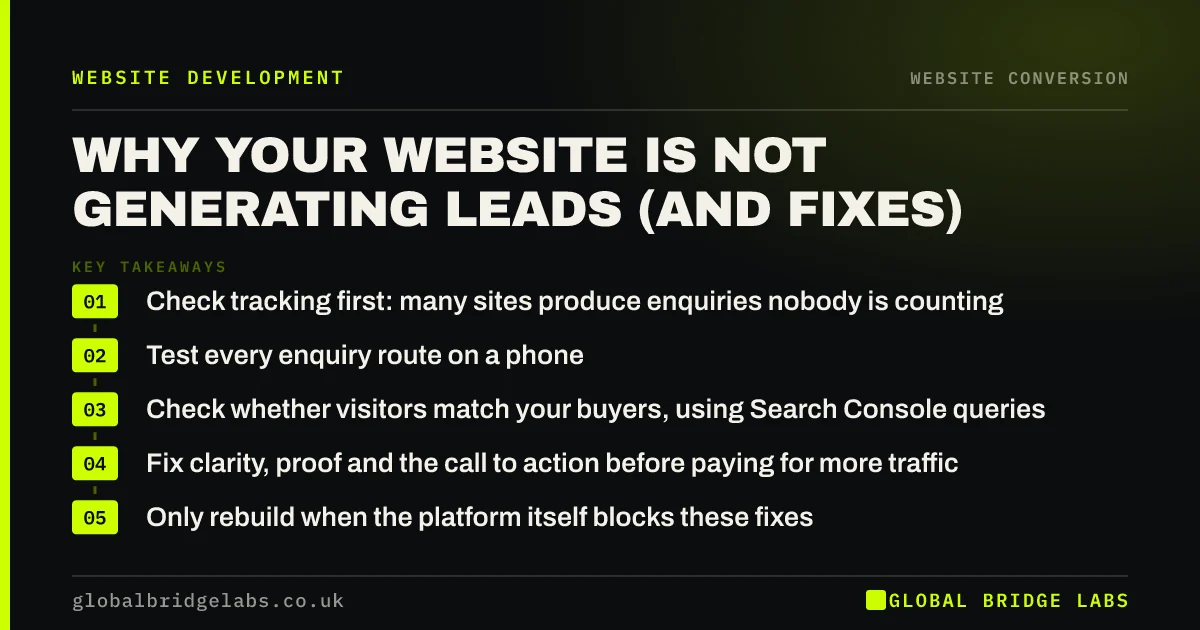
A website not generating leads almost always has one of six causes: the wrong traffic, an unclear offer, a slow mobile experience, no proof, a hard enquiry route, or enquiries that happen but are not tracked. Diagnose which one before you change anything, because each has a different fix and only one of them needs a rebuild.
- Check tracking first: many sites produce enquiries nobody is counting.
- Test every enquiry route on a phone: broken forms are more common than expected.
- Check whether visitors match your buyers, using Search Console queries.
- Fix clarity, proof and the call to action before paying for more traffic.
- Only rebuild when the platform itself blocks these fixes.
Want a quick diagnosis? Send us your URL on WhatsApp and we will tell you which of the six causes we would check first.
Chat on WhatsApp →What counts as a website lead?
A website lead is a potential customer who contacts a business through its website, by submitting a form, calling from a click-to-call link, starting a WhatsApp chat, booking a slot or emailing from a link on the site.
Counting all of those matters. Many businesses judge the site by form submissions alone, while most of their real enquiries arrive by phone from mobile visitors who never touch the form. The site looks broken when it is actually working.
How do you diagnose why leads are not coming?
Work through the six causes in order. Each check takes less than an hour and the order matters, because there is no point improving a page if the enquiries it produces are going missing.
- 1. Tracking: are calls, forms and WhatsApp clicks recorded in GA4 as key events?
- 2. Routes: does every form and button work on a phone, and does the message arrive?
- 3. Traffic: do Search Console queries show buyers, or job seekers and researchers?
- 4. Clarity: can a stranger say what you sell and where after five seconds?
- 5. Speed: do key pages pass Core Web Vitals on mobile?
- 6. Proof and action: is there specific proof and one obvious next step on each page?
What if the traffic is the wrong traffic?
If most visitors arrive from searches unrelated to buying, such as job searches, how-to questions or your brand name from existing customers, the site may be converting the buyers it gets perfectly well. There are simply not enough of them.
The fix is targeted pages: a dedicated page for each service and area, written around the phrases buyers search, plus a Google Business Profile that is complete and active. Paid search can fill the gap while organic rankings build, but only once the landing page is ready to convert.
What if visitors arrive but do not act?
If the traffic is right but enquiry rate is low, the problem is on the page. The three usual causes are an unclear headline, missing proof and a weak or confusing call to action. Visitors who are unsure do nothing, and doing nothing is always easier than filling in a form.
Fix them in that order. Rewrite the headline to name the outcome and area, place a specific review next to each call to action, and reduce each page to one primary action. Then make that action easy on a phone: tap to call, WhatsApp and a form of four fields or fewer.
Want your top page checked for clarity, proof and call to action? Message us on WhatsApp with the link.
Chat on WhatsApp →What does a lead generating website produce?
As a working range, UK lead generation sites turn 2% to 5% of visits into enquiries. A site with 1,500 monthly visits at 1% produces 15 enquiries. At 3% it produces 45, from the same traffic and the same advertising spend.
Across our client work, we have seen a 2.4x enquiry rate after a website rebuild. The changes behind that kind of lift are the ones listed above: clarity, speed, proof, a simpler route to enquire and tracking that shows what worked.
When is the website not the problem?
Sometimes leads arrive and are lost afterwards. If enquiries wait a day for a reply, many buyers will already have booked someone else. If quotes take a week, the site is not the bottleneck.
Check response time before you blame the website. Send a test enquiry and time the reply. A business that answers within an hour in working hours will usually convert more of the same leads than one that replies the next day.
What does this look like in practice?
A pattern in UK trades and professional services: the owner reports that the website produces nothing, but call tracking has never been set up, and most enquiries arrive as phone calls from mobile visitors.
Once tracking is in, the site turns out to produce a steady flow of calls, and the real problem is narrower: the contact form fails on one browser, and the main service page has no price guidance. Fixing those two issues costs far less than the rebuild the owner was about to commission.
Lead diagnosis checklist
Do these in order and note what you find at each step.
- Set up key events for forms, phone clicks and WhatsApp clicks.
- Submit a test enquiry through every route, on a phone.
- Review the top 20 Search Console queries for buyer intent.
- Run a five-second test on the homepage and top service page.
- Check key pages in PageSpeed Insights on mobile.
- Add a specific review next to every call to action.
- Time your reply to a test enquiry.
Next step
If your website is not generating leads and you are not sure why, we will work through the six causes with you in 30 minutes and tell you which fix to make first.
Message us on WhatsApp for a lead diagnosis, or book a 30-minute consultation.
Chat on WhatsApp →Sources and further reading
- About key events · Google Analytics Help
- Google Search Console · Google
- Understanding Core Web Vitals and Google search results · Google Search Central
Frequently asked questions
Why is my website getting traffic but no leads?
Usually because the visitors are not buyers, the offer is unclear, proof is missing, or the enquiry route is awkward or broken on mobile. It is also common for enquiries to be happening by phone without being tracked. Check tracking and every enquiry route before changing anything else.
How can I get more leads from my website?
Make the offer clear in the first screen, give each service its own page, place specific proof next to every call to action, reduce each page to one primary action, add click-to-call and WhatsApp for mobile visitors, and track every enquiry so you can see which changes work.
How many leads should my website generate?
It depends on traffic and intent, but UK lead generation sites typically convert 2% to 5% of visits into enquiries. Multiply your monthly visits by that range for a rough expectation. If you are well below it with relevant traffic, the pages or enquiry routes need work.
Do I need a new website to get more leads?
Often not. Most lead problems come from clarity, proof, forms, speed and tracking, which can be fixed on the existing site. A rebuild makes sense when the platform itself is too slow, insecure or rigid to change, or when the site structure needs to be completely rethought.
Written by

Global Bridge Labs (GBL) is a UK–Sri Lanka partner for social media, websites and BPO. Everything here comes from client delivery, not theory.