On this page
- 01Short answer
- 02What is the difference between a redesign and a rebuild?
- 03Why do businesses rebuild when they do not need to?
- 04When is optimisation enough?
- 05When do you need a redesign?
- 06When do you need a full rebuild?
- 07What do the options typically cost?
- 08What does this look like in practice?
- 09Decision checklist
- 10Next step
- 11Sources and further reading
- 12Frequently asked questions
Short answer
Redesign when the platform is sound but the message, structure or look is failing. Rebuild when the platform itself is slow, insecure, unsupported or too rigid to change. And do neither when a focused set of fixes to clarity, proof, forms and speed would solve the problem, which is more often than agencies admit.
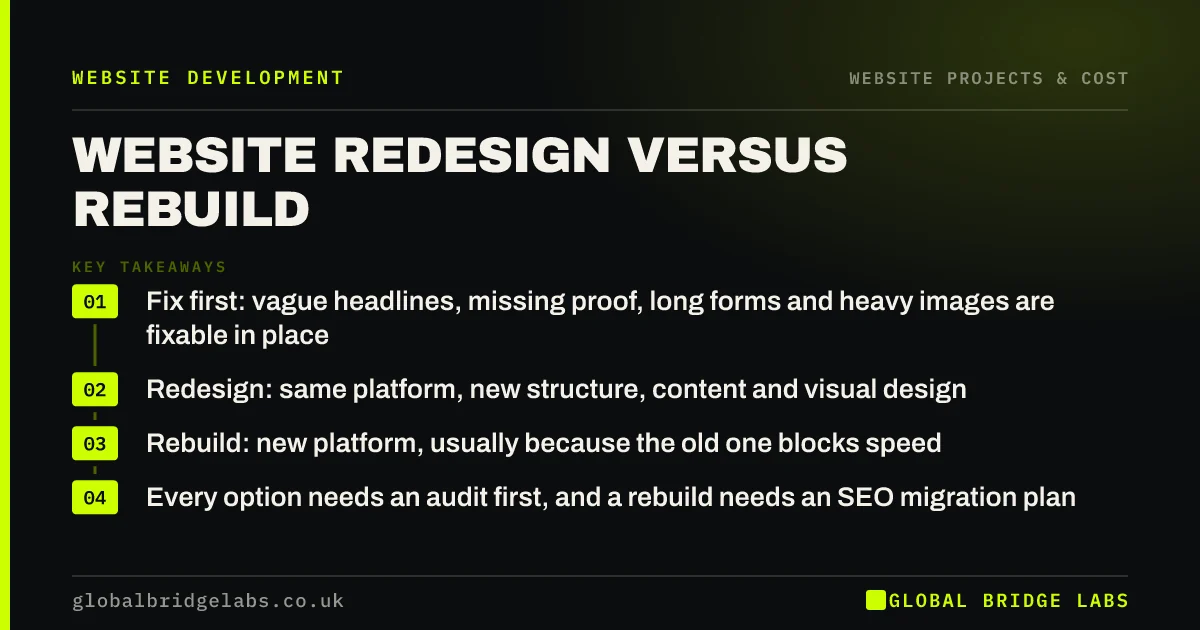
- Fix first: vague headlines, missing proof, long forms and heavy images are fixable in place.
- Redesign: same platform, new structure, content and visual design.
- Rebuild: new platform, usually because the old one blocks speed, security or change.
- Every option needs an audit first, and a rebuild needs an SEO migration plan.
Not sure which you need? Send us your URL on WhatsApp and we will tell you what we would do first.
Chat on WhatsApp →What is the difference between a redesign and a rebuild?
A website redesign changes the structure, content and visual design of a site while keeping the underlying platform. A website rebuild replaces the platform or codebase itself, usually along with the design, and involves migrating content and URLs to the new system.
A third option, optimisation, keeps both platform and design and fixes specific problems. It is the cheapest and fastest, and it is where most small business sites should start.
Why do businesses rebuild when they do not need to?
Usually because the site feels dated, and a rebuild seems like the only way to change that. Sometimes because a new supplier works only in their own platform. The result is a large spend that fixes the look while carrying over the real problems: the same vague copy, missing proof and absent tracking.
A rebuild also carries risk. Changed URLs, missing redirects and lost content can cut search traffic for months if the migration is handled badly.
When is optimisation enough?
Optimisation is enough when the platform is secure, supported and reasonably fast, and the problems are in the content and conversion path. Typical signs:
- Traffic is reasonable but the enquiry rate is low.
- The headline and service pages are vague.
- Proof is missing near calls to action.
- Forms are long or broken.
- Speed problems come from images and plugins rather than the platform.
When do you need a redesign?
Redesign when the site's structure no longer fits the business: services have changed, audiences have split, navigation has grown by addition, or the visual design undermines trust with the buyers you now serve. The platform can stay if it is healthy.
A redesign is a chance to rebuild the content architecture around what buyers search and ask: one page per service, pricing guidance, proof on every page, and a clear conversion path.
When do you need a full rebuild?
Rebuild when the platform is the problem. Signs include software that can no longer be updated safely, a page builder so heavy that Core Web Vitals cannot be passed, a proprietary system you cannot move or edit, or requirements such as e-commerce, booking or integrations that the current platform cannot support.
A rebuild should include an SEO migration plan: a full URL map, 301 redirects from every old URL to its closest new equivalent, and monitoring in Search Console after launch.
Want a redesign or rebuild scoped with the SEO risks spelled out? Message us on WhatsApp.
Chat on WhatsApp →What do the options typically cost?
As typical UK market ranges for small business sites: optimisation work often costs £500–£3,000 depending on the fixes, a redesign on an existing platform around £3,000–£12,000, and a full rebuild £5,000–£20,000 or more, with e-commerce and integrations higher.
Across our client work, we have seen a 2.4x enquiry rate after a website rebuild, but the lift came from the content, proof and tracking decisions made during the project. The platform change on its own would not have produced it.
What does this look like in practice?
A pattern we see when owners ask for a rebuild: an audit shows the platform is sound, but the homepage is vague, the service pages lack pricing and proof, and the form is broken on mobile.
Fixing those in place, then deciding six months later whether a redesign is still needed, often saves the rebuild budget entirely. When it does not, the eventual rebuild starts from better content and real data about what converts.
Decision checklist
Answer these before commissioning any project.
- Run an audit of clarity, conversion, speed and tracking.
- Check the platform is supported and can be updated safely.
- Check whether speed problems come from the platform or content.
- List requirements the current platform cannot meet.
- Estimate cost and SEO risk for each option.
- Choose the smallest change that solves the real problem.
Next step
If you are weighing a redesign or rebuild, we will review your site with you in 30 minutes and tell you honestly which option fits, including when the answer is neither.
Message us on WhatsApp for a redesign or rebuild recommendation, or book a 30-minute consultation.
Chat on WhatsApp →Sources and further reading
- Site moves with URL changes · Google Search Central
- Understanding Core Web Vitals and Google search results · Google Search Central
- Google Search Console · Google
Frequently asked questions
Should I redesign or rebuild my website?
Redesign if the platform is secure, supported and fast enough but the structure, content or look is failing. Rebuild if the platform itself is slow, insecure, unsupported or cannot do what the business needs. Run an audit first, because many problems can be fixed without either.
How often should a business website be redesigned?
There is no fixed cycle. Redesign when the business, audience or services change significantly, or when the site's structure no longer fits. Continuous improvement, reviewed monthly and quarterly, usually beats a big redesign every three years, and avoids the risks of a large relaunch.
Will a website rebuild affect my Google rankings?
It can, if URLs change without redirects or content is lost. A careful migration, with a full URL map, 301 redirects from every old URL, and monitoring in Search Console, usually preserves rankings. Poorly planned rebuilds can lose significant traffic for months.
How much does a website redesign cost?
Typical UK ranges are around £3,000 to £12,000 for a redesign on an existing platform, and £5,000 to £20,000 or more for a full rebuild, with e-commerce and integrations costing more. Focused optimisation work can cost much less and often solves the underlying problem.
Written by

Global Bridge Labs (GBL) is a UK–Sri Lanka partner for social media, websites and BPO. Everything here comes from client delivery, not theory.