On this page
- 01Short answer
- 02What is enquiry source tracking?
- 03Why do most businesses not know where enquiries come from?
- 04How do you track each enquiry route?
- 05How do UTM tags and call tracking work?
- 06How do you close the loop with sales?
- 07When is perfect attribution not worth chasing?
- 08What does this look like in practice?
- 09Enquiry tracking checklist
- 10Next step
- 11Sources and further reading
- 12Frequently asked questions
Short answer
To track website enquiries to their source, record every enquiry route as a key event in analytics, tag every campaign link with UTM parameters, use call tracking if phone matters, and capture the source in your CRM or enquiry log. Then compare tracked enquiries with enquiries actually received every month to find the gaps.
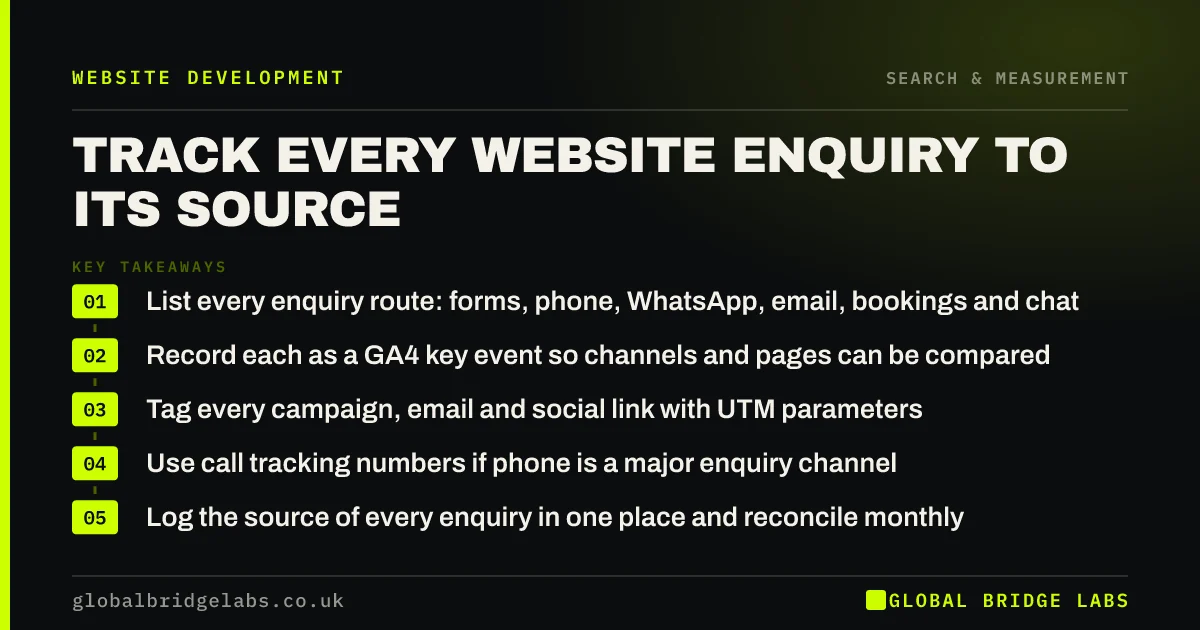
- List every enquiry route: forms, phone, WhatsApp, email, bookings and chat.
- Record each as a GA4 key event so channels and pages can be compared.
- Tag every campaign, email and social link with UTM parameters.
- Use call tracking numbers if phone is a major enquiry channel.
- Log the source of every enquiry in one place and reconcile monthly.
Want to see which channels actually produce your enquiries? Message us on WhatsApp and we will map your tracking.
Chat on WhatsApp →What is enquiry source tracking?
Enquiry source tracking is the process of recording where each website enquiry came from, such as organic search, paid search, social media, email or referral, and which page it started on, so a business can see which marketing produces work.
It is what turns a website from a cost into a measurable asset. Without it, every marketing decision rests on opinion.
Good tracking answers three questions every month: how many enquiries did the website produce, which channels and pages produced them, and which of those enquiries became paying work. The first two come from analytics. The third needs your sales records.
Why do most businesses not know where enquiries come from?
Because enquiries arrive through different routes that are tracked in different places, or not at all. Forms go to an inbox, calls go to a mobile, WhatsApp chats go to someone's phone, and bookings go to a separate system.
Asking customers how they heard about you helps but is unreliable. Many say Google when they mean a Facebook post that led them to search your name. Combining self-reporting with digital tracking gives a truer picture.
How do you track each enquiry route?
Set up tracking for each route you offer.
- Forms: fire a GA4 event on successful submission, or on the thank-you page view.
- Phone: track clicks on tel: links, and use call tracking numbers for full call data.
- WhatsApp: track clicks on wa.me links, and use page-specific prefilled messages.
- Email links: track clicks on mailto: links.
- Bookings: track the booking confirmation step, or use the booking tool's integration.
- Live chat: use the chat tool's analytics integration.
How do UTM tags and call tracking work?
UTM parameters are tags added to a link, such as utm_source=newsletter and utm_medium=email, that tell analytics where a visit came from. Tag every link you control: emails, social posts, ads, QR codes and directory listings. Keep naming consistent, in lower case.
Call tracking uses dynamic number insertion to show a different phone number to visitors from different sources, then records which number was called. It costs a monthly fee, and is worth it when phone calls are a large share of enquiries.
Want a UTM naming convention and tracking plan for your channels? Message us on WhatsApp.
Chat on WhatsApp →How do you close the loop with sales?
Add a source field to your CRM or enquiry spreadsheet and fill it for every enquiry, using analytics data where available and asking the customer where it is not. Record whether each enquiry became a sale and its value.
That lets you calculate cost per enquiry and revenue per channel, which is the only reliable way to decide where to spend. GA4 alone cannot show which enquiries turned into paying work.
When is perfect attribution not worth chasing?
Perfect attribution is impossible. Consent choices, multiple devices, word of mouth and offline conversations all break the chain. Chasing precision can consume more time than the decisions it informs are worth.
Aim for directionally right. If tracked enquiries match 70% to 80% of real ones and the channel mix is consistent month to month, you have enough to make good decisions.
What does this look like in practice?
A pattern in UK SMEs: a business about to cut its SEO budget because analytics shows only a handful of form submissions from organic search, while most organic visitors actually phone.
Adding phone click tracking and a source field in the enquiry log reveals organic search as a major enquiry source. The budget decision reverses, based on data rather than a partial picture.
Enquiry tracking checklist
Set up once, reconcile monthly.
- List every enquiry route.
- Create a GA4 key event for each.
- Tag every campaign link with UTMs.
- Add call tracking if phone is significant.
- Use page-specific WhatsApp messages.
- Record source and outcome for every enquiry.
- Reconcile tracked and actual enquiries monthly.
Next step
If you are making marketing decisions without knowing where enquiries come from, we will map your tracking with you in 30 minutes and show you the gaps.
Message us on WhatsApp for an enquiry tracking plan, or book a 30-minute consultation.
Chat on WhatsApp →Sources and further reading
- About key events · Google Analytics Help
- URL builders: collect campaign data with custom URLs · Google Analytics Help
- How to use click to chat · WhatsApp Help Center
Frequently asked questions
How do I track where my website leads come from?
Record each enquiry route, including forms, phone clicks, WhatsApp clicks and bookings, as a key event in GA4, tag campaign links with UTM parameters, and log the source of every enquiry in your CRM or spreadsheet. Compare tracked enquiries with enquiries actually received each month to spot gaps.
How can I track phone calls from my website?
Track clicks on tel: links as a GA4 event for a basic view. For full call data, use a call tracking service with dynamic number insertion, which shows different numbers to visitors from different sources and records which one was called, including calls from desktop visitors.
What are UTM parameters?
UTM parameters are tags added to the end of a link, such as utm_source, utm_medium and utm_campaign, that tell analytics tools where a visit came from. Use them on every link you control, including emails, social posts, ads and QR codes, with consistent lower-case naming.
Is asking customers how they heard about us enough?
It helps but is unreliable on its own. Customers often name the last thing they remember, such as Google, even when another channel introduced them. Combine self-reported source with digital tracking in analytics to get a more accurate picture of what drives enquiries.
Written by

Global Bridge Labs (GBL) is a UK–Sri Lanka partner for social media, websites and BPO. Everything here comes from client delivery, not theory.