On this page
- 01Key takeaways
- 02What is website maintenance?
- 03Why do sites decay without maintenance?
- 04What should a maintenance plan include?
- 05What does website maintenance cost in the UK?
- 06Can you maintain a website yourself?
- 07When is a maintenance plan poor value?
- 08What does this look like in practice?
- 09Maintenance checklist
- 10Next step
- 11Sources and further reading
- 12Frequently asked questions
Key takeaways
Website maintenance in the UK typically costs £50 to £500 a month for a small business site, depending on the platform, the amount of change and the response time you need. A good maintenance plan covers updates, backups, security, monitoring and a set amount of content and improvement work, with a monthly report showing what was done.
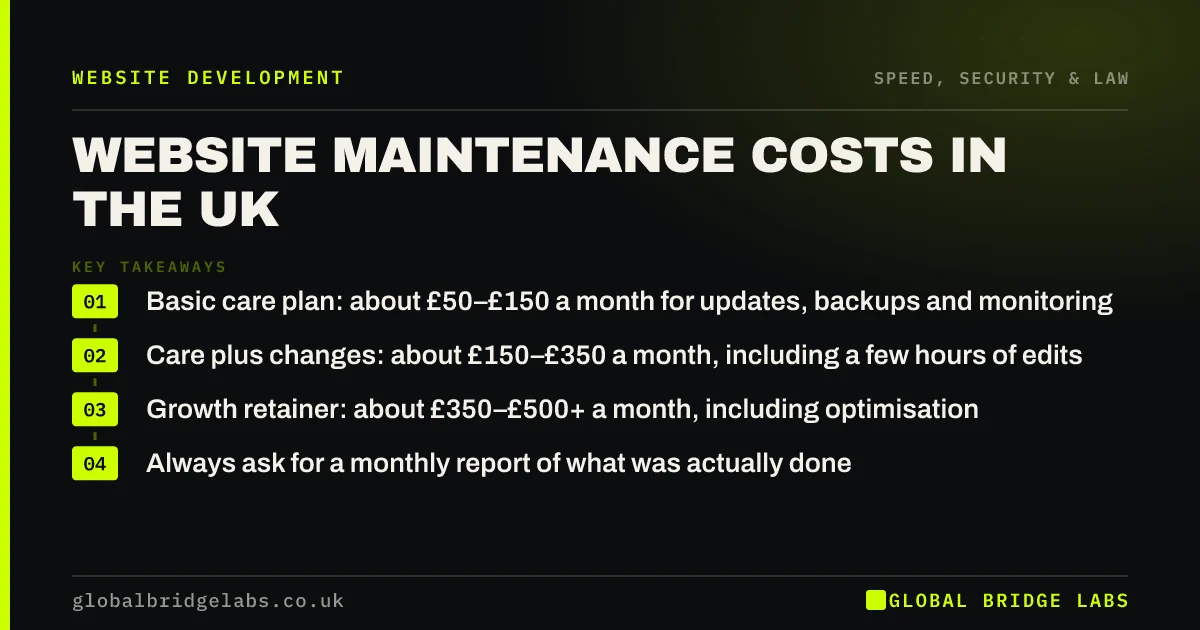
- Basic care plan: about £50–£150 a month for updates, backups and monitoring.
- Care plus changes: about £150–£350 a month, including a few hours of edits.
- Growth retainer: about £350–£500+ a month, including optimisation and new pages.
- Always ask for a monthly report of what was actually done.
Want to know whether your current plan is good value? Send us what it includes on WhatsApp.
Chat on WhatsApp →What is website maintenance?
Website maintenance is the ongoing work required to keep a website secure, fast, working and up to date after launch, including software updates, backups, monitoring, fixes, content changes and performance improvements.
It is not optional for most platforms. A site that is never updated becomes slower, more vulnerable and less accurate every month, until a failure forces an expensive emergency fix or a rebuild.
Maintenance has two halves that are often confused. Technical care keeps the site running: updates, backups, monitoring and fixes. Improvement work makes it earn more: new pages, better proof, faster loading and conversion fixes. Cheap plans usually cover only the first half, so check which one you are buying.
Why do sites decay without maintenance?
Sites decay because everything around them changes. Browsers update, plugins release security patches, hosting software changes, and your own prices, team and services move on. Each unaddressed change adds a little risk.
Security is the sharpest risk. Automated attacks target known weaknesses in outdated software, and the UK government's Cyber Security Breaches Survey 2025/2026 found 43% of businesses reported a breach or attack in the last year.
What should a maintenance plan include?
Compare plans against this list, and ask for it in writing.
- Platform, theme and plugin updates, tested before or after applying.
- Daily off-site backups with a tested restore process.
- Uptime and security monitoring with alerts.
- Performance checks against Core Web Vitals.
- A set number of hours for content changes and fixes.
- A stated response time for urgent problems.
- A monthly report of what was done.
- Annual review of SEO, accessibility and legal pages.
What does website maintenance cost in the UK?
The ranges below are typical UK market prices for small business sites and vary by platform and provider. Hosting may or may not be included, so check before comparing.
- Hosted builders such as Squarespace or Wix: often £0–£100 a month beyond the plan, mostly for content help.
- WordPress basic care plan: around £50–£150 a month.
- WordPress with regular changes: around £150–£350 a month.
- E-commerce or custom sites: around £250–£500+ a month, depending on integrations.
- Ad hoc support: typically £50–£100 an hour, often with a minimum charge.
Want a costed maintenance plan matched to how often your site actually changes? Message us on WhatsApp and we will discuss your requirements.
Chat on WhatsApp →Can you maintain a website yourself?
Yes, if you have the time and a reasonable technical comfort level. The core tasks are applying updates, checking the site afterwards, confirming backups and monitoring. Budget one to three hours a month for a simple site.
The risk is consistency. Updates slip in busy months, and a failed update with no tested backup can take a site down for days. Many owners keep content edits in-house and outsource the technical care.
When is a maintenance plan poor value?
A plan is poor value when you cannot see what is done, when hours are unused every month, or when the provider charges extra for everything the plan appears to include.
It can also be poor value for a very simple site on a hosted builder, where the platform handles updates and security. There, pay for help only when you need it.
What does this look like in practice?
A pattern we see: a monthly maintenance fee paid for years, no report, and a site several major versions out of date with plugins that have not been updated since launch.
Asking for a monthly report, checking the update log in the admin area and testing a backup restore will quickly show whether maintenance is happening. If it is not, move the site to a plan that proves its work.
Maintenance checklist
Use this to check any plan, including your own routine.
- Apply updates at least monthly, security patches promptly.
- Confirm daily off-site backups.
- Test a restore twice a year.
- Monitor uptime and security.
- Check Core Web Vitals quarterly.
- Update prices, team and services as they change.
- Get a monthly report of work done.
Next step
If you are paying for maintenance and cannot see what it buys, or not paying and hoping for the best, we will review your set-up with you in 30 minutes.
Message us on WhatsApp for a maintenance review, or book a 30-minute consultation.
Chat on WhatsApp →Sources and further reading
- Cyber security breaches survey 2025/2026 · DSIT and Home Office
- Small Business Guide: cyber security · National Cyber Security Centre
- Understanding Core Web Vitals and Google search results · Google Search Central
Frequently asked questions
How much does website maintenance cost per month in the UK?
Typically £50 to £150 a month for a basic care plan covering updates, backups and monitoring, £150 to £350 with regular content changes, and £350 to £500 or more for growth retainers or e-commerce sites. Ad hoc support usually costs £50 to £100 an hour.
What does website maintenance include?
Software and plugin updates, daily off-site backups, security and uptime monitoring, performance checks, a set amount of content changes and fixes, an agreed response time for urgent problems and a monthly report. Better plans also include periodic reviews of SEO, accessibility and legal pages.
Do I really need website maintenance?
For most platforms, yes. Unmaintained sites become slower, less secure and less accurate over time, and outdated software is the main way small business sites are hacked. Hosted builders handle much of the technical work themselves, so the need there is mostly for content updates.
Can I maintain my own website?
Yes, if you have the time and reasonable technical comfort. Plan one to three hours a month for updates, checks, backups and monitoring on a simple site. The main risk is missing updates in busy months, so many owners keep content edits in-house and outsource technical care.
Written by

Global Bridge Labs (GBL) is a UK–Sri Lanka partner for social media, websites and BPO. Everything here comes from client delivery, not theory.