On this page
- 01Key takeaways
- 02What are Core Web Vitals?
- 03Why do Core Web Vitals matter for a business?
- 04What are the thresholds?
- 05How do you check your Core Web Vitals?
- 06What usually causes poor scores, and how do you fix them?
- 07When is chasing a perfect score a waste?
- 08What does this look like in practice?
- 09Core Web Vitals checklist
- 10Next step
- 11Sources and further reading
- 12Frequently asked questions
Key takeaways
Core Web Vitals for business websites are Google's three measures of real-world page experience: loading (LCP), responsiveness (INP) and visual stability (CLS). A page passes when 75% of real visits meet all three thresholds. They affect rankings modestly and conversions directly, because slow, jumpy pages lose visitors.
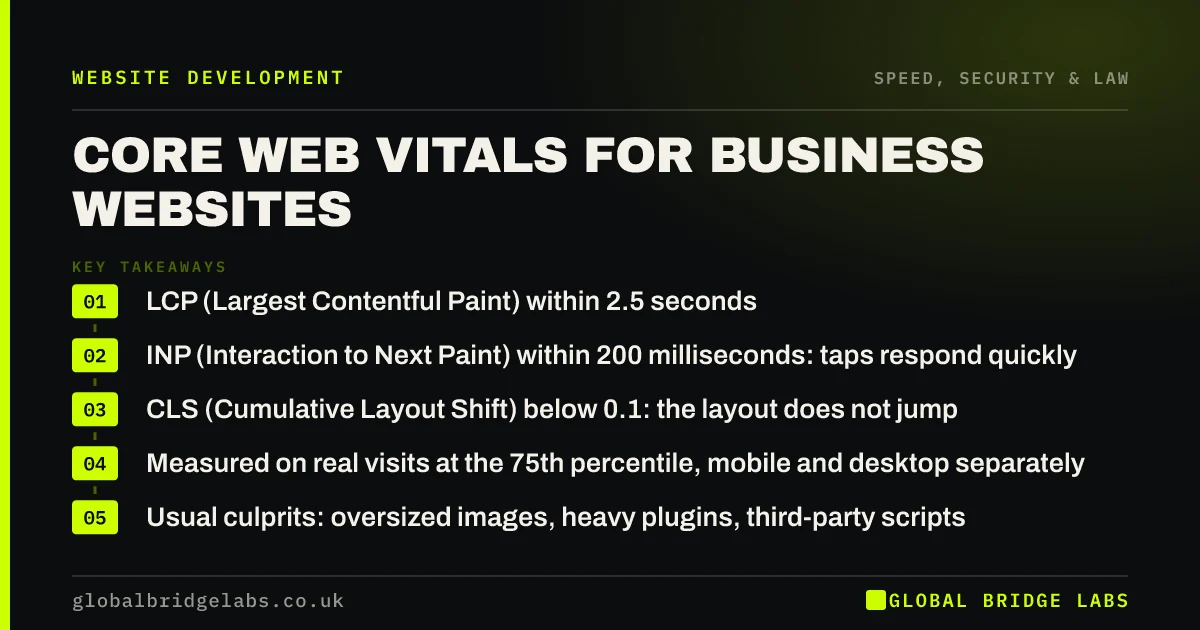
- LCP (Largest Contentful Paint) within 2.5 seconds: the main content loads quickly.
- INP (Interaction to Next Paint) within 200 milliseconds: taps respond quickly.
- CLS (Cumulative Layout Shift) below 0.1: the layout does not jump.
- Measured on real visits at the 75th percentile, mobile and desktop separately.
- Usual culprits: oversized images, heavy plugins, third-party scripts and web fonts.
Want to know why your site fails Core Web Vitals? Send us the URL on WhatsApp.
Chat on WhatsApp →What are Core Web Vitals?
Core Web Vitals are a set of three metrics defined by Google that measure the loading speed, interactivity and visual stability of a web page, based on data from real Chrome users visiting the page.
Interaction to Next Paint replaced First Input Delay as the responsiveness metric in March 2024, so older advice mentioning FID is out of date. Google's Search Central documentation and web.dev are the authoritative references for the current thresholds.
Why do Core Web Vitals matter for a business?
They matter for two reasons. Google uses page experience signals, including Core Web Vitals, as part of its ranking systems, although relevance and content quality matter far more. And slow, unstable pages lose visitors before they read the offer, which directly reduces enquiries.
The conversion effect is the bigger one for most SMEs. A visitor on a phone in a car park will not wait for a four-megabyte hero image, and a button that moves just as they tap it sends them to the wrong place.
What are the thresholds?
Each metric has three bands. Google assesses the 75th percentile of page loads, so three in four visits need to be in the good band for a page to pass.
- LCP: good up to 2.5 seconds, needs improvement to 4 seconds, poor above 4 seconds.
- INP: good up to 200 milliseconds, needs improvement to 500 milliseconds, poor above.
- CLS: good up to 0.1, needs improvement to 0.25, poor above 0.25.
How do you check your Core Web Vitals?
Start with Google Search Console's Core Web Vitals report, which groups your URLs by status using real user data. Then test individual pages in PageSpeed Insights, which shows field data where available and lab diagnostics that point to specific causes.
Small sites may not have enough traffic for field data. In that case, rely on the lab results in PageSpeed Insights and test on a real mid-range phone over a mobile connection, which is what most of your visitors use.
What usually causes poor scores, and how do you fix them?
On small business sites, a handful of causes account for most failures. Fix them in this order.
- Poor LCP: compress and resize hero images, serve WebP or AVIF, preload the main image.
- Poor LCP: move to faster hosting and use caching and a content delivery network.
- Poor INP: remove unused plugins, chat widgets and tracking scripts; defer the rest.
- Poor CLS: set width and height on images, reserve space for banners and embeds.
- Poor CLS: load web fonts efficiently so text does not jump when they arrive.
Want a prioritised fix list for your worst pages? Message us on WhatsApp with the URLs.
Chat on WhatsApp →When is chasing a perfect score a waste?
Chasing a PageSpeed score of 100 is usually a waste. The score is a lab estimate, not the pass or fail that Google uses, and the last few points often cost more than they return. Aim to pass all three Core Web Vitals on mobile for your key pages, then move on to content and conversion.
The trade-off is features. A booking widget, reviews carousel or live chat may cost some speed. Keep those that produce enquiries and remove those that do not.
What does this look like in practice?
A pattern on page-builder sites: a homepage with a full-width video background, several sliders, a reviews widget and three analytics scripts, failing LCP and INP on mobile while the owner sees it load instantly on the office computer.
Replacing the video with a compressed image, removing two sliders and an unused script, and deferring the reviews widget usually brings the page into the good band. The visible design barely changes.
Core Web Vitals checklist
Work through this for your top ten pages.
- Check the Search Console Core Web Vitals report.
- Test each key page in PageSpeed Insights on mobile.
- Compress and resize every hero image.
- Set image dimensions to prevent layout shift.
- Remove unused plugins and scripts.
- Defer non-essential third-party widgets.
- Review hosting and caching.
- Retest after each change and note the result.
Next step
If your site fails Core Web Vitals and you are not sure why, we will go through the report with you in 30 minutes and rank the fixes by effort and impact.
Message us on WhatsApp for a Core Web Vitals review, or book a 30-minute consultation.
Chat on WhatsApp →Sources and further reading
- Understanding Core Web Vitals and Google search results · Google Search Central
- Web Vitals: essential metrics for a healthy site · web.dev (Google)
- Interaction to Next Paint (INP) · web.dev (Google)
Frequently asked questions
What are the three Core Web Vitals?
Largest Contentful Paint measures loading and should be within 2.5 seconds. Interaction to Next Paint measures responsiveness and should be within 200 milliseconds. Cumulative Layout Shift measures visual stability and should be below 0.1. Each is assessed at the 75th percentile of real page visits.
Do Core Web Vitals affect Google rankings?
Yes, as part of Google's page experience signals, but relevance and content quality matter far more. Passing Core Web Vitals will not make a weak page rank, and a strong, relevant page can still rank with borderline scores. The bigger benefit is that faster, stable pages convert better.
How do I check my Core Web Vitals?
Use the Core Web Vitals report in Google Search Console for site-wide status based on real users, and PageSpeed Insights for individual pages. PageSpeed Insights shows field data where Google has enough visits, plus lab diagnostics that point to specific causes such as large images or heavy scripts.
What replaced First Input Delay?
Interaction to Next Paint (INP) replaced First Input Delay as a Core Web Vital in March 2024. INP measures how quickly a page responds to all interactions during a visit, not just the first one, so it gives a fuller picture of how responsive the page feels to users.
Written by

Global Bridge Labs (GBL) is a UK–Sri Lanka partner for social media, websites and BPO. Everything here comes from client delivery, not theory.