On this page
- 01Key takeaways
- 02What is AI search optimisation?
- 03Why does AI search matter for a small business?
- 04What does Google say about AI features?
- 05How do you make pages easy for AI to cite?
- 06What technical steps help AI visibility?
- 07When will AI search send you less traffic?
- 08What does this look like in practice?
- 09AI visibility checklist
- 10Next step
- 11Sources and further reading
- 12Frequently asked questions
Key takeaways
To optimise a website for AI search, make sure AI systems can crawl and index your pages, then write pages that are easy to quote: direct answers under question-style headings, specific facts and numbers, consistent business details, and visible authors and dates. Google says its AI features need no special optimisation beyond good SEO.
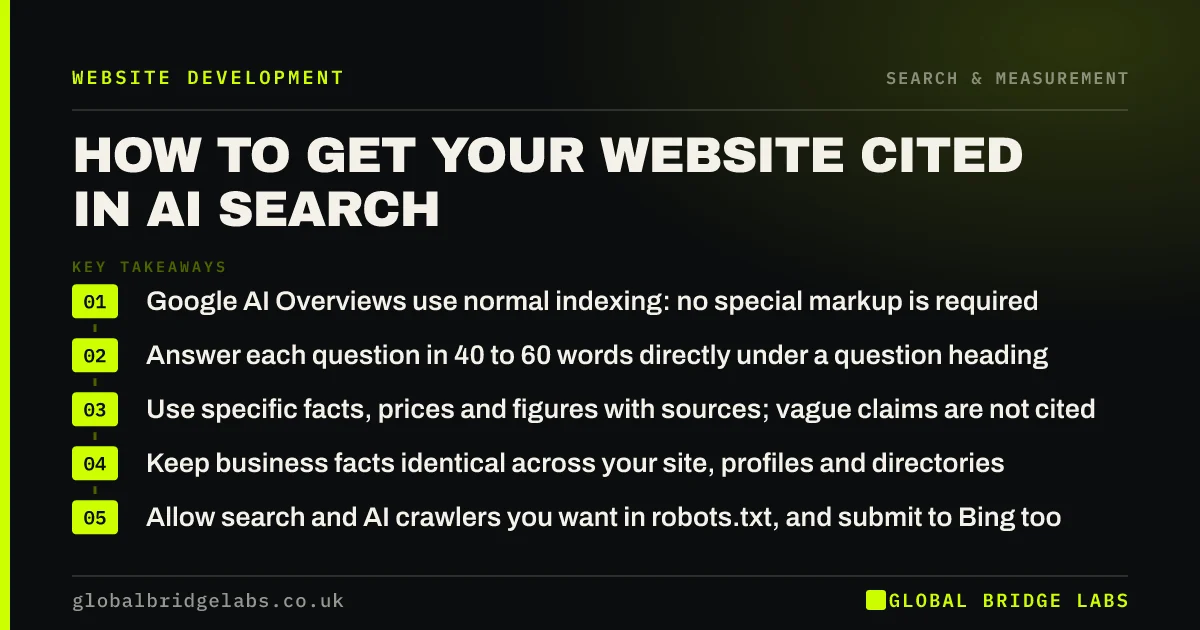
- Google AI Overviews use normal indexing: no special markup is required.
- Answer each question in 40 to 60 words directly under a question heading.
- Use specific facts, prices and figures with sources; vague claims are not cited.
- Keep business facts identical across your site, profiles and directories.
- Allow search and AI crawlers you want in robots.txt, and submit to Bing too.
Want to know whether AI assistants mention your business? Message us on WhatsApp and we will run the checks with you.
Chat on WhatsApp →What is AI search optimisation?
AI search optimisation, sometimes called generative engine optimisation (GEO), is the practice of making a website's content easy for AI-powered search tools, such as Google AI Overviews, AI Mode, ChatGPT search, Perplexity and Microsoft Copilot, to find, understand and cite in their answers.
It is an extension of SEO rather than a replacement. These tools rely on search indexes and crawled pages, so a page that cannot rank or be crawled is unlikely to be cited.
Why does AI search matter for a small business?
Buyers increasingly ask AI tools questions they used to type into a search box: how much should a boiler replacement cost, what should I look for in an accountant, which is better for a small business. The answer often names or links to a few sources, and those sources get the most qualified visitors.
Visitors who arrive from an AI answer are often further into their decision, because the AI has already summarised the basics. Your page has to give them what the summary could not: detail, proof, pricing and a clear next step.
What does Google say about AI features?
Google's Search Central page on AI features and your website states that there are no additional requirements to appear in AI Overviews or AI Mode. Pages must be indexed and eligible to be shown with a snippet. The same SEO best practices apply: crawlable pages, helpful content, good page experience and structured data that matches visible content.
Google also notes that site owners can use existing preview controls, such as nosnippet, to limit how content appears. For most businesses the goal is the opposite: be clear enough to be quoted.
How do you make pages easy for AI to cite?
Write in a way that lets a single section stand alone. AI systems pull passages, not whole pages, so each section must make sense out of context.
- Use question headings matching real searches, with a direct 40 to 60-word answer below.
- Put a short definition sentence near the top: X is a Y that does Z for W.
- Use specific numbers with sources, such as prices, timescales and thresholds.
- Use lists for steps and plain comparisons for options.
- Name the business, place and service explicitly instead of saying we or here.
- Show a named author, published date and updated date.
- Avoid putting key facts only in images, PDFs or scripts.
Want one of your key pages restructured for AI answers? Message us on WhatsApp with the link.
Chat on WhatsApp →What technical steps help AI visibility?
Check robots.txt allows the crawlers you want: Googlebot, Bingbot and the search crawlers of AI tools you want to appear in. Microsoft Copilot and several other assistants draw on Bing's index, so verify your site in Bing Webmaster Tools and consider IndexNow to notify Bing of changes quickly.
Add structured data that matches visible content, such as Organization, LocalBusiness, Service and Article. Some sites also publish an llms.txt file summarising key pages. It is a proposed convention, not a Google requirement, so treat it as optional.
When will AI search send you less traffic?
For simple informational questions, AI answers may satisfy the searcher without a click. That is a real trade-off. Pages built only to answer basic definitions may see fewer visits even while being cited.
The response is to put commercial depth on the page: pricing, comparisons, local proof, and a clear offer. Those are the reasons to click through, and the visitors who do are more likely to enquire.
What does this look like in practice?
A pattern we see when checking AI answers for small businesses: the assistant describes the business using an old address from a directory, lists services the firm stopped offering, and cites a competitor's pricing page for the cost question.
Correcting directory details, publishing a clear services page with price ranges, and restructuring the FAQ into direct question-and-answer blocks gives AI systems accurate, quotable material. Consistency across the web is as important as the website itself.
AI visibility checklist
Review this quarterly.
- Confirm key pages are indexed in Google and Bing.
- Allow wanted crawlers in robots.txt.
- Add question headings with direct answers.
- Add specific, sourced facts and prices.
- Show authors and dates.
- Add structured data that matches visible content.
- Make business details consistent everywhere.
- Ask ChatGPT, Perplexity, Gemini and Copilot five buyer questions monthly and record who is cited.
Next step
If you want to know how AI assistants currently describe your business, we will run the checks with you in 30 minutes and show you what to fix.
Message us on WhatsApp for an AI search visibility check, or book a 30-minute consultation.
Chat on WhatsApp →Sources and further reading
- AI features and your website · Google Search Central
- Creating helpful, reliable, people-first content · Google Search Central
- Bing Webmaster Guidelines · Microsoft Bing
- IndexNow protocol · IndexNow
Frequently asked questions
How do I get my website into Google AI Overviews?
Google says there are no special requirements beyond normal SEO. Pages must be indexed and eligible to show a snippet. Clear, helpful pages with direct answers under question headings, specific facts, good page experience and accurate structured data give you the best chance of being included and cited.
How do I get ChatGPT to recommend my business?
You cannot control it directly, but you can make accurate information easy to find: indexable pages with clear services, prices and locations, consistent details across directories and profiles, genuine reviews, and third-party mentions. Allow relevant AI search crawlers in robots.txt so your pages can be retrieved.
What is generative engine optimisation?
Generative engine optimisation (GEO) is the practice of making content easy for AI tools such as Google AI Overviews, ChatGPT and Perplexity to find, understand and cite. It builds on SEO, emphasising direct answers, specific sourced facts, consistent business details and clear authorship.
Do I need an llms.txt file?
It is optional. llms.txt is a proposed convention for summarising a site's key pages for AI tools, not a Google requirement or ranking factor. It does no harm and can help some tools, but indexable pages with clear content matter far more.
Written by

Global Bridge Labs (GBL) is a UK–Sri Lanka partner for social media, websites and BPO. Everything here comes from client delivery, not theory.