On this page
- 01Key takeaways
- 02What is local SEO?
- 03How does Google rank local results?
- 04What should your website do for local SEO?
- 05Should you create location pages?
- 06How do reviews affect local visibility?
- 07When will local SEO not be enough?
- 08What does this look like in practice?
- 09Local SEO checklist
- 10Next step
- 11Sources and further reading
- 12Frequently asked questions
Key takeaways
Local SEO for a small business website is the work of appearing when people nearby search for what you sell. Google ranks local results on relevance, distance and prominence. Your website supports all three through clear service pages, genuine area pages, consistent business details, reviews and a strong link with your Google Business Profile.
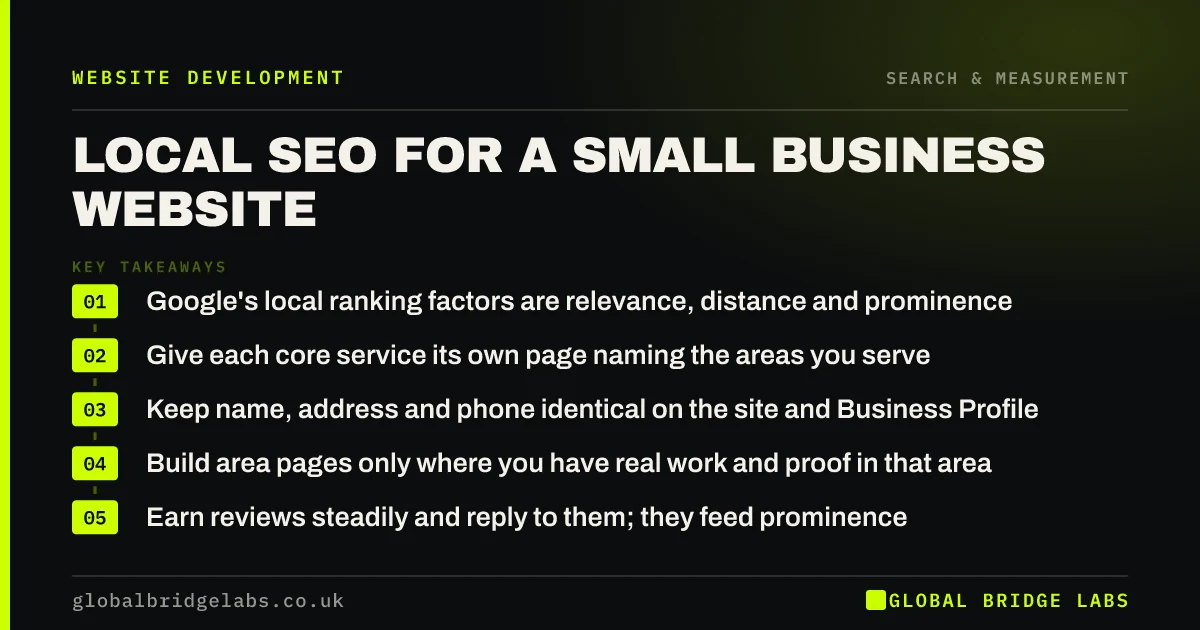
- Google's local ranking factors are relevance, distance and prominence.
- Give each core service its own page naming the areas you serve.
- Keep name, address and phone identical on the site and Business Profile.
- Build area pages only where you have real work and proof in that area.
- Earn reviews steadily and reply to them; they feed prominence.
Want to know why a competitor outranks you locally? Send us both URLs on WhatsApp.
Chat on WhatsApp →What is local SEO?
Local SEO is the practice of improving a business's visibility in search results for location-based queries, such as plumber in Leeds or accountant near me, including the map pack of Google Business Profile listings and the organic results below it.
It combines two assets: your Google Business Profile and your website. The profile wins the map pack. The website wins the organic results, supports the profile's relevance and converts the visitor once they click.
How does Google rank local results?
Google's own help page on local ranking names three factors. Relevance is how well your listing and website match the search. Distance is how far you are from the searcher or the location in the query. Prominence is how well known the business is, informed by reviews, links, articles and your position in general web results.
You cannot change distance, but the website strongly influences relevance and prominence. A profile linked to a site with clear service pages, local proof and consistent details ranks more reliably than one linked to a thin homepage.
What should your website do for local SEO?
The website's job is to make relevance obvious and to back up the profile with consistent facts.
- One page per core service, naming the towns or areas you serve.
- Name, address and phone in the footer, identical to your Business Profile.
- LocalBusiness structured data with the same details.
- Embedded map and directions on the contact page.
- Local proof: reviews naming towns, photographs of local jobs.
- Links from local organisations, suppliers and trade bodies.
Should you create location pages?
Create a location page only when you can say something genuinely specific about that area: jobs completed there, local reviews, local regulations, travel times or a local team. Pages that swap the town name into identical text are doorway pages, which Google's spam policies target.
For most SMEs, three to five strong area pages beat fifty thin ones. Start with the areas that produce the most profitable work.
Want a list of the area pages worth building for your business? Message us on WhatsApp with where you work.
Chat on WhatsApp →How do reviews affect local visibility?
Reviews contribute to prominence, and their content can support relevance when customers mention the service and area. Google's guidance encourages businesses to ask for reviews and to reply to them.
Build a steady flow by asking after every completed job, and reply to all reviews, including negative ones, calmly and specifically. Never buy or fabricate reviews: UK consumer law bans fake reviews and the CMA can fine businesses directly.
When will local SEO not be enough?
Local SEO takes months to build and is limited by distance. If you are based at the edge of your market, or compete with dozens of established firms, you may need paid search or local service ads to reach buyers across the whole area.
The trade-off is cost against time. Paid search delivers quickly at a price per click. Local SEO builds more slowly but keeps producing without per-click costs. Most local businesses benefit from running both, with the website ready to convert either.
What does this look like in practice?
A pattern in trades: a well-reviewed Google Business Profile linked to a single-page website that lists services in one line, with a different phone number from the one on the profile.
Building service pages, matching the phone number everywhere, adding LocalBusiness structured data and showing reviews that mention local towns gives Google stronger relevance signals. The map listing and the website start supporting each other rather than competing.
Local SEO checklist
Work through these in order.
- Complete every section of your Google Business Profile.
- Match name, address and phone exactly on the site and profile.
- Build a page for each core service.
- Add LocalBusiness structured data.
- Create area pages only where you have real local proof.
- Ask every happy customer for a review.
- Reply to every review.
- Earn links from local organisations and suppliers.
Next step
If competitors appear in the map pack and you do not, we will compare your site and profile with theirs in 30 minutes and list what to fix first.
Message us on WhatsApp for a local SEO review, or book a 30-minute consultation.
Chat on WhatsApp →Sources and further reading
- Tips to improve your local ranking on Google · Google Business Profile Help
- Google Business Profile Help · Google
- LocalBusiness type · Schema.org
Frequently asked questions
How do I improve local SEO for my website?
Give each core service its own page naming the areas you serve, keep your name, address and phone identical on the site and Google Business Profile, add LocalBusiness structured data, show local proof such as reviews and job photographs, and earn links from local organisations.
What are Google's local ranking factors?
Google says local results are based mainly on relevance, distance and prominence. Relevance is how well you match the search, distance is how far you are from the searcher, and prominence reflects how well known you are, informed by reviews, links and general web presence.
Are location pages good for SEO?
Only if each one has genuinely specific content, such as local jobs, reviews, team members or area information. Pages that simply swap the town name into identical text are treated as doorway pages under Google's spam policies. A few strong area pages beat many thin ones.
Do I need a website if I have a Google Business Profile?
Yes, for most businesses. The profile helps you appear in the map pack, but a website supports its relevance, ranks in the organic results, holds detailed service and pricing information and converts visitors who want to know more before they call.
Written by

Global Bridge Labs (GBL) is a UK–Sri Lanka partner for social media, websites and BPO. Everything here comes from client delivery, not theory.