
On this page
- 01Key takeaways
- 02What makes up labour cost?
- 03Which options come first?
- 04What does the saving look like in numbers?
- 05What does UK law allow?
- 06Where does outsourcing fit?
- 07What should you avoid?
- 08What does this look like in practice?
- 09Labour cost checklist
- 10Next step
- 11Sources and further reading
- 12Frequently asked questions
Key takeaways
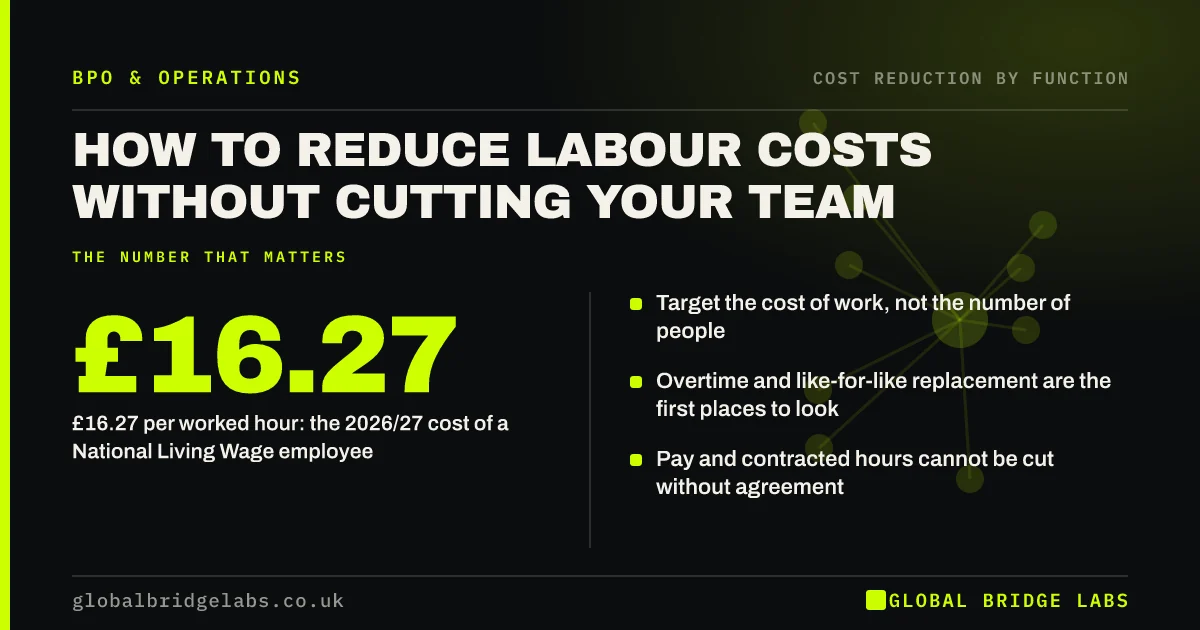
To reduce labour costs without cutting your team, lower the cost of the work instead of the number of people. Remove overtime, stop replacing leavers like for like, take routine tasks off expensive staff and buy variable capacity for peaks. Pay and hours are contractual in the UK, so they cannot be changed without agreement.
- Target the cost of work, not the number of people.
- £16.27 per worked hour: the 2026/27 cost of a National Living Wage employee.
- Overtime and like-for-like replacement are the first places to look.
- Pay and contracted hours cannot be cut without agreement.
Want to see where your labour cost could fall without losing anyone? Message us on WhatsApp with your team structure.
Chat on WhatsApp →What makes up labour cost?
Labour cost is more than wages. In 2026/27, an employee on the National Living Wage of £12.71 an hour costs about £16.27 per worked hour once employer National Insurance at 15% above £5,000, the minimum 3% pension contribution and 28 days of paid holiday are included. Recruitment, training, equipment and management time come on top.
Eligible employers can claim the Employment Allowance, which reduces their National Insurance bill by up to £10,500 a year. Check that you are claiming it.
Which options come first?
Start with the options that change nobody's contract. They are faster, carry no legal risk and often produce the largest saving. Work down the list only as far as you need to.
- 1. Cut regular overtime by fixing its cause.
- 2. Review every vacancy before replacing it.
- 3. Move routine work off higher-paid staff.
- 4. Remove wasted work so fewer hours are needed.
- 5. Buy variable capacity for peaks instead of hiring for them.
- 6. Reduce agency and contractor spend.
- 7. Agree changes to hours or roles with the people affected.
What does the saving look like in numbers?
Take an illustrative team where three people each work 4 hours of overtime a week at time and a half on a loaded £19.81. That is 12 hours a week at about £29.70, or roughly £18,500 a year. Moving the work behind that overtime to a managed team at an indicative £12 an hour costs about £7,500.
Then a leaver is not replaced like for like. Half the role is absorbed by simplifying the process and half is bought as managed hours. No one has been made redundant, and annual labour cost has fallen by a five-figure sum. These are example figures, not a forecast.
- How much can a small business save by outsourcing?
- Hiring freeze? How to keep growing with the team you have
Want this worked through for your overtime and vacancies? Send us the details on WhatsApp.
Chat on WhatsApp →What does UK law allow?
UK employment law treats pay, hours and duties as terms of the contract. You cannot reduce them unilaterally. Changes need the employee's agreement, usually after consultation, and imposing them risks claims. There is generally no legal right to overtime pay unless the contract provides it, but average pay must not fall below the National Minimum Wage.
If existing work is moved to an outside provider, the TUPE regulations may transfer the affected employees to that provider. Take advice before changing anyone's role.
Where does outsourcing fit?
Outsourcing fits options three, five and six. It takes routine work off expensive people, supplies capacity that rises and falls with volume, and replaces agency spend with a managed service. Used this way it absorbs growth and natural turnover. It does not have to mean anyone losing a job.
What should you avoid?
Avoid across-the-board cuts, freezing pay while workloads grow, and cutting training. Each saves money this year and costs more next year through resignations, errors and lost customers. Avoid also reducing headcount while the work stays the same. It returns as overtime, burnout and contractor invoices.
What does this look like in practice?
A pattern we see when someone resigns: the role is advertised the same week, with the same job description, at a higher salary. Nobody asks which of its tasks still need doing, which could be simplified and which could be bought by the hour. A vacancy is the one moment when a role can be redesigned without affecting anyone.
Labour cost checklist
Review these before considering any reduction in headcount.
- Calculate loaded cost per worked hour for each role.
- Total overtime hours and find what causes them.
- List tasks done by people paid more than the task needs.
- Review each vacancy before replacing it.
- Check you claim the Employment Allowance.
- Price peak workload as bought-in capacity.
- Take advice before changing any contract.
Next step
Send us your roles, overtime hours and any vacancies. We will show you which labour costs can fall without changing anyone's contract.
Message us on WhatsApp to review your labour costs, or book a 30-minute consultation.
Chat on WhatsApp →Sources and further reading
- National Minimum Wage and National Living Wage rates · GOV.UK
- Rates and thresholds for employers 2026 to 2027 · HM Revenue & Customs
- Employment Allowance · GOV.UK
- Overtime: your rights · GOV.UK
- Business transfers, takeovers and TUPE · GOV.UK
Frequently asked questions
How can I reduce labour costs without making redundancies?
Cut regular overtime by fixing its cause, review vacancies before replacing them, move routine work off higher-paid staff, remove wasted tasks and buy flexible capacity for peaks. These lower the cost of the work without changing anyone's contract or reducing your permanent team.
Can an employer reduce pay or hours in the UK?
Not without agreement. Pay and hours are contractual terms. An employer must consult and get the employee's consent to change them, unless the contract already allows it. Imposing a change risks claims for breach of contract or unfair dismissal. Take advice first.
What is the true hourly cost of an employee?
In 2026/27, an employee on the National Living Wage of £12.71 costs about £16.27 per worked hour once employer National Insurance, the minimum pension contribution and paid holiday are included. Recruitment, training, equipment and management time add more.
Does outsourcing mean replacing staff?
Not necessarily. Many small businesses use a managed team to absorb growth, cover peaks and take routine tasks off existing staff, with nobody leaving. Where existing work does transfer to a provider, TUPE rules may apply, so take advice before planning that route.
Written by

Global Bridge Labs (GBL) is a UK–Sri Lanka partner for social media, websites and BPO. Everything here comes from client delivery, not theory.


