
On this page
- 01Key takeaways
- 02What is an indexation clause?
- 03Which index is used?
- 04What does indexation do to a saving?
- 05What should you negotiate?
- 06How do you offset the increase?
- 07When is an increase a warning sign?
- 08What does this look like in practice?
- 09Indexation checklist
- 10Next step
- 11Sources and further reading
- 12Frequently asked questions
Key takeaways
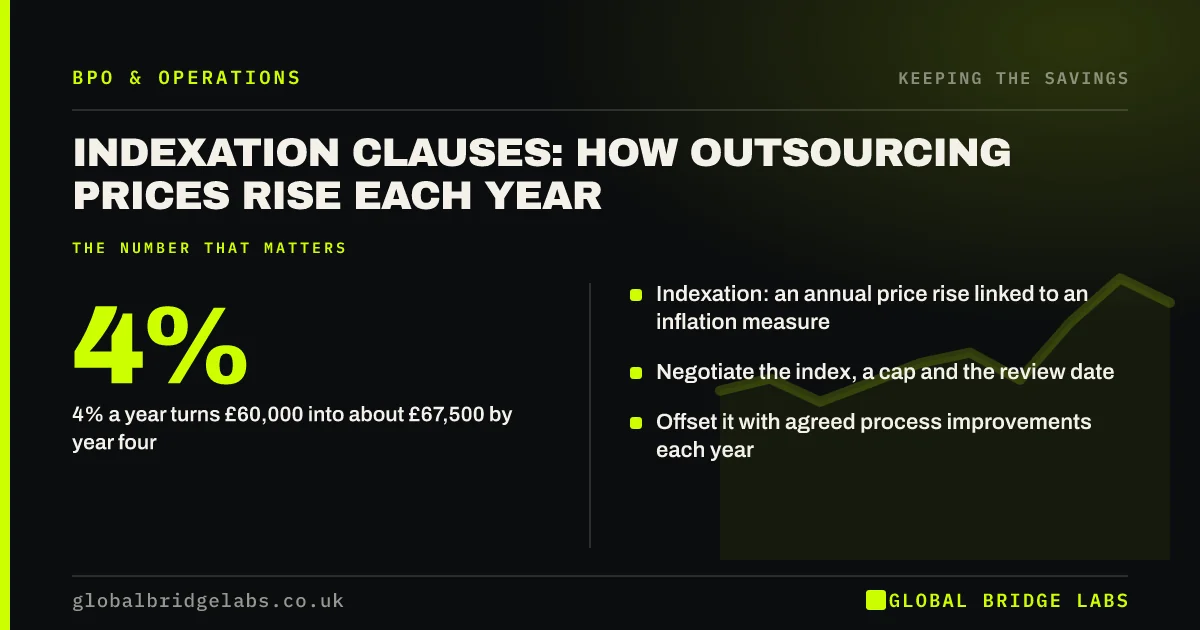
An indexation clause in an outsourcing contract lets the provider raise prices each year in line with an inflation measure. It is normal and fair in principle, since wages rise. But the detail decides how much of your saving survives. In our example, 4% a year turns £60,000 into about £67,500 by the fourth year.
- Indexation: an annual price rise linked to an inflation measure.
- 4% a year turns £60,000 into about £67,500 by year four.
- Negotiate the index, a cap and the review date.
- Offset it with agreed process improvements each year.
Want your contract's price review clause explained in plain terms? Message us on WhatsApp.
Chat on WhatsApp →What is an indexation clause?
An indexation clause is a contract term that adjusts the price of a service at set intervals according to a published index, usually a measure of inflation. It protects the provider against rising costs over a multi-year contract and gives the client a predictable rule in place of annual renegotiation.
Which index is used?
For UK contracts the common reference is the Consumer Prices Index (CPI), published monthly by the Office for National Statistics. Some contracts use a fixed percentage instead. For offshore services, a provider's costs follow wage inflation in its own country, so a UK index is a convenience, not a measure of its real costs.
What matters is that the index is named, the reference month is stated and the calculation can be checked by both sides.
What does indexation do to a saving?
Indexation compounds. In an illustrative contract of £60,000 a year with a 4% annual increase, the price is £62,400 in year two, about £64,900 in year three and about £67,500 in year four. That is £7,500 a year more than the starting price.
If the original saving against in-house cost was £25,000 a year, and in-house wage costs had stayed flat, nearly a third of it would be gone. In reality in-house costs rise too, so the fair comparison is against what the work would cost you now.
- Year 1: £60,000.
- Year 2: £62,400.
- Year 3: about £64,900.
- Year 4: about £67,500.
- Run-rate savings vs one-off savings: count them correctly
- Rising UK employment costs: when to rethink staffing
Want your contract price projected over its term? Send us the clause on WhatsApp.
Chat on WhatsApp →What should you negotiate?
Negotiate the terms that limit surprises. Most providers expect the conversation and will agree reasonable limits.
- A named, public index and reference month.
- A cap on the annual increase.
- No increase in the first 12 months.
- One review date a year, with written notice.
- Increases applied to the rate only, not to pass-through costs.
- A right to exit if an increase exceeds the cap.
How do you offset the increase?
Offset it with productivity. If the price per hour rises 4% and the process is improved so that it needs 4% fewer hours, cost per task is flat. Ask for improvement proposals at the same meeting where the price review is discussed. The two belong together.
When is an increase a warning sign?
An increase is a warning sign when it arrives without notice, exceeds the contract terms, or is justified by costs that should already be in the rate. A provider that priced low to win the work and then seeks large rises has moved the real price to year two. Compare the whole term, not the first-year rate.
What does this look like in practice?
A pattern we see in three-year arrangements: the first-year price was negotiated hard, and the price review clause was not read. The uplift each year is tied to an index with no cap. By the third year the rate is well above what a new quote would give, and the notice period makes moving awkward.
Indexation checklist
Check these in any multi-year services contract.
- The index is named and public.
- There is a cap.
- The first increase date is stated.
- Notice of an increase is required in writing.
- The price over the full term has been projected.
- Improvement commitments sit alongside the review.
Next step
Send us the price review wording from your contract or a quote you are considering. We will explain what it means over the full term and what is reasonable to ask for.
Message us on WhatsApp to review a price clause, or book a 30-minute consultation.
Chat on WhatsApp →Sources and further reading
- Inflation and price indices · Office for National Statistics
- The Sourcing and Consultancy Playbooks · Cabinet Office
- Exchange rates · Central Bank of Sri Lanka
Frequently asked questions
What is an indexation clause in a contract?
An indexation clause adjusts the contract price periodically in line with a published index, usually an inflation measure such as the Consumer Prices Index. It allows the price to keep pace with rising costs without renegotiating the contract each year.
Is it normal for outsourcing prices to rise every year?
Yes. Most multi-year service contracts include an annual price review, because wages and other costs rise. What varies is the mechanism. A named index with a cap and written notice is reasonable. An open-ended right to increase prices is not.
Can I refuse an indexation increase?
Not if it follows the contract terms you agreed. You can challenge an increase that exceeds those terms or is not properly notified. The time to limit increases is before signing, by negotiating a cap and a clear method.
What is a cap and collar?
A cap is the maximum annual increase allowed under an indexation clause, and a collar is the minimum. Together they keep price changes within a known range whatever the index does. A cap protects the client. A collar protects the provider.
Written by

Global Bridge Labs (GBL) is a UK–Sri Lanka partner for social media, websites and BPO. Everything here comes from client delivery, not theory.


