On this page
- 01Key takeaways
- 02What is double data entry?
- 03Where does it hide in a small business?
- 04What does it cost?
- 05How do you stop it?
- 06What if the systems cannot be connected?
- 07What does this look like in practice?
- 08Double data entry checklist
- 09Next step
- 10Sources and further reading
- 11Frequently asked questions
Key takeaways
Double data entry is typing the same information into more than one system. It costs time twice and adds an error each time it is retyped. In our example, rekeying 400 orders a month costs about 20 hours and creates around eight errors. The fix is to enter data once, at the source, and let it flow.
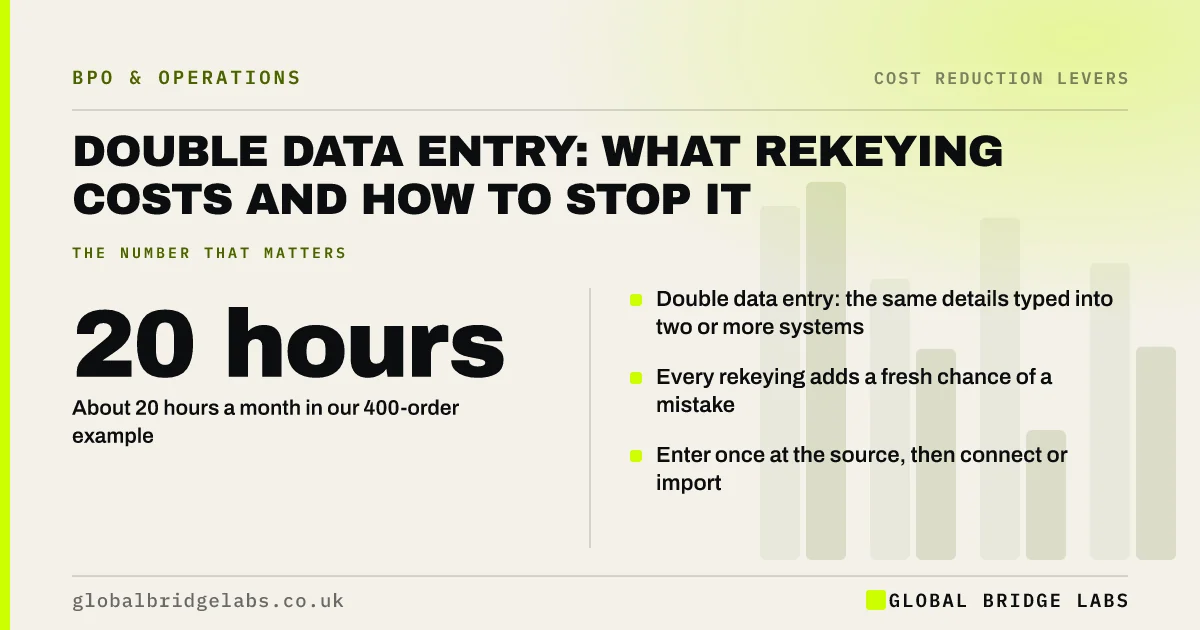
- Double data entry: the same details typed into two or more systems.
- About 20 hours a month in our 400-order example.
- Every rekeying adds a fresh chance of a mistake.
- Enter once at the source, then connect or import.
Want to find where your team types things twice? Message us on WhatsApp with the systems you use.
Chat on WhatsApp →What is double data entry?
Double data entry is the manual re-entry of information that already exists in another system or document. A customer's details typed from an email into the CRM, then into the accounts package, then onto a delivery note, have been entered three times. Each copy can differ from the others.
The phrase also describes a deliberate quality technique in research, where two people key the same data to catch errors. This article is about the accidental kind.
Where does it hide in a small business?
It hides wherever two systems do not talk to each other, and wherever information arrives in a form that cannot be imported. The people doing it often do not see it as a problem, because it has always been part of the job.
- Web orders retyped into an accounts or stock system.
- Enquiry forms copied into a CRM.
- Timesheets retyped into payroll or invoicing.
- Supplier invoices keyed from PDFs.
- Spreadsheet figures copied into reports.
What does it cost?
It costs the keying time, the time to find and correct errors, and the consequences of the errors that are not found. In an illustrative firm, 400 orders a month are retyped from the web shop into the accounts system at 3 minutes each: 20 hours a month. At a loaded £19.81 per worked hour that is about £396 a month, or roughly £4,750 a year.
If one retyped order in fifty contains a mistake, that is eight errors a month. A wrong address or quantity can cost far more than the keying time through a re-delivery, a credit note or a lost customer.
- Admin errors costing money? When accuracy says outsource
- The cost of poor quality in a small business
Want the cost of rekeying worked out for your volumes? Send them on WhatsApp.
Chat on WhatsApp →How do you stop it?
Stop it in order of cost. First, remove any copy that nobody needs. Second, use the import and export features your systems already have. Third, connect the systems with a built-in integration or a connector tool. Custom development is the last resort, justified only by high volume.
- 1. List every place each piece of data is entered.
- 2. Choose one system as the master for each type of data.
- 3. Delete copies with no purpose.
- 4. Use imports or built-in integrations.
- 5. Consider a custom link only for high volume.
What if the systems cannot be connected?
If the systems cannot be connected at a sensible cost, the keying still has to happen, and the question becomes who does it and how accurately. A managed data entry team working to a checked process is cheaper per record than a senior employee doing it between other tasks, and is easier to quality-control.
That is a holding position, not a design. Review the integration options once a year, because they change.
What does this look like in practice?
A pattern we see in firms that have added software one tool at a time: each system was a good choice on its own, and together they need a person to carry data between them. That person is usually the office manager, and the carrying takes a day a week that appears nowhere in the software budget.
Double data entry checklist
Trace one customer record and one order through your systems.
- Count how many times each is typed.
- Name the master system for each data type.
- List copies nobody uses.
- Check each system's import and integration options.
- Estimate monthly keying hours and error rate.
- Decide which link to build or buy first.
Next step
Send us the list of systems your team uses and what gets copied between them. We will show you which links are worth making and what to do about the rest.
Message us on WhatsApp to map your data entry, or book a 30-minute consultation.
Chat on WhatsApp →Sources and further reading
- Labour productivity · Office for National Statistics
- Running a limited company: company and accounting records · GOV.UK
Frequently asked questions
Why is double data entry a problem?
It wastes time by repeating work and introduces errors, because each manual copy can differ from the original. It also creates conflicting versions of the same record, so staff cannot be sure which is correct. The cost grows directly with volume.
How do you eliminate duplicate data entry?
Decide which system is the master for each type of data and enter it there once. Then move it to other systems by import, a built-in integration or a connector tool. Remove any copy that serves no purpose. Custom integration is worth it only at high volume.
How common are manual data entry errors?
Error rates depend on the complexity of the data, the conditions and whether work is checked, so published figures vary widely. Measure your own by sampling 100 keyed records against the source. Even a low rate matters when each error can trigger a wrong delivery or invoice.
Is it worth outsourcing data entry instead of integrating systems?
Integration is the better long-term answer where volume is high and systems support it. Where they cannot be connected at a sensible cost, a managed data entry team is a practical alternative. It lowers the cost per record and adds accuracy checks while the keying remains necessary.
Written by

Global Bridge Labs (GBL) is a UK–Sri Lanka partner for social media, websites and BPO. Everything here comes from client delivery, not theory.