On this page
- 01Key takeaways
- 02Why does cost cutting hurt morale?
- 03What does low morale cost?
- 04What should you say, and when?
- 05How do you involve the team?
- 06How do you introduce outsourcing without alarm?
- 07What are the signs trust is slipping?
- 08What does this look like in practice?
- 09Morale checklist
- 10Next step
- 11Sources and further reading
- 12Frequently asked questions
Key takeaways
Cost cutting and staff morale are linked by uncertainty. People cope with hard news far better than with silence. Say early what is happening, why, what it means for jobs and what will not change. Then involve the team in finding the savings, because they know where the waste is. Morale lost to rumour is expensive to rebuild.
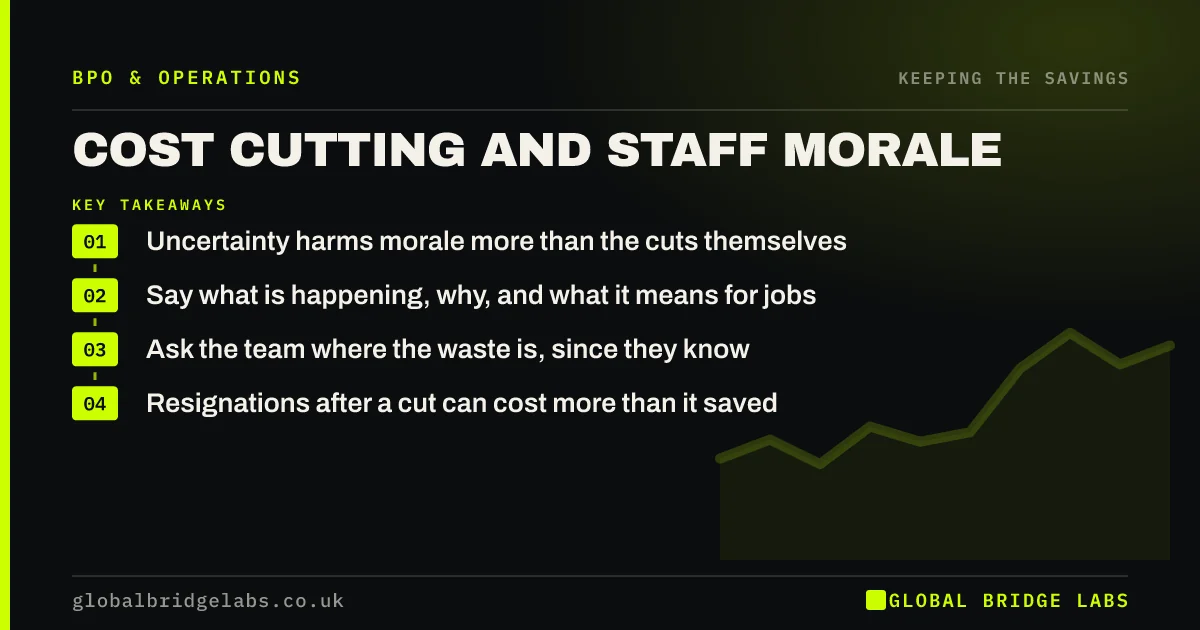
- Uncertainty harms morale more than the cuts themselves.
- Say what is happening, why, and what it means for jobs.
- Ask the team where the waste is, since they know.
- Resignations after a cut can cost more than it saved.
Planning savings and unsure how to tell the team? Message us on WhatsApp with your situation.
Chat on WhatsApp →Why does cost cutting hurt morale?
Cost cutting hurts morale because people fill gaps in information with the worst case. A cancelled order of biscuits is read as a sign of redundancies. The Health and Safety Executive's Management Standards identify how change is managed and communicated as one of six main sources of work-related stress.
What does low morale cost?
Low morale costs output, accuracy and people. The first to leave are those with the most options, who are usually the ones you most want to keep. Replacing an employee means recruitment fees, weeks of vacancy, training and a period of lower output.
In an illustrative case, a savings round that trims £15,000 from a team's budget and prompts one resignation from a £30,000 role can cost more than it saved once recruitment, a two-month vacancy and three months of training are counted.
What should you say, and when?
Say it early, in person and in plain words. Tell everyone at the same time. Cover the reason, the size of the challenge, what it means for jobs, what is not changing and when they will hear more. If you do not know something, say so and give a date.
- 1. Why costs need to come down.
- 2. How much, and by when.
- 3. What this means for jobs, honestly.
- 4. What will not change.
- 5. How people can contribute ideas.
- 6. When the next update will be.
How do you involve the team?
Involve the team by asking the question they are best placed to answer: what do we do that is a waste of time? People who do the work can list pointless steps immediately. Acting on those suggestions visibly, within weeks, shows that the programme is about waste and not about them.
- Run a short session per team on wasted effort.
- Collect ideas in writing and reply to every one.
- Implement the easy ones at once.
- Credit the people who suggested them.
- The eight wastes of lean in an office, and how to cut them
- Value stream mapping for service and admin processes
Want a session plan for gathering savings ideas? Send us your team size on WhatsApp.
Chat on WhatsApp →How do you introduce outsourcing without alarm?
Introduce outsourcing by being specific about which tasks are moving, why, and what each affected person will do instead. In many small businesses the honest message is a good one: routine work is going so that existing staff can do more of the work they were hired for.
If roles are at risk, or work is transferring to a provider, employment law including TUPE may apply. Take advice and consult properly before announcing anything.
What are the signs trust is slipping?
Watch for changes in behaviour. They appear before anyone resigns.
- Meetings go quiet.
- Questions stop.
- Sickness absence rises.
- Good people become hard to reach.
- Rumours reach you from customers.
What does this look like in practice?
A pattern we see in owner-led firms: the owner delays telling the team until every detail is settled, to avoid worrying them. By then the team has known for weeks that something is going on and has assumed the worst. An early, incomplete, honest briefing would have cost nothing.
Morale checklist
Check these before and during any savings programme.
- The reason is explained in one clear sentence.
- Everyone hears at the same time.
- The effect on jobs is stated honestly.
- Staff are asked for savings ideas.
- Easy ideas are implemented quickly.
- Updates happen on the promised dates.
- Advice is taken before any role changes.
Next step
Tell us what savings you are planning and how your team is likely to react. We will help you shape a plan that finds the money without losing the people.
Message us on WhatsApp to plan savings your team can support, or book a 30-minute consultation.
Chat on WhatsApp →Sources and further reading
- What are the Management Standards for work-related stress? · Health and Safety Executive
- Work-related stress and how to manage it · Health and Safety Executive
- Business transfers, takeovers and TUPE · GOV.UK
Frequently asked questions
How does cost cutting affect employee morale?
It creates uncertainty about job security and workload, which lowers motivation and trust. The effect is strongest when communication is poor. Clear, early and honest information reduces the damage considerably, even when the news itself is unwelcome.
How do you announce cost cuts to employees?
Tell everyone together, in person where possible. Explain why costs need to fall, by how much, what it means for jobs and what will stay the same. Invite questions, admit what is not yet decided and commit to a date for the next update.
Should employees be involved in finding savings?
Yes. People who do the work know where time and money are wasted. Asking them produces practical ideas and shows the programme is aimed at waste, not at them. Respond to every suggestion and act quickly on the simple ones.
Will outsourcing damage morale?
It can if it is announced vaguely. It often improves morale when routine tasks are removed and staff can concentrate on more skilled work. Be specific about what is moving and what each person's role becomes, and take advice if any jobs are affected.
Written by

Global Bridge Labs (GBL) is a UK–Sri Lanka partner for social media, websites and BPO. Everything here comes from client delivery, not theory.