On this page
- 01Key takeaways
- 02Why do cost cuts backfire?
- 03Which mistakes are most common?
- 04What does a backfired cut look like in numbers?
- 05How do you spot a mistake early?
- 06What should you do instead?
- 07Is outsourcing a cost-cutting mistake?
- 08What does this look like in practice?
- 09Before-you-cut checklist
- 10Next step
- 11Sources and further reading
- 12Frequently asked questions
Key takeaways
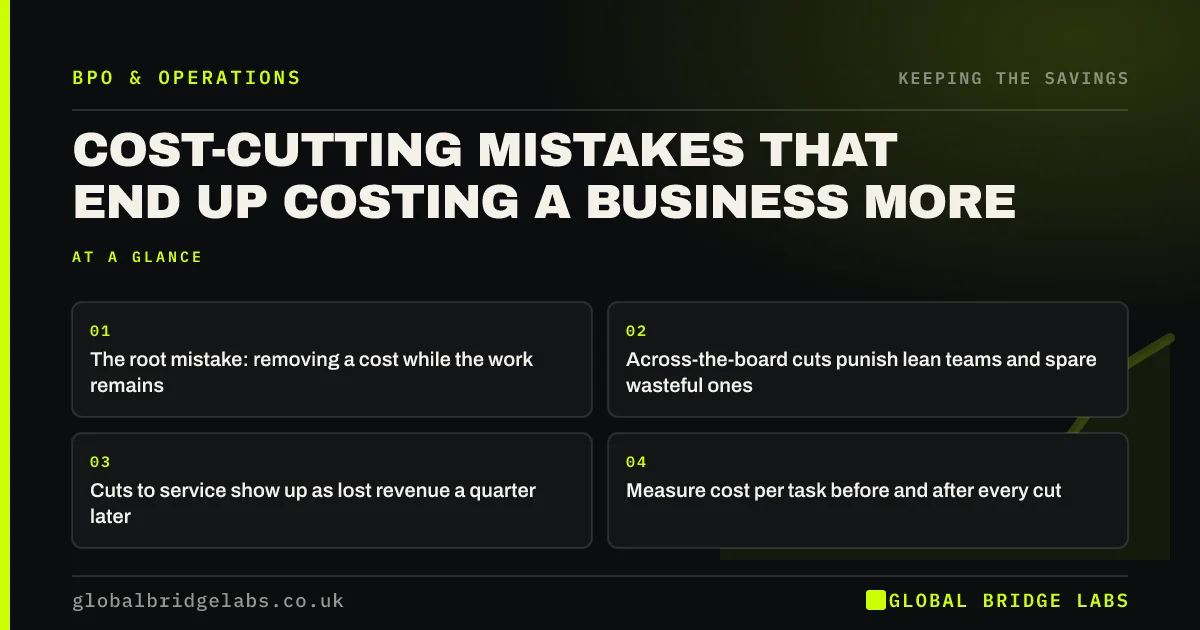
The most common cost cutting mistakes share one cause: the cost is removed but the work is not. The work then returns as overtime, errors, slower service or lost customers, and usually costs more than the saving. Lasting reductions change how work is done. The checks below take an hour and prevent most of the damage.
- The root mistake: removing a cost while the work remains.
- Across-the-board cuts punish lean teams and spare wasteful ones.
- Cuts to service show up as lost revenue a quarter later.
- Measure cost per task before and after every cut.
Planning cuts and want a second opinion? Message us on WhatsApp with what is on the list.
Chat on WhatsApp →Why do cost cuts backfire?
Cost cuts backfire when they treat a budget line as the problem instead of the work behind it. A budget is a symptom. If a team costs too much because its process is wasteful, shrinking the team leaves the waste and removes the capacity. The remaining people work longer, make more errors and leave.
Which mistakes are most common?
Eight mistakes account for most failed cost reductions in small businesses. Each looks sensible in a spreadsheet.
- 1. Cutting every budget by the same percentage.
- 2. Cutting people before fixing the process.
- 3. Cutting customer-facing capacity.
- 4. Choosing the cheapest supplier on rate alone.
- 5. Stopping training and maintenance.
- 6. Counting one-off savings as permanent.
- 7. Ignoring the cost of making the change.
- 8. Not measuring afterwards.
What does a backfired cut look like in numbers?
Take an illustrative firm that removes one of three support roles to save £34,500 a year. Response times double. If slower replies lose two customers a month worth £1,500 each, that is £36,000 of revenue a year. The remaining two staff work overtime at about £29.70 an hour for 6 hours a week between them, adding roughly £9,300.
The saving has become a net cost, and the figures above leave out the price of replacing whoever resigns next. These are example figures to show the mechanism, not a prediction.
- Slow response to enquiries: what it costs and the fix
- Rising overtime costs: when outsourcing is cheaper
Want a planned cut stress-tested like this? Send us the details on WhatsApp.
Chat on WhatsApp →How do you spot a mistake early?
Spot it by watching the measures that move first. Cost falls immediately. The damage shows a few weeks later in other numbers.
- Response and turnaround times lengthening.
- Error and rework rates rising.
- Overtime and contractor spend increasing.
- Backlogs growing.
- Complaints mentioning delay.
- Good people updating their CVs.
What should you do instead?
Start with the work. Measure what each process costs per task, remove steps nobody needs, standardise the rest and then choose the cheapest reliable way to run it. Cut obvious waste freely: unused subscriptions, reports with no reader, duplicate tools. For everything else, change the method before the budget.
Is outsourcing a cost-cutting mistake?
Outsourcing becomes a cost-cutting mistake when it is done for rate alone, with no documented process and no measurement. It is a sound cost reduction when a defined process moves to a managed team at a lower cost per task with quality tracked. The difference is preparation, not the decision itself.
What does this look like in practice?
A pattern we see a year after a round of cuts: the same costs are back under different headings. The salary line is lower, and agency fees, overtime and software to patch the gaps are higher. Nobody reversed the decision. The work simply found another way to be paid for.
Before-you-cut checklist
Answer these for every proposed cut.
- What work does this cost pay for?
- Will the work stop, or just move?
- Who will notice, and how soon?
- What is the cost per task now?
- What will it cost to make the change?
- Is the saving recurring or one-off?
- Which measures will show if it is going wrong?
Next step
Send us the cuts you are considering and the saving expected from each. We will tell you which look safe, which carry a risk worth testing and where a change of method would save more.
Message us on WhatsApp to pressure-test your cost plan, or book a 30-minute consultation.
Chat on WhatsApp →Sources and further reading
- UK Customer Satisfaction Index · Institute of Customer Service
- Labour productivity · Office for National Statistics
- Work-related stress and how to manage it · Health and Safety Executive
Frequently asked questions
What are the most common cost-cutting mistakes?
The most common are cutting every budget by the same percentage, reducing headcount before fixing processes, cutting customer service capacity, choosing suppliers on price alone, stopping training, and failing to measure whether the saving was real.
Why do across-the-board cuts fail?
They assume waste is evenly spread, which it never is. Efficient teams lose capacity they needed, while inefficient teams absorb the cut without changing anything. The result is damage where the business was working well and little improvement where it was not.
What should a business never cut?
Avoid cutting the things customers pay for and notice: response speed, product or service quality, and the people who hold key relationships. Be cautious with training and maintenance, where the cost of cutting appears later and is larger.
How can I cut costs safely?
Remove genuine waste first. For work that must continue, lower the cost per task by simplifying and standardising it, then choose the most economical way to run it. Track quality and speed alongside cost so any harm is visible quickly.
Written by

Global Bridge Labs (GBL) is a UK–Sri Lanka partner for social media, websites and BPO. Everything here comes from client delivery, not theory.