
On this page
- 01Key takeaways
- 02What is budget variance analysis?
- 03How do you calculate a variance?
- 04How do you split price from volume?
- 05What should you do with the result?
- 06How does this apply to outsourcing costs?
- 07What are the limits of variance analysis?
- 08What does this look like in practice?
- 09Variance analysis checklist
- 10Next step
- 11Sources and further reading
- 12Frequently asked questions
Key takeaways
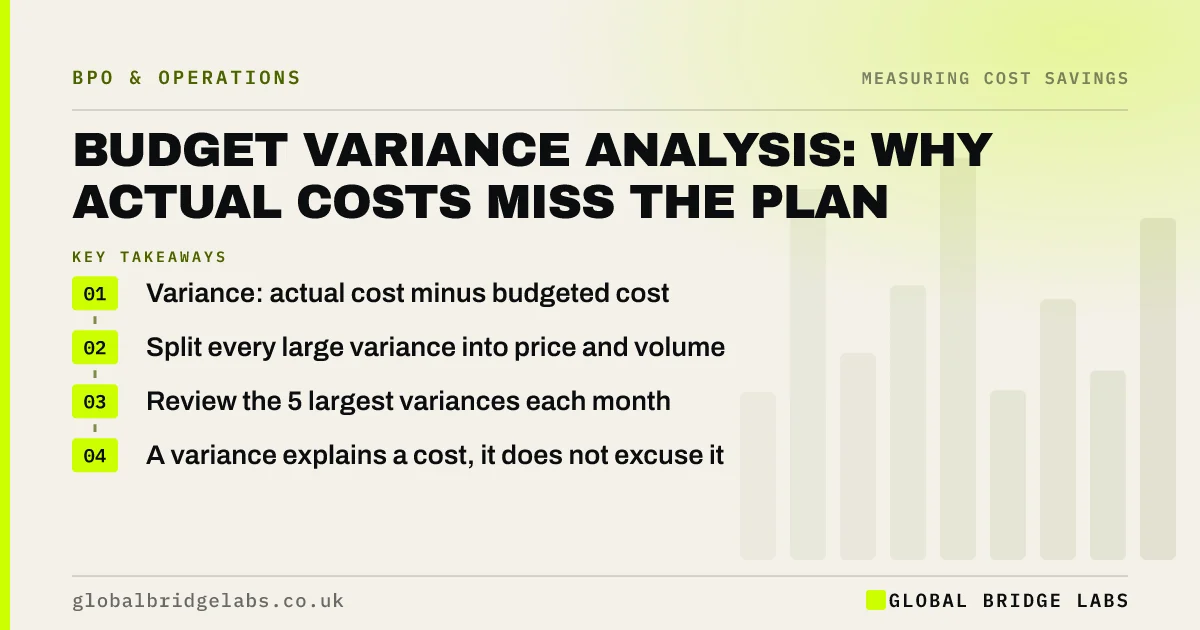
Budget variance analysis compares what was actually spent with what was planned and explains the gap. The explanation is the point. A cost can be over budget because prices rose, because more was used, or because the budget was wrong. Each calls for a different response, and a monthly review of the five largest variances is enough for most small businesses.
- Variance: actual cost minus budgeted cost.
- Split every large variance into price and volume.
- Review the 5 largest variances each month.
- A variance explains a cost, it does not excuse it.
Want help reading your budget against actuals? Message us on WhatsApp with the lines that are furthest out.
Chat on WhatsApp →What is budget variance analysis?
Budget variance analysis is the process of comparing actual financial results with the budget for the same period, calculating the difference for each line and identifying why it occurred. A variance is favourable when cost is below budget and adverse when it is above.
How do you calculate a variance?
Subtract the budgeted amount from the actual amount for each cost line, and express the difference as a percentage of budget. Then rank the lines by the size of the variance in pounds. A 50% overrun on a £200 line matters less than a 6% overrun on a £40,000 one.
- 1. List budget and actual for each cost line.
- 2. Subtract budget from actual.
- 3. Divide by budget for the percentage.
- 4. Rank by pounds and take the top five.
How do you split price from volume?
Split a variance by asking how much of it came from paying more per unit and how much from using more units. In an illustrative quarter, customer service was budgeted at 6,000 contacts and £2.50 each, or £15,000. Actual spend was £17,920 for 6,400 contacts at £2.80.
The volume effect is 400 extra contacts at the budgeted £2.50, or £1,000. The price effect is 30p more on all 6,400 contacts, or £1,920. Two-thirds of the overrun is the cost per contact rising, not the business being busier.
- Total variance: £2,920 adverse.
- Volume variance: 400 contacts at £2.50, £1,000.
- Price variance: 6,400 contacts at £0.30, £1,920.
- Cost per contact: compare in-house and outsourced support
- Cost drivers: what really moves your operating costs
Want a variance split like this for one of your cost lines? Send us the figures on WhatsApp.
Chat on WhatsApp →What should you do with the result?
Act according to the cause. A volume variance driven by sales is usually good news and the budget should flex. A volume variance driven by rework or avoidable contact needs fixing at source. A price variance means cost per unit has drifted, through overtime, a supplier increase or lower efficiency.
How does this apply to outsourcing costs?
For an outsourced process, compare the invoice with the scope. A rising bill may be more volume at the agreed rate, a higher rate, or extra tasks added informally. Ask the provider to show volume and rate separately each month, so a price variance cannot hide inside a volume one.
What are the limits of variance analysis?
Variance analysis only measures against the budget, so it is only as good as the budget. A padded budget produces favourable variances and no improvement. It also looks backwards. Use it to ask questions, and use unit costs and process measures to find answers.
What does this look like in practice?
A pattern we see in monthly management meetings: the owner notes that wages are over budget, someone says it has been busy, and the meeting moves on. Splitting the figure shows that volume was up slightly and overtime accounted for the rest. Busy was true. It was not the explanation.
Variance analysis checklist
Run this as part of each month-end review.
- Budget and actual are compared line by line.
- The five largest variances are identified.
- Each is split into price and volume.
- Each has a one-line explanation.
- Each adverse variance has an action and an owner.
- The budget is updated if an assumption was wrong.
Next step
Send us the three cost lines furthest from budget. We will help you separate price from volume and see which ones need action.
Message us on WhatsApp to review your budget variances, or book a 30-minute consultation.
Chat on WhatsApp →Sources and further reading
Frequently asked questions
What is a budget variance?
A budget variance is the difference between the amount budgeted for a cost or income line and the amount that actually occurred. For costs, spending less than budget is a favourable variance and spending more is an adverse variance.
What causes budget variances?
The main causes are changes in volume, changes in price or cost per unit, timing differences, one-off events and budgets built on wrong assumptions. Identifying which applies matters, because the right response to each is different.
What is the difference between price variance and volume variance?
Volume variance is the part of a cost difference caused by using more or fewer units than planned. Price variance is the part caused by each unit costing more or less than planned. Together they explain the total variance on a cost line.
How often should a small business review variances?
Monthly, as part of reviewing the management accounts. Focus on the five largest variances in pounds. Reviewing every line wastes time. A short, regular review catches drifting costs within weeks instead of at the year end.
Written by

Global Bridge Labs (GBL) is a UK–Sri Lanka partner for social media, websites and BPO. Everything here comes from client delivery, not theory.


