
On this page
- 01Key takeaways
- 02What is a quarterly business review?
- 03Why does it matter for cost?
- 04What should be on the agenda?
- 05What numbers should you bring?
- 06Which questions get the most from the meeting?
- 07What makes a QBR fail?
- 08What does this look like in practice?
- 09QBR checklist
- 10Next step
- 11Sources and further reading
- 12Frequently asked questions
Key takeaways
A quarterly business review with an outsourcing provider is a 60-minute meeting that looks at cost, quality, scope and improvement over the last three months and agrees actions for the next three. It is where savings are protected. Weekly calls handle today's issues. The quarterly review is the only place the direction of the arrangement is examined.
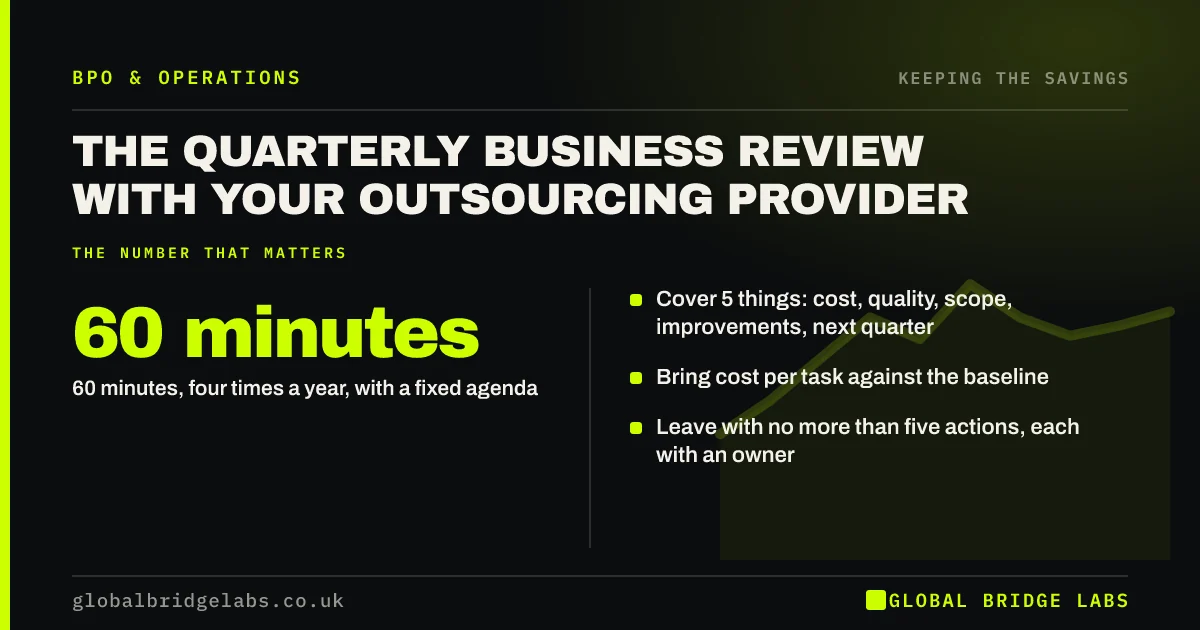
- 60 minutes, four times a year, with a fixed agenda.
- Cover 5 things: cost, quality, scope, improvements, next quarter.
- Bring cost per task against the baseline.
- Leave with no more than five actions, each with an owner.
Want a QBR agenda tailored to your arrangement? Message us on WhatsApp with what you outsource.
Chat on WhatsApp →What is a quarterly business review?
A quarterly business review (QBR) is a structured meeting between a client and a supplier, held every three months, to assess performance against agreed measures and plan the period ahead. It sits above day-to-day management and below contract renewal.
Why does it matter for cost?
It matters because the forces that erode a saving all act slowly. Scope drifts by a task a month. Cost per task creeps with rework. An annual increase arrives. None of these shows up in a weekly call about open tickets. A quarterly look at trends is how they are caught while they are still small.
What should be on the agenda?
Keep the agenda to five items in the same order each time, so both sides arrive prepared.
- 1. Performance: volume, quality and turnaround against target.
- 2. Cost: cost per task against baseline and last quarter.
- 3. Scope: what has been added, changed or dropped.
- 4. Improvements: proposals from the provider and decisions needed.
- 5. Next quarter: expected volumes, changes and actions.
What numbers should you bring?
Bring six numbers on one page, with the baseline and the previous quarter beside each. In an illustrative review: volume 12,400 tasks, cost per task £2.05 against a £3.00 baseline, right first time 96%, average turnaround 1.4 days, hours billed 2,340, and in-house review time 36 hours.
The provider should supply the first four. You add the cost figures. If either side cannot produce its numbers, that is the first action.
- Volume handled.
- Cost per task.
- Right first time rate.
- Turnaround time.
- Hours or units billed.
- Your own review time.
- Cost baseline: measure today's cost before you change it
- Right first time rate: the quality number that cuts cost
- Process cycle time: how to measure and shorten it
Want a one-page QBR pack built for you? Send us your current reports on WhatsApp.
Chat on WhatsApp →Which questions get the most from the meeting?
The most useful questions are the ones that invite the provider to tell you something you do not know. Their team sees your process more closely than you do.
- What are the top three reasons work came back for correction?
- Which tasks take longest, and why?
- What do we ask you to do that seems unnecessary?
- What would you change if this were your business?
- What do you need from us that you are not getting?
What makes a QBR fail?
A QBR fails when it becomes a presentation. Forty slides of green indicators, no discussion and no decisions. It also fails when the client sends someone with no authority, so every proposal is taken away to be considered. Keep it to one page of numbers and send a decision-maker.
What does this look like in practice?
A pattern we see where reviews have lapsed: the arrangement runs for a year on weekly operational calls, and the first strategic conversation happens at renewal, when positions have hardened. Firms that hold a short review every quarter rarely have a difficult renewal, because nothing in it is a surprise.
QBR checklist
Prepare with this list.
- Date fixed a quarter ahead.
- One-page data pack sent three days before.
- A decision-maker attends from each side.
- Scope changes are listed.
- At least two improvement proposals are tabled.
- Five actions or fewer, each with an owner and date.
- Notes circulated within two days.
Next step
Tell us what you outsource and how you review it today. We will send back an agenda and a one-page data pack you can use at your next review.
Message us on WhatsApp for a QBR template, or book a 30-minute consultation.
Chat on WhatsApp →Sources and further reading
- The Sourcing and Consultancy Playbooks · Cabinet Office
- Contracts and liabilities between controllers and processors · Information Commissioner's Office
Frequently asked questions
What is a QBR with a vendor?
A QBR, or quarterly business review, is a meeting held every three months between a client and a supplier to review performance, costs and scope, and to agree priorities for the next quarter. It focuses on trends and decisions instead of day-to-day issues.
What should a QBR agenda include?
Five items work well: performance against targets, cost per task against baseline, changes to scope, improvement proposals, and the plan for the next quarter. Keeping the same order each time helps both sides prepare and compare.
How long should a quarterly business review take?
About 60 minutes is enough for a small or mid-sized arrangement, provided a one-page data pack is circulated beforehand. If it regularly runs longer, operational detail is creeping in that belongs in the weekly call.
Who should attend a QBR?
The person who owns the relationship on the client side, with authority to make decisions, and the provider's account lead and team leader. Finance may join for the cost section. Keep the group small enough to have a conversation.
Written by

Global Bridge Labs (GBL) is a UK–Sri Lanka partner for social media, websites and BPO. Everything here comes from client delivery, not theory.


