
On this page
- 01Key takeaways
- 02What is the operating expense ratio?
- 03How do you calculate it?
- 04What is a good operating expense ratio?
- 05Why does the ratio creep up as a business grows?
- 06How do you bring the ratio down?
- 07What does the ratio not tell you?
- 08What does this look like in practice?
- 09Operating expense ratio checklist
- 10Next step
- 11Sources and further reading
- 12Frequently asked questions
Key takeaways
The operating expense ratio is operating expenses divided by revenue, shown as a percentage. It tells you how much of each pound of sales is spent on running the business. There is no universal good figure. The useful reading is your own trend: a ratio that rises for two years running means costs are outgrowing sales.
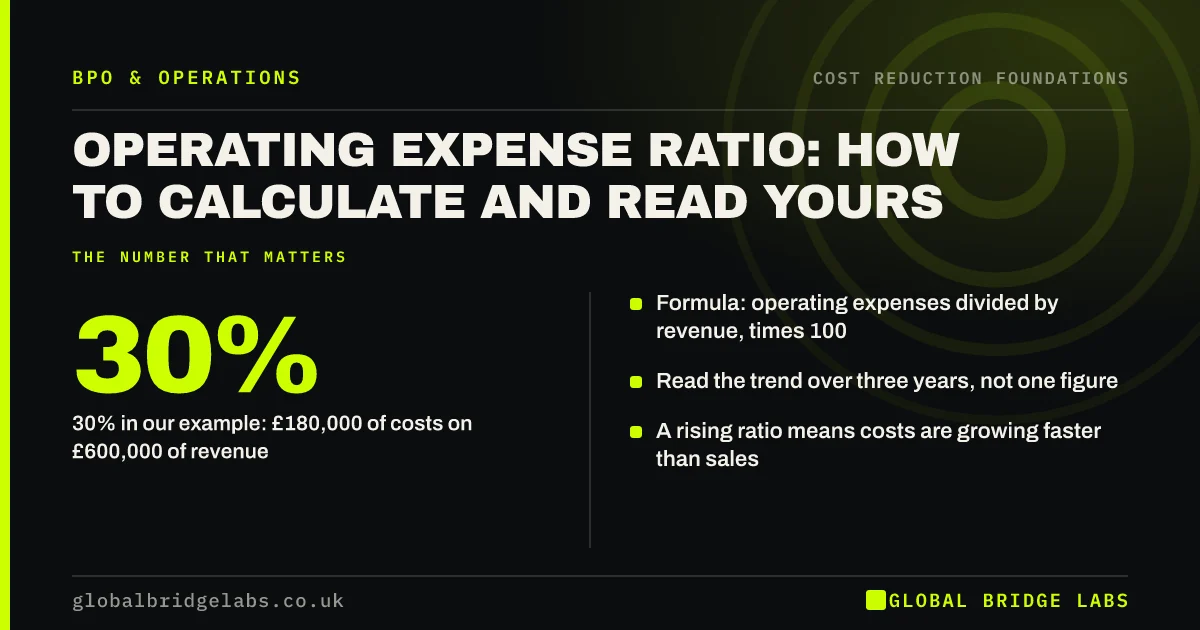
- Formula: operating expenses divided by revenue, times 100.
- 30% in our example: £180,000 of costs on £600,000 of revenue.
- Read the trend over three years, not one figure.
- A rising ratio means costs are growing faster than sales.
Want help reading your ratio? Message us on WhatsApp with three years of revenue and operating costs.
Chat on WhatsApp →What is the operating expense ratio?
The operating expense ratio is a financial measure that compares the cost of running a business with the revenue it earns. It is calculated by dividing operating expenses by revenue. A lower ratio means more of each pound of sales is left for profit, reinvestment and the owner.
How do you calculate it?
Divide total operating expenses for a period by revenue for the same period and multiply by 100. Use the same definition of operating expenses each time. In an illustrative firm with £600,000 of revenue and £180,000 of operating expenses, the ratio is 30%.
If the same firm grows revenue to £690,000 while operating expenses rise to £227,700, the ratio becomes 33%. Sales rose 15% but running costs rose 26.5%, and three more pence of every pound now goes on overhead.
- 1. Total twelve months of operating expenses.
- 2. Total revenue for the same twelve months.
- 3. Divide expenses by revenue and multiply by 100.
- 4. Repeat for the previous two years.
What is a good operating expense ratio?
A good operating expense ratio is one that is stable or falling while service quality holds. Ratios vary too much between sectors to give one target: a consultancy that treats salaries as operating expenses will show a far higher figure than a wholesaler whose main cost is stock. Compare with your own history first and with close competitors second.
Why does the ratio creep up as a business grows?
The ratio creeps up when a business adds cost in steps and revenue in a slope. Each hire, each software seat and each new process is added to cope with growth, and few are removed. Coordination grows too: more people means more meetings, more handovers and more management.
The usual signs are flat revenue per employee and a payroll share that will not come down.
How do you bring the ratio down?
Bring the ratio down by lowering the cost of routine work per task, not by cutting capacity customers rely on. Split the ratio by cost type, find the type growing fastest, and look at the processes behind it. In service firms that is usually people time spent on admin and customer contact.
- Split the ratio into people, premises, technology and other costs.
- Find the group growing faster than revenue.
- List the processes that consume that group's hours.
- Standardise them, then decide what to automate or hand over.
- The cost lever scorecard: find savings process by process
- How to improve operational efficiency in a small business
Want to find the process behind a rising ratio? Send us your cost split on WhatsApp.
Chat on WhatsApp →What does the ratio not tell you?
The ratio does not tell you whether a cost is useful. It will improve if you stop answering the phone, and customers will then leave. It also moves when prices change, so a price rise can hide growing inefficiency. Always read it beside a quality measure and a unit cost such as cost per order.
What does this look like in practice?
A pattern we see in growing UK firms: revenue is up every year and the owner is working harder for the same profit. The ratio, calculated for the first time, has risen several points in three years. The cause is rarely one large cost. It is usually a dozen routine tasks that grew with customer numbers and were never redesigned.
Operating expense ratio checklist
Run these checks once a quarter.
- Calculate the ratio for the last twelve months.
- Compare it with the previous two years.
- Split it by cost type.
- Note any price changes that flatter the figure.
- Read it beside revenue per employee and cost per task.
- Pick one process to improve before the next review.
Next step
Send us revenue and operating expenses for the last three years. We will calculate the ratio with you and point to where the growth in cost is most likely coming from.
Message us on WhatsApp to review your operating expense ratio, or book a 30-minute consultation.
Chat on WhatsApp →Sources and further reading
- Running a limited company: company and accounting records · GOV.UK
- Labour productivity · Office for National Statistics
Frequently asked questions
What is the formula for the operating expense ratio?
The operating expense ratio is operating expenses divided by revenue, multiplied by 100. Operating expenses of £180,000 on revenue of £600,000 give a ratio of 30%. Use the same definition of operating expenses every time, or the trend will not be reliable.
Is a lower operating expense ratio always better?
Not always. A lower ratio means more revenue is left after running costs, but a ratio pushed down by under-staffing or poor service can cost customers later. A falling ratio is good news only when response times, error rates and customer retention are holding steady.
How often should a small business calculate it?
Quarterly on a rolling twelve-month basis is enough for most small businesses. Monthly figures swing with seasonality and one-off bills, which makes them hard to read. A rolling year smooths those out and shows the direction clearly.
Does outsourcing lower the operating expense ratio?
It can, when routine work moves to a managed team at a lower cost per task. Outsourcing replaces part of the wage bill with a service fee, so the saving shows only if the fee plus your review time is lower than the cost it replaced. Measure cost per task before and after.
Written by

Global Bridge Labs (GBL) is a UK–Sri Lanka partner for social media, websites and BPO. Everything here comes from client delivery, not theory.


