
On this page
- 01Key takeaways
- 02What is scope creep in outsourcing?
- 03Why does it happen?
- 04What does it cost?
- 05How do you spot it?
- 06How do you control it without being rigid?
- 07When is extra scope a good thing?
- 08What does this look like in practice?
- 09Scope control checklist
- 10Next step
- 11Sources and further reading
- 12Frequently asked questions
Key takeaways
Scope creep in outsourcing is the gradual addition of tasks beyond what was agreed, without a matching decision about cost. Each request is small and reasonable. Together they raise the bill or dilute the service. In our example, nine extra hours a week costs about £5,600 a year. A written scope and a one-page change process prevent it.
- Scope creep: extra tasks added without a decision on cost.
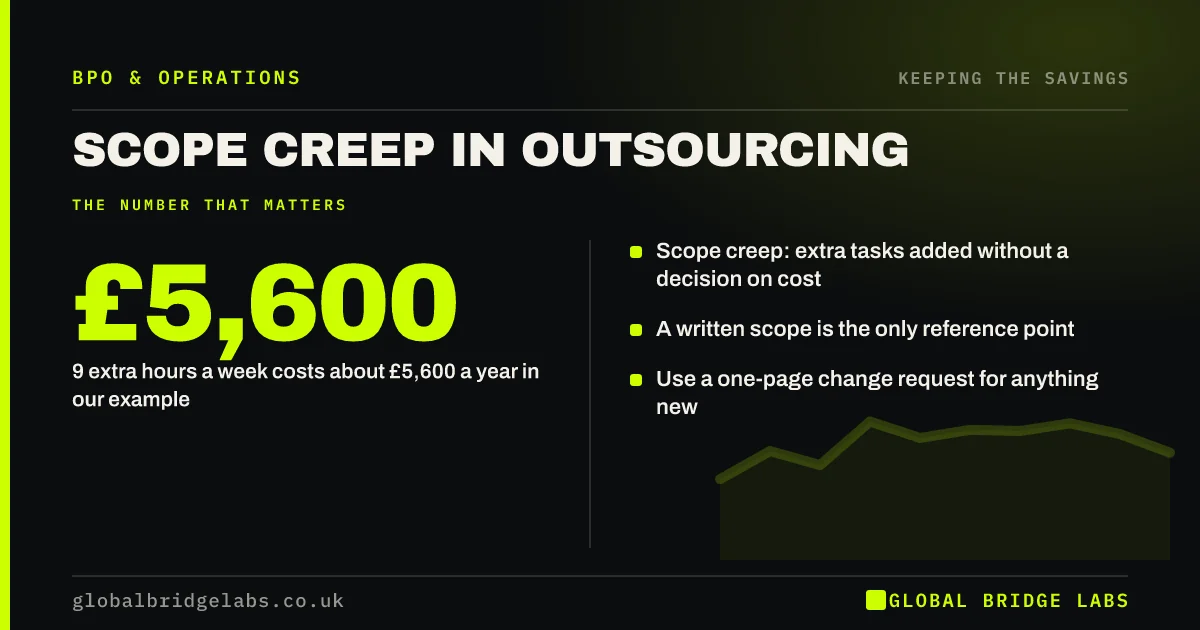
- 9 extra hours a week costs about £5,600 a year in our example.
- A written scope is the only reference point.
- Use a one-page change request for anything new.
Want your current scope checked against what is really being done? Message us on WhatsApp.
Chat on WhatsApp →What is scope creep in outsourcing?
Scope creep is the uncontrolled growth of the work a provider is asked to do after a contract begins. It happens through informal requests: could you also update this sheet, send that report, handle those enquiries. Nothing is renegotiated, so either the invoice rises or the original tasks receive less attention.
Why does it happen?
It happens because a capable team is an easy place to send work, and because nobody wants to appear difficult. Staff on both sides say yes. The scope document, if one exists, is not consulted. Six months later the team is doing a noticeably different job from the one that was priced.
- The original scope was vague.
- Several people on the client side give instructions.
- The provider is reluctant to push back.
- No one tracks what has been added.
What does it cost?
Take an illustrative arrangement for 60 hours a week at an indicative £12 an hour, or £37,440 a year. Over nine months, small additions add 9 hours a week. If they are billed, the cost rises by 15%, about £5,600 a year. If they are absorbed, 15% of the team's time has left the original tasks, and turnaround or accuracy slips instead.
Either way the business case has changed, and nobody decided it should.
- Budget variance analysis: why actual costs miss the plan
- Why outsourcing sometimes fails to save money
Want to know how far your scope has drifted? Send us the original task list on WhatsApp.
Chat on WhatsApp →How do you spot it?
Spot it by comparing three things each quarter: the scope document, the task list the team actually works from, and hours or volume on the invoice. Any task on the second list that is not on the first is creep. Rising hours with flat volume is another sign.
- Tasks performed that are not in the scope.
- Hours rising faster than volume.
- Original service levels slipping.
- Requests arriving from people outside the agreed contacts.
How do you control it without being rigid?
Control it with a simple change process, not a refusal. New work is welcome. It just needs a decision. A one-page request stating the task, expected volume, time per item and effect on cost is enough. One named person on your side approves it.
- 1. Write the scope as a list of tasks with volumes.
- 2. Name one person who can add to it.
- 3. Use a short change request for anything new.
- 4. Agree the cost or the trade-off before work starts.
- 5. Update the scope document each time.
When is extra scope a good thing?
Extra scope is good when it is deliberate. A team that handles one process well is often the cheapest place to put the next one, and adding work is how many firms deepen their saving. The problem is never the growth. It is growth that no one priced or approved.
What does this look like in practice?
A pattern we see at contract renewal: the client feels the service has become more expensive or less sharp, and the provider feels it has been doing extra for free. Both are right. Laying the original scope beside the current task list usually settles the conversation in ten minutes.
Scope control checklist
Review these each quarter.
- The scope lists tasks and volumes.
- One named person approves changes.
- A change request exists and is used.
- The scope document is current.
- Hours and volume are compared on each invoice.
- Service levels on original tasks are holding.
Next step
Send us your original scope and a list of what the team does today. We will mark what has been added and help you decide what to keep, price or stop.
Message us on WhatsApp for a scope review, or book a 30-minute consultation.
Chat on WhatsApp →Sources and further reading
- The Sourcing and Consultancy Playbooks · Cabinet Office
- Contracts and liabilities between controllers and processors · Information Commissioner's Office
Frequently asked questions
What is scope creep?
Scope creep is the gradual expansion of work beyond what was originally agreed, without a formal change to price, time or resources. In outsourcing it usually takes the form of small extra tasks requested informally over months.
How do you prevent scope creep in an outsourcing contract?
Write the scope as a specific list of tasks with expected volumes, name one person who can approve additions, and use a short change request for anything new. Agree the cost or trade-off before the extra work begins and keep the scope document updated.
Who is responsible for scope creep?
Usually both sides. Clients add requests informally and providers accept them without flagging the effect. Clear ownership on the client side and a provider willing to raise changes openly are the best protection. A quarterly comparison of the scope and the task list keeps both honest.
Is scope creep always bad?
No. Adding work to a team that performs well is often sensible and cost-effective. It becomes a problem only when it is unplanned and unpriced, so costs rise or quality on the original tasks falls without anyone having decided that.
Written by

Global Bridge Labs (GBL) is a UK–Sri Lanka partner for social media, websites and BPO. Everything here comes from client delivery, not theory.


