On this page
- 01Key takeaways
- 02What is a weekly operations review?
- 03Why weekly, not monthly?
- 04Which five numbers should you review?
- 05What is a good agenda?
- 06Who should attend?
- 07When does the review stop working?
- 08What does this look like in practice?
- 09Weekly review checklist
- 10Next step
- 11Sources and further reading
- 12Frequently asked questions
Key takeaways
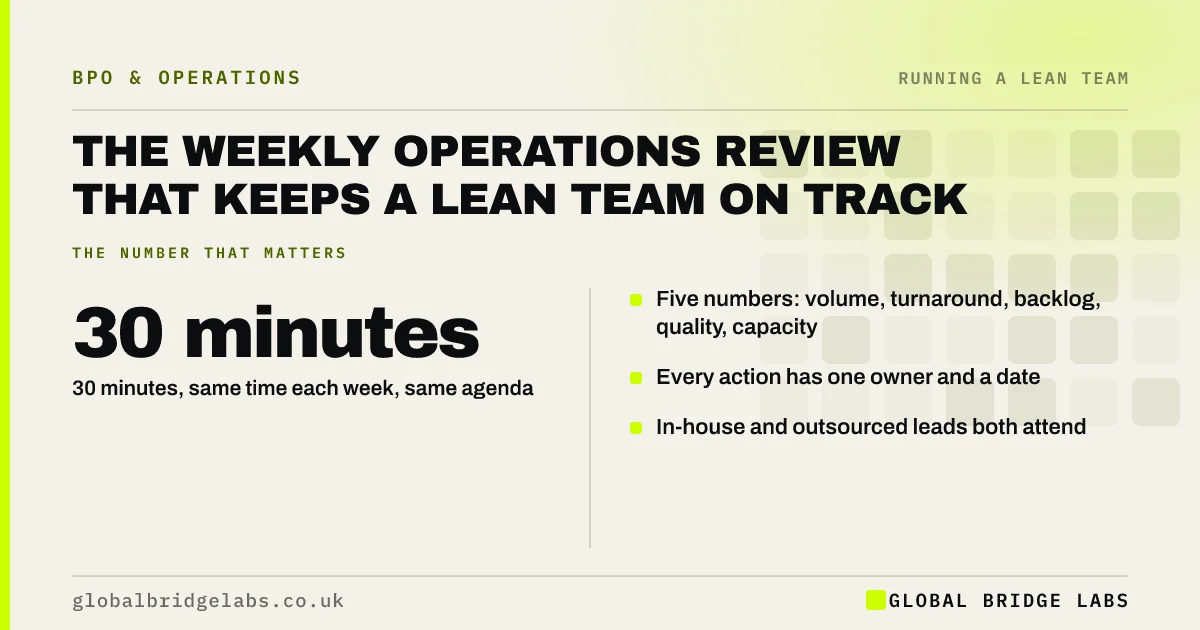
A weekly operations review meeting is a fixed 30 minutes in which the people running day-to-day work look at the same few numbers, agree what is off track and assign actions. For a lean team with outside capacity it is the main control. Five numbers and a fixed agenda are enough.
- 30 minutes, same time each week, same agenda.
- Five numbers: volume, turnaround, backlog, quality, capacity.
- Every action has one owner and a date.
- In-house and outsourced leads both attend.
Want a one-page review template for your team? Message us on WhatsApp.
Chat on WhatsApp →What is a weekly operations review?
A weekly operations review is a short, regular meeting that compares last week's operational results with targets and decides what to change. It is not a status round-table. It looks at numbers first, discusses only the exceptions and ends with a short list of actions.
Why weekly, not monthly?
Weekly because problems in operations compound quickly. A backlog that starts on Monday is a complaint by the following week. Monthly reviews arrive too late to adjust staffing or fix a process. A weekly rhythm catches a drift while it is still small and cheap to correct.
Which five numbers should you review?
Review five numbers for each main process. Keep the definitions fixed so that week-to-week changes mean something.
- Volume: how much work arrived.
- Turnaround: how quickly it was completed.
- Backlog: what is still open and how old.
- Quality: errors or failed checks from the sample.
- Capacity: hours available against hours needed next week.
What is a good agenda?
A good agenda is the same every week. Five minutes on last week's actions. Ten on the numbers, exceptions only. Ten on the one or two issues that need a decision. Five on next week's capacity and any changes the team should know about. Anything longer belongs in a separate session.
- 1. Actions from last week: done or not.
- 2. The numbers: what is off target.
- 3. Issues: decide and assign.
- 4. Next week: volume, capacity, changes.
Want the agenda and scorecard set up with your own numbers? Send us your processes on WhatsApp.
Chat on WhatsApp →Who should attend?
Attendance should be small: the internal process owner, the provider's team leader if work is outsourced, and whoever can make decisions about staffing and priorities. The business owner need not attend every week. A one-page summary keeps them informed.
When does the review stop working?
The review stops working when it turns into a discussion without numbers, when actions have no owner, or when it is cancelled in busy weeks, which are the weeks it matters most. It also fails if the numbers are used to blame people. The purpose is to find and fix causes.
What does this look like in practice?
A pattern we see in UK firms without a review: the first sign of a problem is a customer complaint or a month-end surprise. After a few weeks of a fixed 30-minute review, the same firms spot rising backlogs on a Tuesday and add hours on a Wednesday, and month end becomes uneventful.
Weekly review checklist
Set these up before the first meeting.
- A fixed day and time in the diary.
- A one-page scorecard with five numbers per process.
- Written definitions for each number.
- A standing four-part agenda.
- An action log with owner and date.
- A one-page summary for the business owner.
Next step
Tell us your main processes and what you currently measure. We will suggest five numbers for each and a review format that fits in half an hour.
Message us on WhatsApp for a review template, or book a 30-minute consultation.
Chat on WhatsApp →Sources and further reading
- Labour productivity · Office for National Statistics
- UK Customer Satisfaction Index · Institute of Customer Service
Frequently asked questions
What should a weekly operations meeting cover?
A weekly operations meeting should cover last week's actions, the key numbers for each main process, the one or two issues needing a decision, and next week's expected volume and capacity. It should end with a short list of actions, each with an owner and a date.
How long should a weekly operations review take?
Thirty minutes is enough for a small business if the numbers are circulated beforehand and discussion is limited to exceptions. If the meeting regularly runs longer, the agenda is too broad or problems are being solved in the meeting instead of assigned.
What KPIs should a small business review weekly?
For each main process, review volume received, turnaround time, backlog size and age, quality from a sample check, and capacity for the week ahead. These five show whether work is flowing, whether customers are waiting and whether more hours are needed.
Who should run the weekly operations review?
The internal process owner should run it, usually an operations or office manager. They prepare the scorecard, keep the meeting to time and maintain the action log. If work is outsourced, the provider's team leader presents their numbers in the same meeting.
Written by

Global Bridge Labs (GBL) is a UK–Sri Lanka partner for social media, websites and BPO. Everything here comes from client delivery, not theory.