On this page
- 01Key takeaways
- 02What is continuous improvement in outsourcing?
- 03Why do savings stall after year one?
- 04What should improvement look like in numbers?
- 05Where do later savings come from?
- 06How do you build it into the contract?
- 07What is your part in it?
- 08What does this look like in practice?
- 09Continuous improvement checklist
- 10Next step
- 11Sources and further reading
- 12Frequently asked questions
Key takeaways
Continuous improvement in outsourcing is the practice of steadily lowering cost and raising quality after the initial handover. Year one savings come mostly from the rate. Savings after that have to come from the process: fewer steps, less rework, more automation. They do not happen unless the contract asks for them and someone reviews them every quarter.
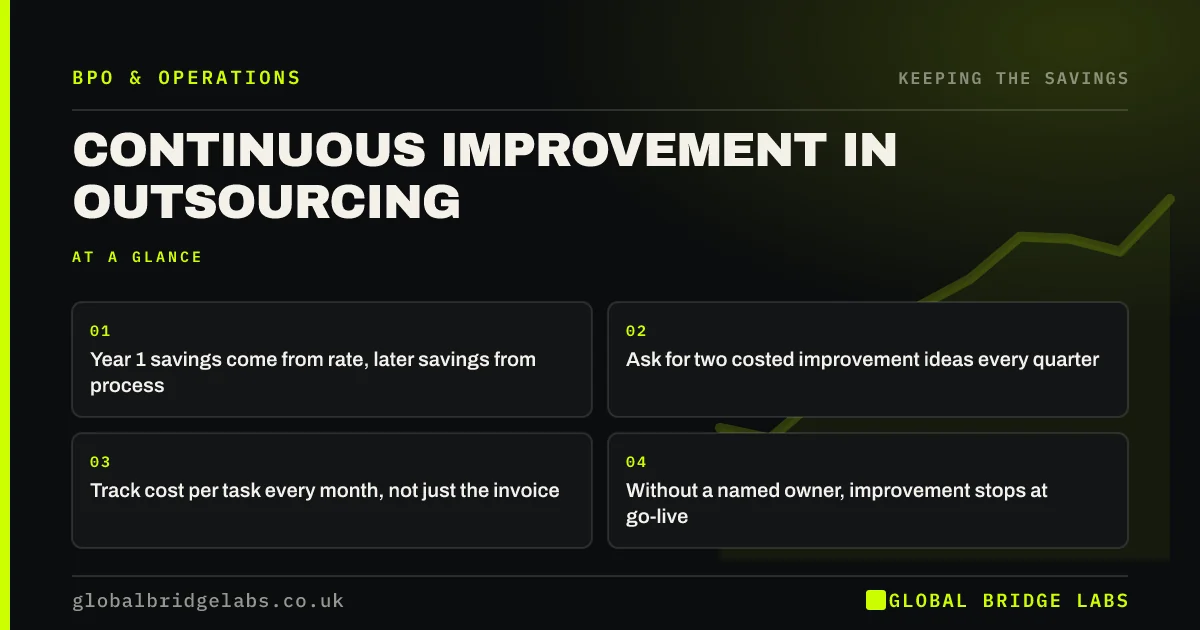
- Year 1 savings come from rate, later savings from process.
- Ask for two costed improvement ideas every quarter.
- Track cost per task every month, not just the invoice.
- Without a named owner, improvement stops at go-live.
Want an improvement plan for an existing outsourced process? Message us on WhatsApp with how long it has been running.
Chat on WhatsApp →What is continuous improvement in outsourcing?
Continuous improvement is a method of making small, regular changes to a process so that it gets better over time. In outsourcing it means the provider and client keep working on cost, quality and speed after the service is stable, instead of running it unchanged for the life of the contract.
Why do savings stall after year one?
Savings stall because the easy gain has been taken and nobody is responsible for the next one. The provider is delivering what was specified. The client has moved on to other things. Meanwhile annual price increases and small additions to scope start to erode the original saving.
- The rate saving is taken once and does not repeat.
- The provider is paid for stability, not change.
- Nobody in-house owns the process any more.
- Indexation and scope creep push cost back up.
What should improvement look like in numbers?
Take an illustrative process that cost £3.00 per task in-house and £2.00 after handover. If nothing more is done and the price rises 4% a year, cost per task is about £2.16 by year three. If the team instead removes steps and errors worth 5% a year, cost per task falls to about £1.95 over the same period even with the price rise.
The gap between those two paths, 21p per task, is the value of continuous improvement. On 50,000 tasks a year it is £10,500.
- Run-rate savings vs one-off savings: count them correctly
- Work out your cost per task before you outsource
Want your year-three cost projected both ways? Send us your current cost per task on WhatsApp.
Chat on WhatsApp →Where do later savings come from?
Later savings come from the work itself. A team that has run a process for a year knows where time is lost.
- Removing steps that add nothing.
- Fixing the causes of the commonest errors.
- Reducing avoidable customer contact.
- Automating stable, rule-based steps.
- Simplifying exceptions into rules.
How do you build it into the contract?
Build it in with a light obligation and a regular forum. Heavy productivity clauses are hard to enforce in a small contract. A short, specific commitment is easier to hold to.
- 1. Require two costed improvement proposals per quarter.
- 2. Review them at a quarterly business review.
- 3. Agree how any saving is shared.
- 4. Report cost per task and error reasons monthly.
- 5. Name an owner on each side.
What is your part in it?
Your part is to respond. Many improvements need a decision only the client can make: dropping a report, changing an approval rule, fixing a form on the website. Providers stop proposing when proposals go unanswered. Give each idea a yes, a no or a date within two weeks.
What does this look like in practice?
A pattern we see in the second year of an arrangement: the service is steady, the monthly call has become a formality and cost per task has not moved since month four. Asking one question at each review, what would you change if this were your business, usually restarts the flow of ideas.
Continuous improvement checklist
Check these once the service is stable.
- Cost per task is tracked monthly.
- Error reasons are logged and ranked.
- The provider proposes improvements quarterly.
- Each proposal gets a decision within two weeks.
- Savings are measured against the baseline.
- An owner is named on each side.
Next step
Tell us how long your current arrangement has run and whether cost per task has changed since the start. We will suggest where the next saving is likely to be.
Message us on WhatsApp to restart improvement on an outsourced process, or book a 30-minute consultation.
Chat on WhatsApp →Sources and further reading
- The Sourcing and Consultancy Playbooks · Cabinet Office
- Labour productivity · Office for National Statistics
Frequently asked questions
What is continuous improvement in BPO?
It is the ongoing effort by a provider and client to make an outsourced process cheaper, faster and more accurate after the initial transition. It relies on measuring performance, finding the causes of waste and errors, and making small changes regularly.
Why do outsourcing savings reduce over time?
The first saving, usually from a lower rate, is taken once. After that, annual price increases and extra tasks added informally push costs up. Unless the process itself keeps improving, the net saving shrinks each year.
Should a contract include productivity targets?
A light commitment is practical for small contracts, such as two costed improvement proposals per quarter. Hard annual productivity percentages are common in large contracts but can be difficult to measure and enforce at small scale.
Who is responsible for improvement, the client or the provider?
Both. The provider sees where time is lost and should propose changes. The client controls many of the causes, such as approval rules and input quality, and has to make decisions quickly. Improvement stalls if either side stops.
Written by

Global Bridge Labs (GBL) is a UK–Sri Lanka partner for social media, websites and BPO. Everything here comes from client delivery, not theory.