
On this page
- 01Key takeaways
- 02What is a cost reduction target?
- 03Why do flat percentage targets fail?
- 04How do you build a target from the bottom up?
- 05What does a worked target look like?
- 06How ambitious should a target be?
- 07What should you track alongside?
- 08What does this look like in practice?
- 09Cost reduction target checklist
- 10Next step
- 11Sources and further reading
- 12Frequently asked questions
Key takeaways
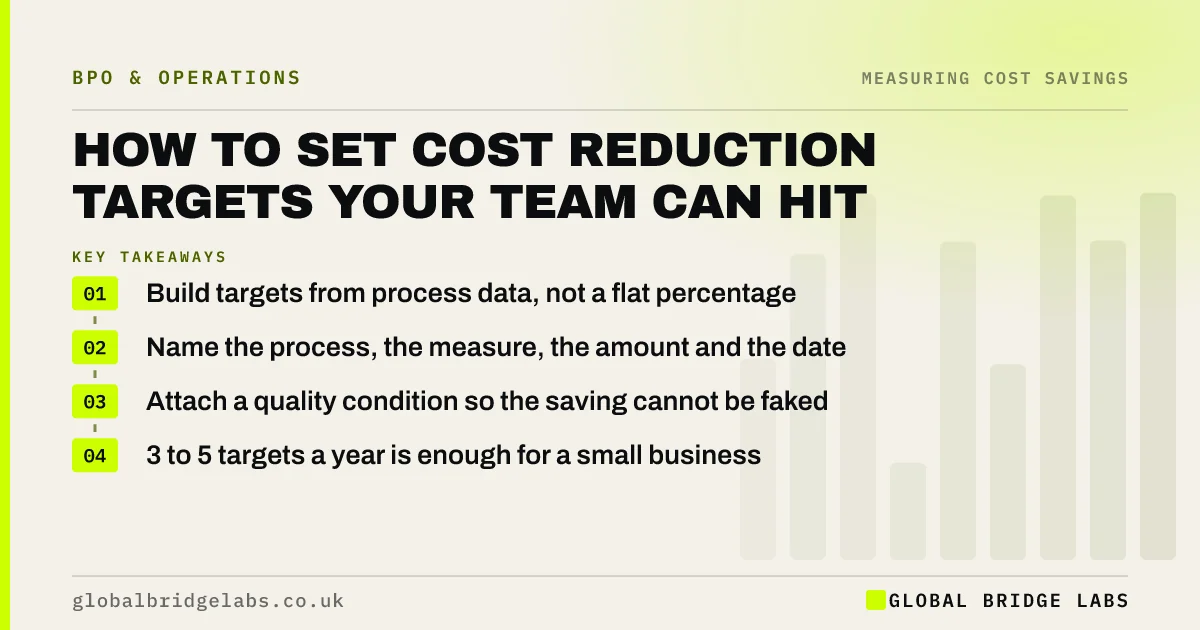
Good cost reduction targets are built from the bottom up: process by process, from measured hours and volumes, with a quality condition attached. Top-down targets such as 10% off every budget are quick to announce and usually miss, because they ignore where the waste is. A target should name the process, the measure, the amount and the date.
- Build targets from process data, not a flat percentage.
- Name the process, the measure, the amount and the date.
- Attach a quality condition so the saving cannot be faked.
- 3 to 5 targets a year is enough for a small business.
Want help turning a savings goal into process targets? Message us on WhatsApp with the figure you have in mind.
Chat on WhatsApp →What is a cost reduction target?
A cost reduction target is a specific, measurable commitment to lower a defined cost by a stated amount within a stated time. It differs from a budget cut in that it says how the saving will be made, and it differs from a hope in that someone is accountable for it.
Why do flat percentage targets fail?
Flat percentage targets fail because waste is not spread evenly. A lean team asked for 10% has to cut capacity. A wasteful one finds 10% without effort and keeps the rest. The target punishes efficiency and rewards padding, and managers learn to hold something back for next year's round.
How do you build a target from the bottom up?
Build it from a baseline. For each candidate process, take today's cost per task and identify what would lower it: fewer steps, less rework, a different rate. Estimate each effect conservatively, add them, and that is the target. The total across processes becomes the company figure.
- 1. Baseline the cost per task.
- 2. List the specific changes planned.
- 3. Estimate the effect of each, cautiously.
- 4. Subtract the cost of making the change.
- 5. Set the date and name the owner.
What does a worked target look like?
Take an illustrative invoicing process costing £3.46 per invoice at 4,700 invoices a year, or about £16,260. Planned changes are a standard template, removing the owner's weekly check for invoices under £500, and moving preparation to a managed team. The estimated new cost is £2.00 per invoice.
The target reads: reduce invoicing cost from £3.46 to £2.00 per invoice by 31 March, saving about £6,860 a year, with the error rate at or below 5% and invoices sent within two days of job completion. One sentence, four numbers, two conditions.
- Work out your cost per task before you outsource
- Run-rate savings vs one-off savings: count them correctly
Want a target written this way for one of your processes? Send us the baseline on WhatsApp.
Chat on WhatsApp →How ambitious should a target be?
A target should be ambitious enough to require a change in how the work is done, and modest enough that the estimate behind it is believable. The UK government's Green Book notes a systematic tendency to overstate benefits, which it calls optimism bias. Trim your first estimate, and expect the first quarter to be spent on setup.
What should you track alongside?
Track quality and speed alongside every cost target. A cost per task that falls while errors rise has not been reduced. It has been moved to customers and to the people who fix mistakes. Report the three together monthly.
- Cost per task against target.
- Error or rework rate.
- Turnaround time.
- Volume, so falls in cost are not just falls in work.
What does this look like in practice?
A pattern we see after a board asks for savings: the instruction reaches each team as a percentage, and each team responds by delaying purchases and leaving a vacancy open. The number is hit for one year and the costs return the next. Targets attached to named process changes do not bounce back in the same way.
Cost reduction target checklist
Test every target against these.
- It names one process or cost.
- It starts from a measured baseline.
- It lists the changes that will deliver it.
- It has an amount and a date.
- It has one accountable owner.
- It carries a quality and a speed condition.
- It is reviewed monthly.
Next step
Tell us the saving you need and which processes you think it might come from. We will help you turn it into a small set of targets with numbers you can stand behind.
Message us on WhatsApp to set your cost reduction targets, or book a 30-minute consultation.
Chat on WhatsApp →Sources and further reading
- The Green Book: appraisal and evaluation in central government · HM Treasury
- Labour productivity · Office for National Statistics
Frequently asked questions
What is a realistic cost reduction target?
It depends on how much waste exists in the specific process. A realistic target is one calculated from a baseline and a list of planned changes, not a round percentage. Processes with heavy rework or senior staff doing routine tasks can support larger targets than ones already running lean.
How do you set cost saving goals?
Measure what the process costs per task now, list the changes you will make, estimate each effect cautiously, subtract the cost of changing, and set a date and an owner. Add conditions for quality and speed so the saving is real.
Should cost targets be the same for every department?
No. Equal percentage targets penalise efficient teams and let wasteful ones off lightly. Set each target according to the opportunity in that area, based on measured data. Some teams may have no target at all in a given year.
How often should cost targets be reviewed?
Monthly for progress and quarterly for whether the target itself is still right. Volumes change, and a target set on last year's workload may need adjusting. Reviewing regularly also catches savings that are slipping before the year ends.
Written by

Global Bridge Labs (GBL) is a UK–Sri Lanka partner for social media, websites and BPO. Everything here comes from client delivery, not theory.


