
On this page
- 01Key takeaways
- 02Why does the decision need making at all?
- 03What are the five uses?
- 04How do you decide?
- 05What does a worked split look like?
- 06What about the hours, not the money?
- 07When should savings go to customers?
- 08What does this look like in practice?
- 09Reinvestment checklist
- 10Next step
- 11Sources and further reading
- 12Frequently asked questions
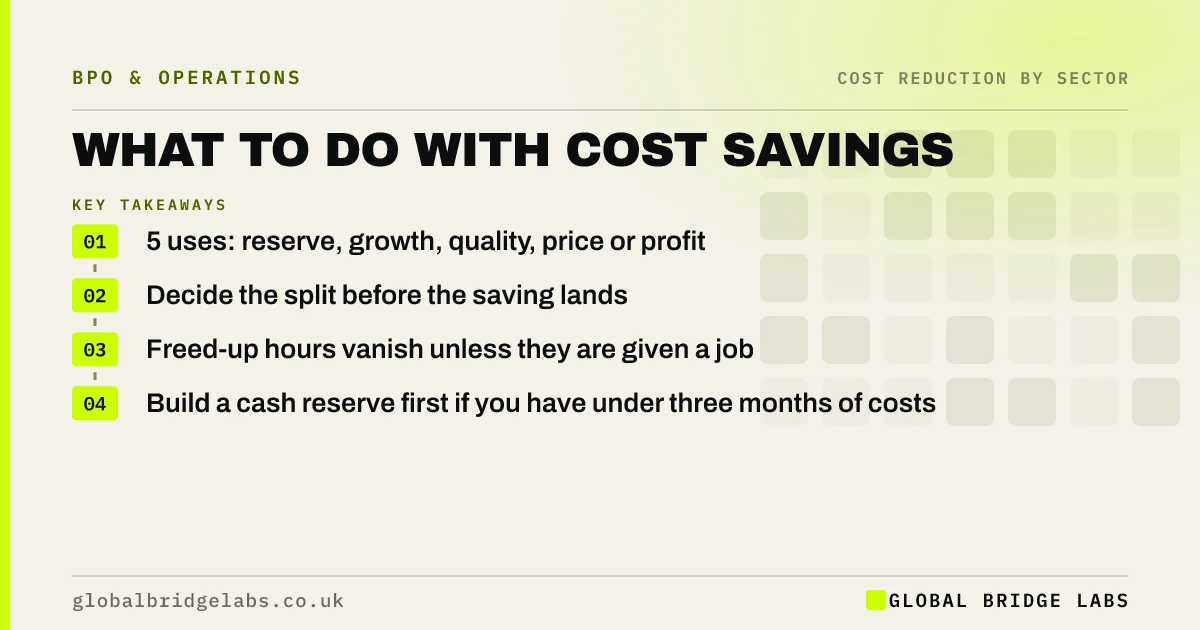
Key takeaways
Deciding what to do with cost savings is as important as finding them. A saving has five possible uses: build a cash reserve, reinvest in growth, improve the product or service, lower prices, or take it as profit. Decide before the saving arrives. Unallocated savings, and especially freed-up hours, are absorbed by the business within months.
- 5 uses: reserve, growth, quality, price or profit.
- Decide the split before the saving lands.
- Freed-up hours vanish unless they are given a job.
- Build a cash reserve first if you have under three months of costs.
Found savings and not sure where to put them? Message us on WhatsApp with the amount and your priorities.
Chat on WhatsApp →Why does the decision need making at all?
The decision needs making because savings with no destination leak. Money left in the current account funds small upgrades nobody planned. Hours released from admin fill with email and meetings. Six months on, the cost base is lower and nothing else has changed. A saving is only worth what it is turned into.
What are the five uses?
Each use suits a different position. Most businesses split a saving across two or three.
- Reserve: build cash to cover slow months and shocks.
- Growth: fund sales, marketing or a new service.
- Quality: improve response times, product or training.
- Price: pass some on to win or keep customers.
- Profit: pay down debt or pay the owners.
How do you decide?
Decide by asking what limits the business today. If one bad month would cause real trouble, the answer is reserve. If demand exists and capacity or visibility is the limit, it is growth. If customers are leaving over service, it is quality. If price is losing you work, it is price.
- 1. How many months of costs do we hold in cash?
- 2. What is stopping us growing right now?
- 3. Why do customers leave or not buy?
- 4. What return would each use give in a year?
What does a worked split look like?
Take an illustrative firm that has cut operating costs by £30,000 a year and holds one month of costs in cash. It puts £12,000 into reserve for the first year, £12,000 into marketing that has a measured return, and £6,000 into staff training. From year two, the reserve portion moves to growth.
It has also released 20 hours a week of the owner's time. Those hours are assigned in the diary: 12 to sales calls and 8 to supervising delivery. Without that step, they would have gone.
- Reserve: £12,000 in year one.
- Marketing with a measured return: £12,000.
- Training: £6,000.
- Owner hours: 12 to sales, 8 to delivery.
- How outsourcing helps small businesses scale without hiring
- The hidden costs of doing everything in-house
Want help planning where your savings and hours should go? Send us the numbers on WhatsApp.
Chat on WhatsApp →What about the hours, not the money?
Hours are the harder half. Across our client work, owners have got 31 hours a week back, and what happens next depends on whether those hours were given a purpose. Write down what each released person will now do, put it in their diary, and review it after a month.
For staff, this is also the honest answer to what outsourcing means for them: here is the more valuable work you will be doing instead.
When should savings go to customers?
Savings should go to customers when price is the reason you are losing work, or when a competitor is about to make the same efficiency gain. Otherwise, improving service usually does more for retention than a small price cut, and is harder for rivals to copy.
What does this look like in practice?
A pattern we see a year after a successful cost project: the owner agrees the saving was real and cannot point to what it bought. The business is a little more comfortable and otherwise the same. Firms that named the destination in advance can show a reserve, a campaign or a new hire that the saving paid for.
Reinvestment checklist
Complete this when a saving is confirmed.
- The saving is stated as a recurring annual figure.
- Cash reserve is measured in months of costs.
- The main limit on the business is named.
- The saving is split across named uses.
- Released hours are assigned in diaries.
- The result is reviewed after 90 days.
Next step
Tell us what you have saved or expect to save, in money and in hours, and what is holding the business back. We will help you decide where each should go.
Message us on WhatsApp to plan your reinvestment, or book a 30-minute consultation.
Chat on WhatsApp →Sources and further reading
- Labour productivity · Office for National Statistics
- The Green Book: appraisal and evaluation in central government · HM Treasury
Frequently asked questions
What should a business do with cost savings?
Choose between building a cash reserve, reinvesting in growth, improving quality, lowering prices or taking profit, according to what limits the business most. Decide before the saving arrives, and split it across named uses so it does not drift into general spending.
Should I reinvest savings or keep them as cash?
If you hold less than about three months of operating costs in cash, build the reserve first. Beyond that, reinvest where you can measure a return, such as marketing with a known cost per lead or capacity for work you are currently turning away.
How do you make sure freed-up time is used well?
Assign it before it is released. Write down what each person will do with the hours, put it in their diary and review after a month. Time with no assigned purpose is quickly absorbed by email, meetings and low-value tasks.
Should cost savings be passed on to customers?
Only when price is costing you work or competitors are about to cut theirs. In most cases, investing the saving in faster or better service does more for customer retention and is harder for a competitor to match than a small price reduction.
Written by

Global Bridge Labs (GBL) is a UK–Sri Lanka partner for social media, websites and BPO. Everything here comes from client delivery, not theory.


