On this page
- 01Key takeaways
- 02What is a false economy?
- 03What are the common examples?
- 04How do you test for one?
- 05What does the test show in numbers?
- 06When is the cheap option the right one?
- 07How does this apply to outsourcing?
- 08What does this look like in practice?
- 09False economy checklist
- 10Next step
- 11Sources and further reading
- 12Frequently asked questions
Key takeaways
A false economy in business is a saving that leads to a larger cost later. The cheapest quote, the delayed repair and the task kept in-house to avoid a fee are the usual forms. The test is whole-life cost: the price, plus the time it takes you, plus what it costs when it goes wrong. Compare that, not the invoice.
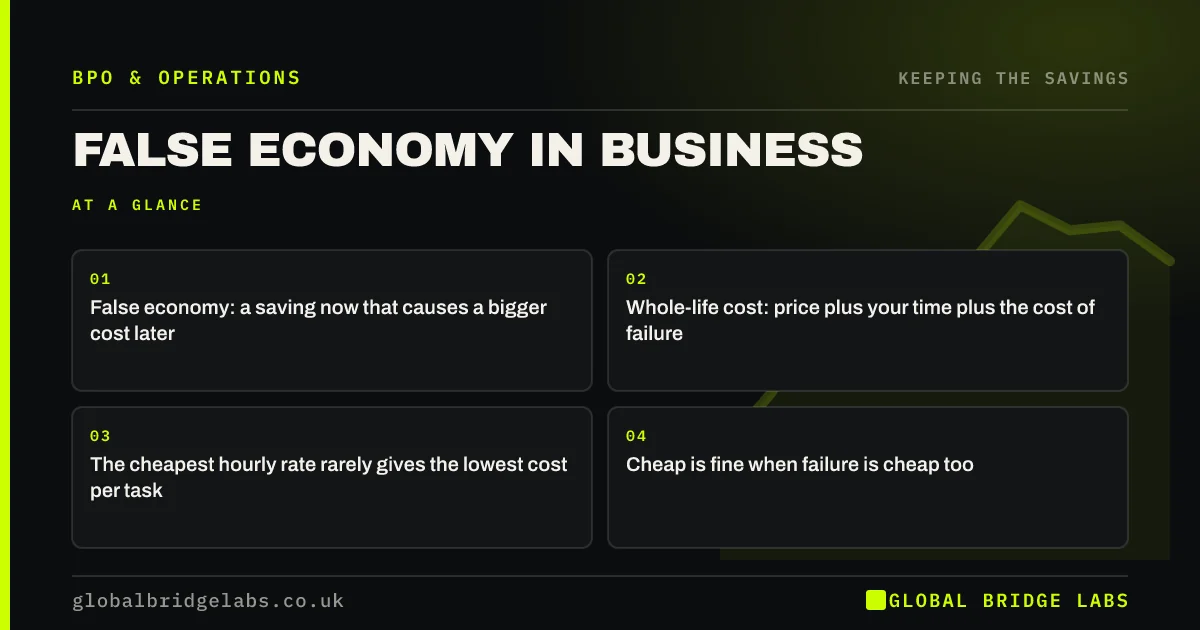
- False economy: a saving now that causes a bigger cost later.
- Whole-life cost: price plus your time plus the cost of failure.
- The cheapest hourly rate rarely gives the lowest cost per task.
- Cheap is fine when failure is cheap too.
Weighing a cheaper option and unsure? Message us on WhatsApp with the two choices.
Chat on WhatsApp →What is a false economy?
A false economy is an action that saves money in the short term and costs more in the long term. The initial saving is visible and immediate. The later cost is spread out, delayed or falls on someone else's budget, which is why it is so often missed.
What are the common examples?
The common examples in small businesses involve underpaying for something that then needs doing twice, or doing something yourself that someone else would do faster and better.
- Choosing the lowest quote without checking what it includes.
- Having senior staff do admin to avoid a support cost.
- Skipping documentation or training to save time.
- Delaying maintenance or software updates.
- Buying a cheaper tool that needs manual workarounds.
- Under-staffing customer service.
How do you test for one?
Test with whole-life cost. Add the purchase price, the time you and your team will spend making it work, and the expected cost of failure, which is the chance of something going wrong multiplied by what it would cost. The option with the lowest total is the economical one.
The UK government's Green Book applies the same principle to public spending, asking appraisers to consider costs and benefits over the whole life of an option, not just the initial outlay.
- 1. Price: what you pay.
- 2. Effort: your hours to manage, check and correct.
- 3. Failure: likelihood times consequence.
- 4. Add the three for each option and compare.
What does the test show in numbers?
Take two illustrative quotes for 40 hours a week of admin. Provider A charges £9 an hour and Provider B £13. On price, A is £18,720 a year and B is £27,040. But A's work needs 6 hours a week of checking and correction by a £23.20-an-hour employee, and B's needs 1.5.
Checking adds about £7,240 a year to A and £1,810 to B. A now costs £25,960 and B £28,850. If A's higher error rate also loses one £3,000 customer a year, A is the more expensive option.
- Provider A: £18,720 plus £7,240 checking, £25,960.
- Provider B: £27,040 plus £1,810 checking, £28,850.
- One lost £3,000 customer makes A the dearer choice.
Want two quotes compared on whole-life cost? Send them on WhatsApp and we will discuss your requirements.
Chat on WhatsApp →When is the cheap option the right one?
The cheap option is right when failure is cheap and easily reversed: a low-risk internal task, a short trial, something you can redo in minutes. It is also right when the dearer option offers quality you do not need. Not every job warrants the premium version. Match the spend to the consequence of getting it wrong.
How does this apply to outsourcing?
In outsourcing, the false economy is the lowest hourly rate. A rate that looks 30% cheaper can hide weaker supervision, higher staff turnover and no cover. Ask what the rate includes, how quality is checked and how staff are paid relative to their local market. Then compare cost per completed task.
What does this look like in practice?
A pattern we see repeatedly: a firm chooses a provider on rate, spends a year correcting the output, concludes that outsourcing does not work and brings everything back in-house. The decision that failed was the buying decision. Outsourcing was never given a fair test.
False economy checklist
Ask these before choosing the cheaper option.
- What does the price exclude?
- How many of my hours will this take?
- What happens if it goes wrong?
- How likely is that, honestly?
- Who pays when it does?
- Is the dearer option's quality something I need?
Next step
Send us the options you are comparing, with prices and what each includes. We will run the whole-life cost with you and say which is the real economy.
Message us on WhatsApp to compare options on whole-life cost, or book a 30-minute consultation.
Chat on WhatsApp →Sources and further reading
- The Green Book: appraisal and evaluation in central government · HM Treasury
- UK Customer Satisfaction Index · Institute of Customer Service
Frequently asked questions
What does false economy mean?
A false economy is a saving that turns out to cost more than it saved. Money is spared at the start, and greater costs follow through poor quality, extra work, failure or replacement. The phrase warns against judging a choice on its initial price alone.
What is an example of a false economy in business?
Choosing the cheapest supplier and then spending hours each week correcting their work is a common example. Another is having a senior employee do routine admin to avoid paying for support, when their time is worth far more elsewhere.
How do you avoid a false economy?
Compare whole-life cost instead of price. Add the purchase price, the time you will spend managing and correcting, and the likely cost of things going wrong. Choose the option with the lowest total for the quality you need.
Is the cheapest outsourcing provider always a false economy?
Not always, but often. A low rate can be fair if the work is simple and quality is checked. It becomes a false economy when supervision is thin, errors are frequent and your own staff spend time fixing output. Compare cost per completed task.
Written by

Global Bridge Labs (GBL) is a UK–Sri Lanka partner for social media, websites and BPO. Everything here comes from client delivery, not theory.