On this page
- 01Key takeaways
- 02Why does a slow response to enquiries lose business?
- 03How do you measure your response time?
- 04What does a slow response cost?
- 05Why do replies slow down as a business grows?
- 06When is outsourcing the right fix for slow replies?
- 07Which fixes should you try before outsourcing?
- 08What should an outsourced team not do with enquiries?
- 09What should the first reply to an enquiry include?
- 10What does this look like in practice?
- 11Response time checklist
- 12Next step
- 13Sources and further reading
- 14Frequently asked questions
Key takeaways
A slow response to enquiries costs sales because buyers often contact several businesses and book with the first credible reply. If enquiries regularly wait more than a working day, the cause is usually capacity, not effort. Measure your reply time by channel, set a target of under an hour in business hours, and outsource first replies if the team cannot meet it.
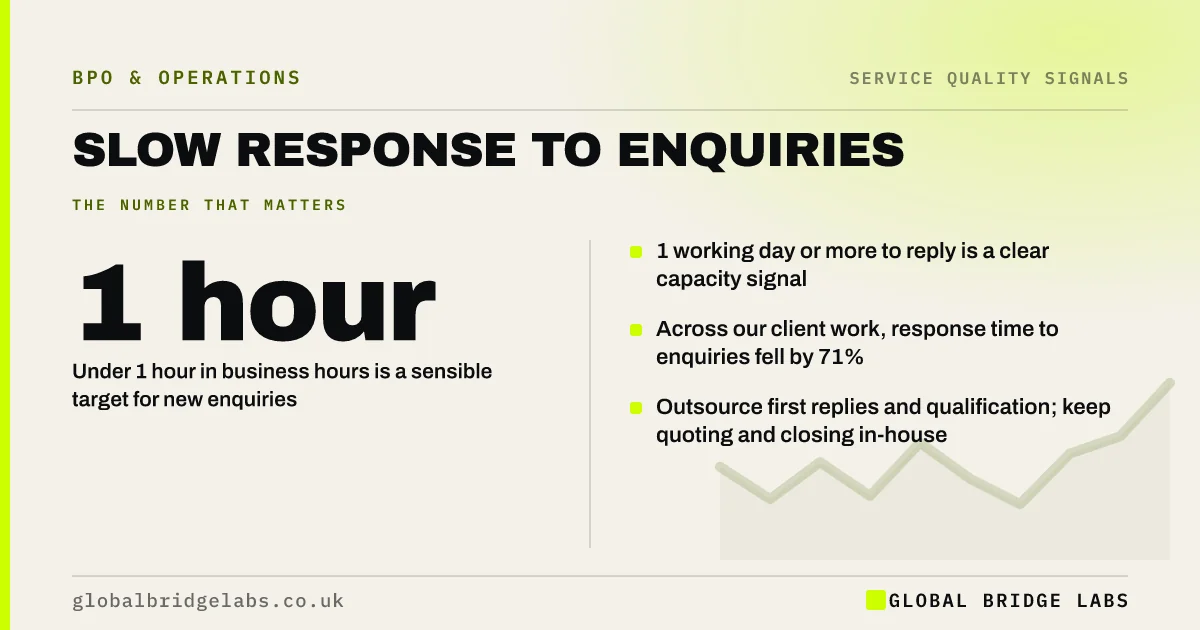
- 1 working day or more to reply is a clear capacity signal.
- Under 1 hour in business hours is a sensible target for new enquiries.
- Across our client work, response time to enquiries fell by 71%.
- Outsource first replies and qualification; keep quoting and closing in-house.
Enquiries waiting too long? Message us on WhatsApp with your average reply time.
Chat on WhatsApp →Why does a slow response to enquiries lose business?
Because buyers rarely wait. Someone who needs a plumber, a solicitor or a delivery quote usually contacts two or three businesses at once and moves ahead with whoever replies first with something useful. A slow response to enquiries hands those buyers to competitors before your team has even seen the message.
Customers notice speed. The Institute of Customer Service's UK Customer Satisfaction Index was 78.3 out of 100 in July 2026, and prompt, first-time resolution is consistently what separates the highest-scoring organisations.
How do you measure your response time?
Take the last 50 enquiries from each channel, note when each arrived and when the first useful reply went out, and calculate the median and the slowest 10%. Separate business hours from evenings and weekends. An auto-reply does not count; the clock stops when a person answers the question or books the next step.
- Median time to first useful reply, by channel.
- Share of enquiries answered within one hour.
- Slowest 10% of replies.
- Out-of-hours enquiries and their reply times.
What does a slow response cost?
Estimate it from lost enquiries. If a business receives 60 enquiries a month, loses 8 to slow replies, converts 30% and averages £1,500 per job, the monthly cost is about £3,600. That figure is usually larger than the cost of an outsourced seat handling first replies.
Want to put a number on your slow replies? Send us your enquiry figures on WhatsApp.
Chat on WhatsApp →Why do replies slow down as a business grows?
Because enquiries are handled by people with other jobs. The owner, a salesperson or an office manager answers between other work, so replies wait for a gap. As volume grows, gaps shrink and replies slip. Adding channels such as WhatsApp and live chat spreads the same people thinner.
When is outsourcing the right fix for slow replies?
Outsource when enquiries arrive through the day, the first reply follows clear rules, and the team cannot meet a one-hour target without dropping other work. An outsourced team can answer common questions, qualify the enquiry and book a call or visit, leaving your team to quote and close.
Which fixes should you try before outsourcing?
Try the quick fixes first. Templates for common questions, a shared inbox with clear ownership, online booking and notifications to one person's phone can cut reply times without extra staff. If replies are still slow after a month, the gap is capacity and outsourcing is worth testing.
- Saved replies for the ten most common questions.
- A shared inbox with one named owner each day.
- Online booking for visits and calls.
- Instant notifications for new web and WhatsApp enquiries.
What should an outsourced team not do with enquiries?
An outsourced team should not quote complex jobs, negotiate prices or promise outcomes it cannot control. Give it a clear list of what it can answer, what it must ask, and when to hand over. That keeps replies fast without the business losing control of pricing and commitments.
What should the first reply to an enquiry include?
A useful first reply answers the question asked, asks the two or three things you need to quote, and offers a clear next step, such as a call or visit slot. A reply that only says someone will be in touch does not stop the buyer contacting a competitor. Speed matters, but so does moving the enquiry forward.
- A direct answer to the question asked.
- Two or three qualifying questions.
- A specific next step with a time or a booking link.
- A named person and a way to reach them.
What does this look like in practice?
A pattern we see in UK trades and home improvement firms: enquiries wait until the evening because the team is on site all day. Outsourcing first replies and survey booking to a managed team brings replies inside the hour. Across our client work, response time to enquiries has fallen by 71% once the process was written down and handed to a managed team.
Response time checklist
Use this to fix slow replies.
- Measure the last 50 enquiries per channel.
- Set a target, such as under one hour in business hours.
- Add templates, a shared inbox and online booking.
- Re-measure after one month.
- Outsource first replies if the target is still missed.
- Keep quoting and closing in-house.
Next step
Send us your average reply time and enquiry volume. We will tell you what it is costing and whether outsourcing first replies would fix it.
Message us on WhatsApp about your response times, or book a 30-minute consultation.
Chat on WhatsApp →Sources and further reading
- UK Customer Satisfaction Index · Institute of Customer Service
- How to use click to chat · WhatsApp Help Center
- National Minimum Wage and National Living Wage rates · GOV.UK
Frequently asked questions
How quickly should a business respond to an enquiry?
Aim for under one hour in business hours for new enquiries, and a same-day reply at most. Buyers often contact several businesses and book with the first useful reply. Out-of-hours enquiries should get a clear auto-reply and a reply first thing next working morning.
Why is my business slow to respond to enquiries?
Usually because enquiries are handled by people with other jobs, so replies wait for a gap in their day. As volume and channels grow, the gaps shrink. Templates and booking tools help; if replies are still slow, the problem is capacity.
Can I outsource enquiry handling?
Yes. An outsourced team can answer common questions, qualify enquiries and book calls or visits into your diary from a written guide. Your team keeps quoting, pricing and closing. It works best when the first-reply rules are clear.
Written by

Global Bridge Labs (GBL) is a UK–Sri Lanka partner for social media, websites and BPO. Everything here comes from client delivery, not theory.