
On this page
- 01Key takeaways
- 02What are the eight wastes of lean?
- 03What does each waste look like in an office?
- 04Which wastes cost a small business most?
- 05How do you find the wastes in a process?
- 06Which wastes can BPO remove, and which can it not?
- 07Where does lean thinking go wrong in offices?
- 08What does this look like in practice?
- 09Eight wastes checklist
- 10Next step
- 11Sources and further reading
- 12Frequently asked questions
Key takeaways
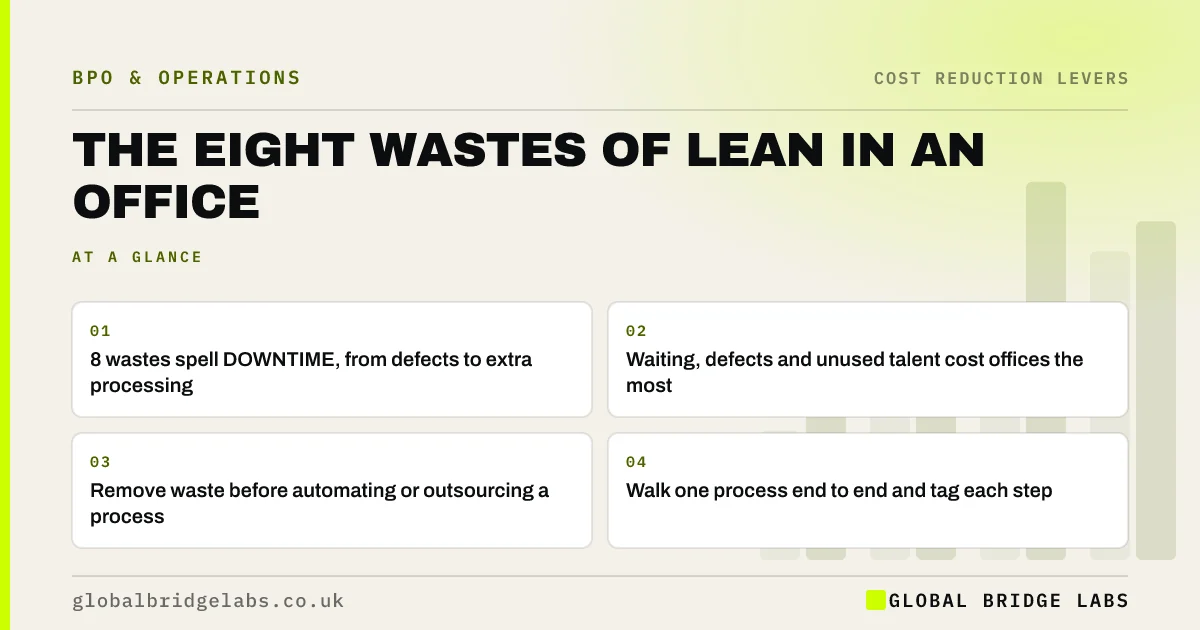
The 8 wastes of lean in an office are defects, overproduction, waiting, unused talent, transport, inventory, motion and extra processing. They come from manufacturing, but every one has an office equivalent, from retyped data to reports nobody reads. In admin work, waiting, defects and unused talent usually cost the most.
- 8 wastes spell DOWNTIME, from defects to extra processing.
- Waiting, defects and unused talent cost offices the most.
- Remove waste before automating or outsourcing a process.
- Walk one process end to end and tag each step.
Want a waste walk on one of your processes? Message us on WhatsApp with the process name.
Chat on WhatsApp →What are the eight wastes of lean?
The eight wastes are categories of activity that use time or money without adding anything a customer would pay for. Seven were identified by Taiichi Ohno at Toyota. An eighth, unused talent, was added later. They are often remembered by the word DOWNTIME: defects, overproduction, waiting, non-utilised talent, transport, inventory, motion and extra processing.
What does each waste look like in an office?
In an office, the wastes are less visible than on a factory floor because nothing piles up where you can see it. They show as delay, correction and duplicated effort. Each has a recognisable form in admin and customer service work.
- Defects: wrong invoices, mistyped records, replies that miss the question.
- Overproduction: reports, copies and updates nobody asked for.
- Waiting: for approval, information or another person's part.
- Unused talent: senior people doing routine admin.
- Transport: files and requests passed between people and systems.
- Inventory: backlogs of unanswered emails and unprocessed orders.
- Motion: searching folders, switching screens, hunting for a password.
- Extra processing: checks, formats and sign-offs beyond what is needed.
Which wastes cost a small business most?
Waiting, defects and unused talent usually cost a small business most. Waiting stretches a ten-minute task across three days. Defects mean doing work twice and apologising for it. Unused talent is the most expensive of all, because it prices routine work at a senior person's rate.
Take an illustrative director costing £60 an hour who spends six hours a week on scheduling and invoicing. That is £18,720 a year for work a managed team could do at an indicative £12 an hour, or about £3,740. The waste is not the task. It is who is doing it.
Want to know what unused talent costs in your firm? Send us the roles on WhatsApp.
Chat on WhatsApp →How do you find the wastes in a process?
Find them by following one item through the process from start to finish and noting what happens to it at every step, including the time it spends doing nothing. Mark each step as value, necessary but not value, or waste. The proportion that is pure value is usually small.
- 1. Choose one process and one real item.
- 2. List every step, including waits.
- 3. Record working time and elapsed time for each.
- 4. Tag each step with a waste type or as value.
- 5. Remove or shorten the largest waste first.
Which wastes can BPO remove, and which can it not?
BPO directly removes unused talent, by moving routine work to people whose job it is, and it reduces inventory by adding capacity where backlogs build. It reduces defects when the provider runs quality checks. It does not remove overproduction, extra processing or waiting for your approvals. Those are design choices, and only you can change them.
Where does lean thinking go wrong in offices?
Lean goes wrong when it becomes a hunt for busy-looking inefficiency instead of a way to serve customers better. Removing every buffer makes a team fragile. Treating conversation as waste damages the working relationships that fix problems quickly. The aim is less wasted effort, not less thinking time.
What does this look like in practice?
A pattern we see when a team maps its own work: a weekly report takes half a day to prepare and is sent to six people. Asked directly, two of them read it and one uses a single figure. Replacing it with that figure, sent automatically, returns the half day and removes nothing anyone needed.
Eight wastes checklist
Ask one question per waste for the process you are reviewing.
- Defects: how often is this corrected?
- Overproduction: who uses each output?
- Waiting: where does work sit idle?
- Talent: is the right level of person doing it?
- Transport: how many times does it change hands?
- Inventory: how large is the backlog?
- Motion: how much time goes on searching?
- Extra processing: which checks could go?
Next step
Choose one process that feels slower than it should. Tell us roughly how it runs and we will walk it with you, tag the wastes and suggest what to remove first.
Message us on WhatsApp for a waste walk, or book a 30-minute consultation.
Chat on WhatsApp →Sources and further reading
- Labour productivity · Office for National Statistics
- Multitasking: switching costs · American Psychological Association
Frequently asked questions
What are the 8 wastes of lean?
The 8 wastes are defects, overproduction, waiting, non-utilised talent, transport, inventory, motion and extra processing. They describe activity that consumes time or money without adding value for the customer. The first letters spell DOWNTIME, which is the usual way of remembering them.
Does lean apply to office work?
Yes. Office waste is harder to see because it is made of time and information instead of materials, but the same categories apply. Backlogs are inventory, approvals are waiting, retyping is extra processing, and errors in documents are defects.
Which lean waste is the most expensive?
In small businesses it is often unused talent: owners and senior staff doing routine tasks at a high hourly cost. Waiting and defects follow closely, because they stretch simple tasks over days and create work twice. The order differs by process, so measure before deciding.
How do you start with lean in a small business?
Start with one process, not a programme. Follow a single item from start to finish, write down every step and delay, and tag each as value or waste. Remove the largest waste, measure the result, then move to the next process.
Written by

Global Bridge Labs (GBL) is a UK–Sri Lanka partner for social media, websites and BPO. Everything here comes from client delivery, not theory.


