On this page
- 01Key takeaways
- 02What do rising overtime costs tell you?
- 03How much does overtime really cost?
- 04When is overtime the right answer?
- 05When is outsourcing cheaper than overtime?
- 06What are the legal limits on overtime?
- 07How do you reduce overtime without losing service?
- 08How do you compare overtime and outsourcing fairly?
- 09What does this look like in practice?
- 10Overtime checklist
- 11Next step
- 12Sources and further reading
- 13Frequently asked questions
Key takeaways
Rising overtime costs mean a regular capacity gap is being covered at a premium rate by tired people. Occasional overtime is sensible; routine overtime for more than two months usually costs more than outsourcing the repeatable work behind it, and it raises error rates and staff turnover.
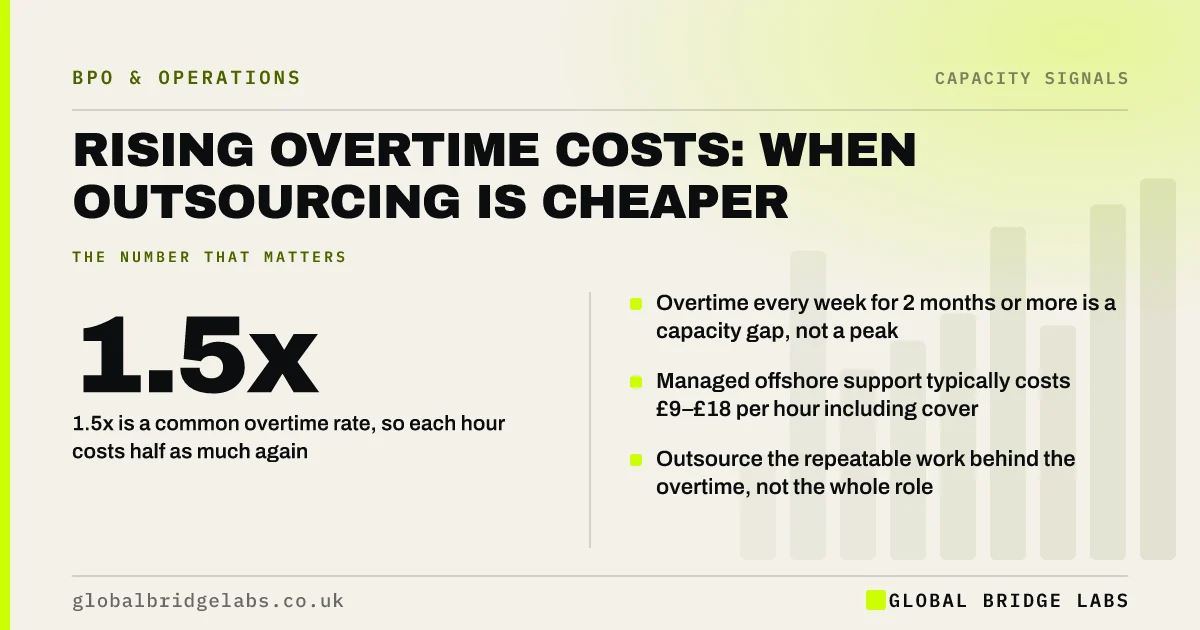
- 1.5x is a common overtime rate, so each hour costs half as much again.
- Overtime every week for 2 months or more is a capacity gap, not a peak.
- Managed offshore support typically costs £9–£18 per hour including cover.
- Outsource the repeatable work behind the overtime, not the whole role.
Overtime bill climbing? Message us on WhatsApp with the hours and the work behind them.
Chat on WhatsApp →What do rising overtime costs tell you?
Rising overtime costs tell you that the team's contracted hours no longer cover the work, and you are buying the difference at a higher rate from the same people. It is a signal of a lasting capacity gap when it happens every week, and of a peak when it happens for a few weeks a year.
How much does overtime really cost?
Overtime costs the premium rate plus employer National Insurance and pension on top, and its hidden costs are often larger. UK employers do not have to pay a premium for overtime, but average pay across all hours must not fall below the National Minimum Wage. Many contracts pay time and a half.
At time and a half on a £14-an-hour role, each overtime hour costs about £21 plus on-costs, often £24 or more, well above an indicative managed offshore rate of £9–£18 per hour.
- Premium rate: often 1.25x to 2x base pay, set by contract.
- On-costs: employer National Insurance at 15% and pension on top.
- Hidden costs: fatigue errors, sickness and staff leaving.
When is overtime the right answer?
Overtime is right for short, predictable peaks such as a year end, a stock take or a two-week launch. It uses people who already know the work, costs nothing to set up and ends when the peak ends. It stops being right when it becomes routine, because the premium rate and fatigue compound month after month.
When is outsourcing cheaper than overtime?
Outsourcing is usually cheaper when the overtime is regular, the work behind it is repeatable, and there are at least 10 hours a week of it. A managed part-time seat covering those hours at an indicative £12 per hour costs roughly half the loaded overtime rate on many roles, and it comes with cover.
Want a side-by-side of your overtime and an outsourced seat? Ask us on WhatsApp.
Chat on WhatsApp →What are the legal limits on overtime?
Workers in the UK cannot be made to work more than 48 hours a week on average, normally over 17 weeks, unless they opt out voluntarily and in writing. Regular overtime also needs to be managed as a health and safety risk, because long hours are a recognised cause of work-related stress.
How do you reduce overtime without losing service?
Find the work that creates the overtime, move the repeatable part to extra capacity, and keep the in-house team on the judgement-heavy work during contracted hours. Reduce overtime gradually over four to six weeks while the new capacity settles, and track reply times so service does not dip.
- Log what overtime hours are spent on for two weeks.
- Separate repeatable from judgement-heavy work.
- Move the repeatable work to an outsourced seat.
- Taper overtime as the seat reaches target quality.
How do you compare overtime and outsourcing fairly?
Compare the loaded cost per hour of each option over three months, not the base rate. For overtime, add employer National Insurance and pension to the premium rate. For outsourcing, add any setup fee spread over the period and your internal owner's review time. Then compare the result per hour of work delivered.
Add one qualitative line for each: fatigue and error risk for overtime, handover and learning time for outsourcing. Those decide which way to lean when the numbers are close.
- Overtime: premium rate plus 15% employer National Insurance plus pension.
- Outsourcing: hourly rate plus setup fee spread over three months.
- Both: internal management time per week.
- Result: loaded cost per hour of work delivered.
What does this look like in practice?
A pattern we see in UK logistics and wholesale firms: the customer service team works 8 to 12 hours of overtime a week each, mostly answering delivery status queries after 5pm. Moving evening status queries to a managed team ends most of the overtime and gives customers replies in the evening, which they did not get before.
Overtime checklist
Use this to decide whether to replace overtime.
- Total overtime hours and cost for the last three months.
- Add employer National Insurance and pension.
- Log what the overtime is spent on.
- Check whether it is a peak or a weekly pattern.
- Cost an outsourced seat for the repeatable part.
- Taper overtime over four to six weeks.
Next step
Send us your overtime hours and what they are spent on. We will compare them with an outsourced seat and tell you honestly which costs less.
Message us on WhatsApp with your overtime numbers, or book a 30-minute consultation.
Chat on WhatsApp →Sources and further reading
- Overtime: your rights · GOV.UK
- Maximum weekly working hours · GOV.UK
- Rates and thresholds for employers 2026 to 2027 · HM Revenue & Customs
- Work-related stress and how to manage it · Health and Safety Executive
Frequently asked questions
Is it cheaper to pay overtime or outsource?
For short peaks, overtime is usually cheaper because there is no setup. For regular overtime on repeatable work of 10 or more hours a week, outsourcing usually costs less, because the loaded overtime rate is often well above a managed seat at £9–£18 per hour.
How much overtime is too much?
Overtime every week for more than two months signals a lasting capacity gap. UK workers cannot be required to work more than 48 hours a week on average unless they opt out in writing, and long hours raise stress, errors and turnover.
Do UK employers have to pay extra for overtime?
No, not by law. Overtime pay rates are set by the employment contract. However, the worker's average pay across all hours worked must not fall below the National Minimum Wage. Many contracts pay time and a half or double time.
Written by

Global Bridge Labs (GBL) is a UK–Sri Lanka partner for social media, websites and BPO. Everything here comes from client delivery, not theory.