On this page
- 01Key takeaways
- 02What does turning followers into customers mean?
- 03Why do followers so often fail to become customers?
- 04What are the five steps from follower to customer?
- 05How do you attract followers who can actually buy?
- 06What makes a follower trust you enough to buy?
- 07What offer should you make to followers?
- 08How short should the path from post to enquiry be?
- 09How fast should you follow up with a follower who enquires?
- 10Should you move followers off social media?
- 11Does paid social help convert followers you already have?
- 12What is the value of fixing the funnel? A worked example
- 13What does it cost to improve follower conversion?
- 14How do you know it is working?
- 15When is chasing follower conversion the wrong move?
- 16How do you score your follower conversion?
- 17What does this look like in practice?
- 18Which guide in this series do you need next?
- 19Your follower conversion checklist
- 20Next step
- 21Sources and further reading
- 22Frequently asked questions
Key takeaways
To turn social media followers into customers, a UK business has to close five gaps in order: follow the right people, show proof they can trust, make one clear offer, shorten the path from post to enquiry, and follow up quickly. Most firms post more content when sales stall. The fix is usually in the last two steps, not the first.
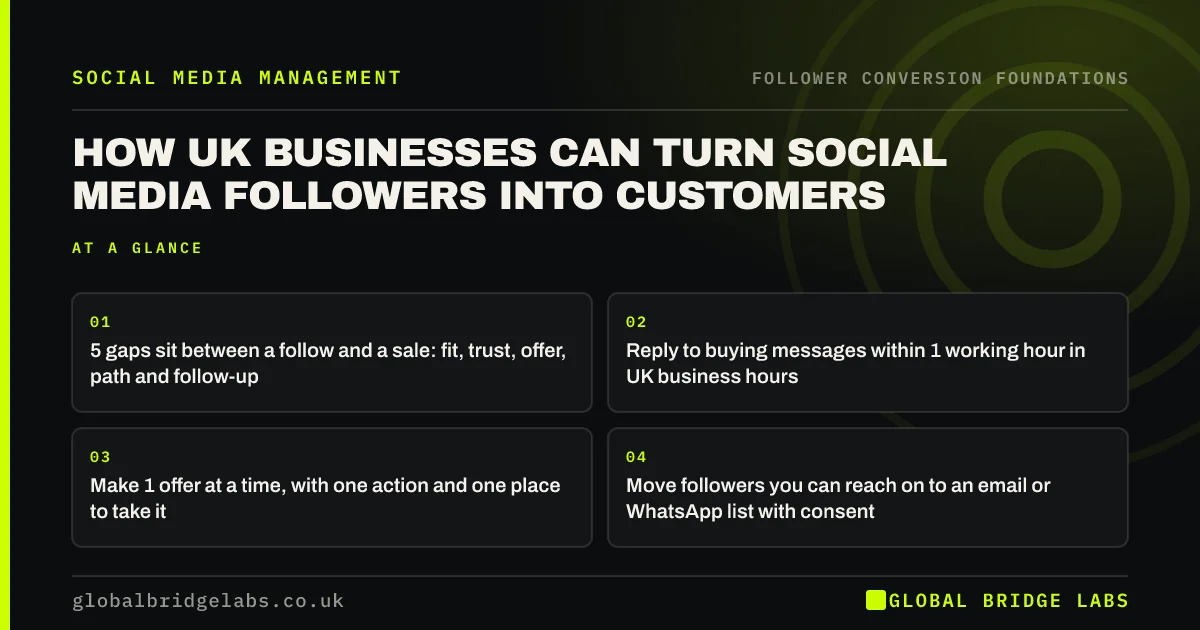
- 5 gaps sit between a follow and a sale: fit, trust, offer, path and follow-up.
- Reply to buying messages within 1 working hour in UK business hours.
- Make 1 offer at a time, with one action and one place to take it.
- Move followers you can reach on to an email or WhatsApp list with consent.
- Score yourself out of 10 and fix the lowest line first.
Want this mapped to your own accounts? Message us on WhatsApp with your handle and what you sell.
Chat on WhatsApp →What does turning followers into customers mean?
Turning followers into customers, often called follower conversion, is the process of moving people who follow a business on social media to a first purchase, booking or signed contract, and then to a second one. It is measured in customers and revenue, not in likes or follower counts.
This guide is written by Global Bridge Labs (GBL), a UK–Sri Lanka delivery partner, for owners, managing directors and marketing leads at UK small and medium-sized enterprises (SMEs) who have an audience on Instagram, Facebook, LinkedIn or TikTok and cannot yet see it in their sales figures.
Why do followers so often fail to become customers?
Followers fail to become customers because a follow is a low-cost signal of interest, not a decision to buy. Most followers are not ready to buy this month, some were never buyers at all, and those who are ready often meet a slow reply, a vague offer or a profile with no obvious next step.
Social media use is close to universal in the UK. Ofcom reports that 89% of adult internet users use at least one social media platform, so reaching people is rarely the constraint. The constraint is what happens after they notice you. LinkedIn's research with the Ehrenberg-Bass Institute describes the same pattern for business buyers: at any time, about 95% of them are not in the market, which is why the 5% who are need a clear and fast way in.
What are the five steps from follower to customer?
The five steps are fit, trust, offer, path and follow-up. Each one is a place a follower can drop out, and a strong step cannot make up for a broken one later. A business with ideal followers and great proof still loses the sale if nobody answers the message for two days.
- 1. Fit: the people following you could realistically buy from you.
- 2. Trust: they can see proof that you do what you say, for people like them.
- 3. Offer: they know what to buy or book first, and why now.
- 4. Path: they can act in two taps, from the post or the profile.
- 5. Follow-up: someone replies quickly and keeps going until there is an answer.
How do you attract followers who can actually buy?
You attract followers who can buy by writing every post for one named type of customer and one problem they pay to solve. Content that is entertaining to everyone builds a large audience of people who will never spend money with you. Content about a buyer's specific problem builds a smaller audience that converts.
If your followers are mostly other businesses in your trade, friends, or people outside the area you serve, conversion will stay low whatever you do later in the funnel. Fix fit first in that case.
What makes a follower trust you enough to buy?
Followers trust a business enough to buy when they see evidence from people like them: finished work, named reviews, short case studies, and a visible history of replies. Claims about quality do little. A before-and-after photo of a job in their town does a lot.
Proof has rules. Under the Digital Markets, Competition and Consumers Act 2024, fake reviews and concealed incentivised reviews are banned, and the Competition and Markets Authority (CMA) can now fine firms directly. Share genuine reviews, ask permission to name people, and label anything paid for as an advert.
What offer should you make to followers?
Make one offer that is easy to say yes to and leads naturally to the main sale: a free quote, a short consultation, a sample, a first-visit price or a small entry product. Followers who like your content still need a specific reason to act this week. Without an offer, they keep watching.
One offer at a time works better than several, because each additional choice adds a decision. Change the offer every month or quarter if you like, but keep only one live on the profile and in the posts.
How short should the path from post to enquiry be?
The path from a post to an enquiry should take two taps or fewer: one to the profile or link, one to a message, form or booking. Every extra step, such as a generic home page, a desktop-only form or a request to email, loses a share of the people who were ready to act.
Followers arrive on a phone. Check the path on your own phone: tap the link in your bio, find the offer, and start an enquiry. If that takes more than a minute, it is too long.
- Bio link goes to a page about the current offer, not the home page.
- A message, booking or WhatsApp button is on every relevant post.
- Forms ask for three to five fields, not ten.
- Prices or price ranges are visible where they can be.
How fast should you follow up with a follower who enquires?
Reply to a follower's enquiry within one working hour in UK business hours, and on the same day at the latest. People often message several firms at once, and the first helpful answer has the advantage. Then follow up two or three more times over the following ten days if they go quiet.
This is the step most UK SMEs lose. Messages arrive in three apps, nobody owns them, and replies wait until the evening. A named person, saved replies and one shared inbox fix most of it. Where the hours cannot be covered in-house, it is a task that can be handed to a managed team.
- Turn social media messages into enquiries and sales
- How many times should you follow up with a social lead?
- Who handles social media enquiries? Fixing the handover
Losing messages between apps or outside hours? Message us on WhatsApp and we will discuss your requirements.
Chat on WhatsApp →Should you move followers off social media?
Yes, where they agree to it. A follower on a platform can only be reached when the algorithm shows them your post. A subscriber on your email list or WhatsApp broadcast list can be reached when you choose. Offer something useful in exchange, such as a checklist, a price guide or early access, and record consent.
The Privacy and Electronic Communications Regulations (PECR) mean you generally need consent to send marketing emails or messages to individuals. The "soft opt-in" only covers people who have bought from you or negotiated to buy, so a new follower must opt in.
Does paid social help convert followers you already have?
Paid social helps convert existing followers when it is used to show an offer to warm audiences: people who follow you, watched your videos or visited your website. These retargeting audiences are small and cheap to reach, and they already know you. Many small firms spend their whole budget finding new people instead.
Retargeting website visitors depends on the Meta pixel or a similar tag, and in the UK that needs cookie consent first under PECR. Audiences built from engagement on the platform itself do not.
What is the value of fixing the funnel? A worked example
Here is an illustrative example. A home improvement firm has 3,000 followers. In a typical month about 900 of them see its posts, 60 visit the profile, 12 send a message and 3 become customers worth £2,000 each in sales. That is £6,000 a month from social media.
The firm adds a bio link to a quote page and a message button on each post, so profile visitors who enquire rise from 1 in 5 to 2 in 5. It also replies within the hour, so customers per enquiry rise from 1 in 4 to 1 in 3. Now 24 messages produce 8 customers, worth £16,000. No extra followers were needed. The figures are illustrative, but the shape is typical: the later steps multiply everything before them.
What does it cost to improve follower conversion?
Improving follower conversion costs mainly staff time, plus a small advertising budget if you retarget. Replying to messages, writing offers and fixing the bio link are hours, not software. At the April 2026 National Living Wage of £12.71, an hour of an employee's time costs a UK employer about £16.27 once National Insurance, pension and holiday are added.
As indicative UK market ranges, retargeting can be tested from about £100–£300 a month in ad spend, and most UK SMEs that use an agency for managed social media pay £950–£2,500 a month. Tools such as a link-in-bio page, scheduling and a shared inbox are often free or under £50 a month at small-business scale. Global Bridge Labs (GBL) does not publish a rate card; we scope each piece of work to the requirement.
Want a costed plan to convert the followers you already have? Message us on WhatsApp and we will discuss your requirements.
Chat on WhatsApp →How do you know it is working?
You know it is working when the number of customers who came from social media rises month on month, at a cost per customer you can afford. Track four numbers: profile or link clicks, enquiries, customers and revenue. Ask every new customer how they heard of you, and tag social links so Google Analytics 4 (GA4) can record them.
- Enquiries from social media per month.
- Enquiry-to-customer rate.
- Customer acquisition cost from social media.
- Revenue and repeat purchases from those customers.
When is chasing follower conversion the wrong move?
Chasing follower conversion is the wrong move when buyers only look for you at the moment of need, as with an emergency locksmith, when you have under a few hundred followers who fit, or when the business cannot take more work. In the first case, search and a Google Business Profile should come first. In the second, fix who you attract. In the third, fix capacity before demand.
It is also wrong to push every post towards a sale. Followers who are not ready yet need useful content that keeps you in mind. A business that only ever asks for the sale trains its audience to scroll past.
How do you score your follower conversion?
Score it with the GBL Follower Conversion Scorecard: five lines, each scored 0, 1 or 2, where 2 means the step works well. Fit: are most followers potential buyers? Trust: can a new follower see proof within one scroll? Offer: is there one clear first offer? Path: can someone enquire in two taps from a post? Follow-up: are buying messages answered within the working hour and chased?
A total of 8 to 10 means the funnel converts well, and more of the right followers will grow sales. A total of 5 to 7 means fix the weakest line before adding content. A total of 4 or below means start with path and follow-up, because they are the cheapest to fix and the quickest to show.
What does this look like in practice?
A pattern we see with UK service businesses: a well-run Instagram or Facebook account with steady growth, a bio link to the home page, no named offer, and messages answered by whoever is free that evening. The owner's conclusion is that social media does not bring customers, and the next step being considered is more video.
The changes that move sales are usually duller: one offer, a bio link to a page about it, a message button on posts, a named person on the inbox each day, and a follow-up routine. Across GBL social media clients, the average reach lift in the first 90 days is +184% and qualified leads per month rise by an average of +62%. Treat those as context for what is possible, not a promise for any single business.
Which guide in this series do you need next?
This guide is the hub of a 60-article series from Global Bridge Labs (GBL) on turning social media followers into customers. Start with the step that scored lowest.
- Weak offer: read the offers, entry offer and guarantee guides.
- Long path: read the link in bio, lead ads and booking button guides.
- Slow follow-up: read the follow-up, handover and out-of-hours guides.
- Cannot see results: read the GA4, acquisition cost and attribution guides.
- Need sector advice: read the trades, restaurant, e-commerce and clinic guides.
- Ready to act: follow the 90-day plan and the checklist.
- A 90-day plan to turn social media followers into customers
- How tradespeople turn social media followers into jobs
- Turn e-commerce followers into first and repeat orders
- Turn LinkedIn connections into clients for professional firms
- Turn restaurant followers into bookings and repeat visits
- How clinics turn social media followers into patients
- How logistics firms win contracts from social media
- Social selling for small businesses: a practical guide
Your follower conversion checklist
- Check that most of your followers could realistically buy from you.
- Pin three posts that show proof: a review, a result and a case study.
- Choose one first offer and name it in your bio.
- Point the bio link at a page about that offer.
- Add a message, booking or WhatsApp action to every relevant post.
- Name one person to answer messages each working day.
- Follow up quiet enquiries two or three times over ten days.
- Invite followers on to an email or WhatsApp list, with consent.
- Tag social links and ask every customer how they found you.
- Score yourself monthly on the GBL Follower Conversion Scorecard.
Next step
Open your own profile on your phone as if you were a customer. Find the offer, tap the link and send an enquiry. Note every point where you hesitated: that is your first fix.
Message us on WhatsApp with your handle and we will score it on the GBL Follower Conversion Scorecard, or book a 30-minute consultation.
Chat on WhatsApp →Sources and further reading
- Adults' media use and attitudes · Ofcom
- The 95-5 rule: most B2B buyers are out of market · LinkedIn B2B Institute
- Digital Markets, Competition and Consumers Act 2024 · legislation.gov.uk
- Publishing consumer reviews and complying with consumer protection law · Competition and Markets Authority
- Electronic and telephone marketing under PECR · Information Commissioner's Office
- Cookies and similar technologies under PECR · Information Commissioner's Office
- National Minimum Wage and National Living Wage rates · GOV.UK
Frequently asked questions
How do you turn social media followers into customers?
Close five gaps in order. Attract followers who can buy, show proof they trust, make one clear first offer, let them enquire in two taps and reply within the working hour. Then follow up quiet enquiries and invite followers on to an email or WhatsApp list with consent.
Why do I have followers but no customers?
Usually because the followers are the wrong people, there is no clear offer, the route to enquire is too long, or messages are answered slowly. Check each in that order. Many businesses with a few thousand followers convert few of them simply because nobody replies to messages on the same day.
How many followers do you need to make sales?
Fewer than most people think. A few hundred followers who live in your area or work in your target sector can produce regular enquiries if the offer and path are clear. A large following of people who cannot buy from you produces almost none. Fit matters more than count.
How long does it take to turn followers into customers?
Fixing the path and follow-up can produce more enquiries within weeks, because those followers are already interested. Building trust with new followers usually takes two to three months of consistent posting. Higher-value purchases, such as B2B contracts, can take six months or more from first follow to signed deal.
Should I sell directly on social media or send followers to my website?
Use whichever path is shorter for your buyer. Simple products can sell through social shops or messages. Services usually convert better with a message or a booking page. Avoid sending followers to a generic home page: link to a page about the specific offer they saw.
Written by

Global Bridge Labs (GBL) is a UK–Sri Lanka partner for social media, websites and BPO. Everything here comes from client delivery, not theory.