On this page
- 01Key takeaways
- 02What is social selling?
- 03How is it different from social media marketing?
- 04Which platform suits social selling?
- 05What does a daily social selling routine look like?
- 06When should you move from helping to selling?
- 07What are the rules on messaging potential buyers?
- 08When is social selling not worth the time?
- 09What does this look like in practice?
- 10Social selling checklist
- 11Next step
- 12Sources and further reading
- 13Frequently asked questions
Key takeaways
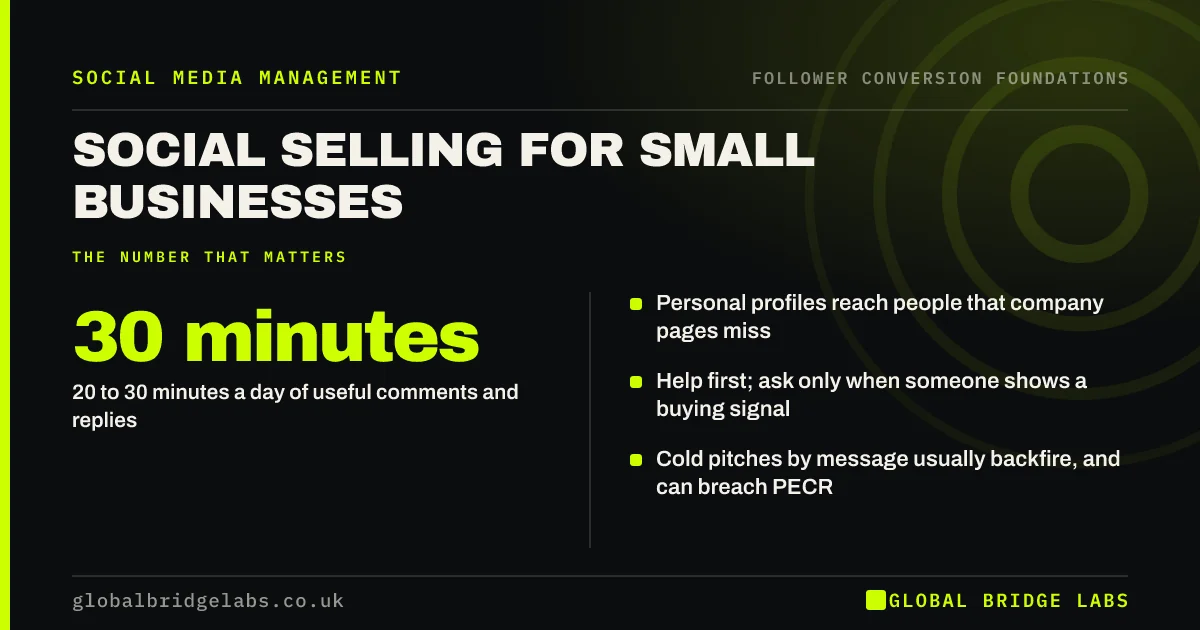
Social selling is when the people who sell for a business use their own social profiles to find, help and talk to potential buyers, building relationships that lead to sales. For a UK small business it means the owner or sales lead spending 20 to 30 minutes a day on LinkedIn, Instagram or Facebook in useful conversation, not sending pitches.
- 20 to 30 minutes a day of useful comments and replies.
- Personal profiles reach people that company pages miss.
- Help first; ask only when someone shows a buying signal.
- Cold pitches by message usually backfire, and can breach PECR.
Want a social selling routine for your team? Message us on WhatsApp.
Chat on WhatsApp →What is social selling?
Social selling is a sales approach in which individuals use their personal social media profiles to build relationships with potential buyers, by sharing expertise, commenting on buyers' posts and holding conversations, so that buyers come to them when they need the service. It sits alongside, not instead of, the business's own marketing.
How is it different from social media marketing?
Social media marketing is the business speaking to many people through its page and adverts. Social selling is a person speaking to a few people through their own profile. Marketing builds the audience and the reputation. Social selling turns specific people within that audience into conversations.
Which platform suits social selling?
LinkedIn suits business-to-business (B2B) and professional services, because buyers list their role and company. Instagram and Facebook suit local and consumer services, especially through groups and replies. LinkedIn also offers a Social Selling Index score in Sales Navigator, but the useful measure is conversations started, not the score.
What does a daily social selling routine look like?
A daily routine takes 20 to 30 minutes. Reply to every comment on your own posts. Leave three to five useful comments on posts by potential buyers or the people they listen to. Accept and welcome relevant connections. Reply to messages. Post your own view or a piece of work two or three times a week.
- 5 minutes: reply to comments and messages.
- 10 minutes: comment usefully on buyers' posts.
- 5 minutes: welcome new relevant connections.
- Twice a week: post an opinion, a lesson or a result.
When should you move from helping to selling?
Move to selling when the other person shows a buying signal: they ask how you work, mention a problem you solve, or ask for a call. Then offer a specific next step. Until then, keep helping. B2B buyers are mostly out of the market at any moment: LinkedIn's research with the Ehrenberg-Bass Institute puts it at about 95%. Social selling keeps you remembered for the 5% who are not.
Not sure how to move conversations to calls? Message us on WhatsApp and we will discuss your requirements.
Chat on WhatsApp →What are the rules on messaging potential buyers?
Replying to people who contact you is fine. Unsolicited marketing messages to individuals by electronic means are restricted under PECR and generally need consent; rules for corporate subscribers differ, but you must still identify yourself and honour requests to stop. Social platforms also limit and penalise mass messaging. Treat a cold pitch by direct message as a last resort, not a tactic.
When is social selling not worth the time?
Social selling is not worth it when the sale is small and transactional, such as a £20 product, or when buyers decide in minutes at the point of need. It suits considered purchases: services, B2B contracts, higher-priced items. It also depends on one person's time, so it stops when they are busy.
What does this look like in practice?
A pattern we see in professional services: a well-run company page with little reach, and a founder who rarely posts. Twenty minutes a day of useful comments and two posts a week from the founder often reaches more of the right people than the page does.
Social selling checklist
- Update your personal profile to say who you help and how.
- List 50 people or firms who could buy from you.
- Spend 20 to 30 minutes a day helping, not pitching.
- Post your own view or work twice a week.
- Offer a call only after a buying signal.
- Record conversations started each week.
Next step
Rewrite your personal headline today so it says who you help and with what, then spend 20 minutes commenting on buyers' posts.
Message us on WhatsApp for a social selling routine for your team, or book a 30-minute consultation.
Chat on WhatsApp →Sources and further reading
- The 95-5 rule: most B2B buyers are out of market · LinkedIn B2B Institute
- LinkedIn Pages best practices · LinkedIn
- Electronic and telephone marketing under PECR · Information Commissioner's Office
- Direct marketing and privacy and electronic communications · Information Commissioner's Office
Frequently asked questions
What is social selling?
Social selling is using personal social media profiles to build relationships with potential buyers by sharing expertise, commenting on their posts and holding useful conversations, so they come to you when they need the service. It is about conversations with individuals, not broadcasting from a company page.
Does social selling work for small businesses?
Yes, especially for services and B2B sales where trust matters. The owner's personal profile often reaches more of the right people than the business page. It needs 20 to 30 minutes a day of consistent effort and works over months, not days.
Is it legal to send sales messages on LinkedIn?
Replying to people who contact you is fine. Unsolicited marketing messages to individuals are restricted under PECR and generally need consent, and LinkedIn limits mass messaging. Rules for corporate subscribers differ, but you must still identify yourself and stop when asked. Helping in public before messaging is safer and works better.
Written by

Global Bridge Labs (GBL) is a UK–Sri Lanka partner for social media, websites and BPO. Everything here comes from client delivery, not theory.