On this page
- 01Key takeaways
- 02Why do viral posts rarely lead to sales?
- 03What are the five reasons views do not become sales?
- 04How do you check which reason applies to you?
- 05What should your profile show a viral visitor?
- 06Is it still worth having gone viral?
- 07What does this look like in practice?
- 08Next step
- 09Sources and further reading
- 10Frequently asked questions
Key takeaways
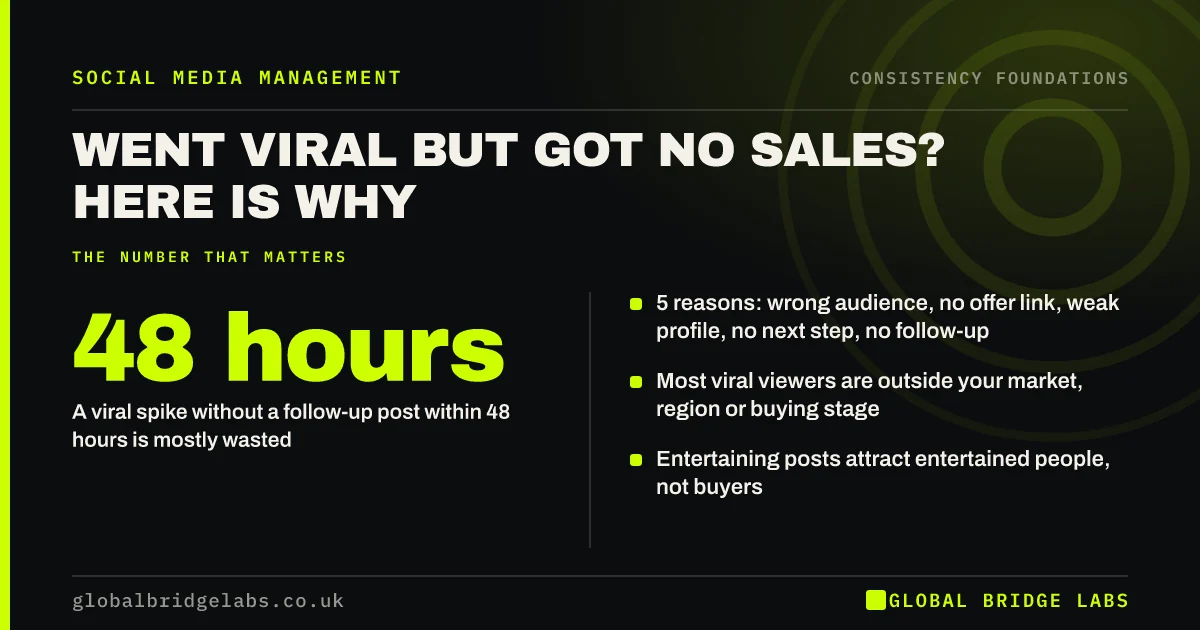
A viral post usually fails to produce sales because the people it reached were never likely to buy, the post did not connect to what you sell, and nothing on your profile told visitors what to do next. Views measure attention. Sales need the right audience, a clear offer and a working path to buy.
- 5 reasons: wrong audience, no offer link, weak profile, no next step, no follow-up.
- Most viral viewers are outside your market, region or buying stage.
- Entertaining posts attract entertained people, not buyers.
- A viral spike without a follow-up post within 48 hours is mostly wasted.
- Consistency with the right audience beats reach with the wrong one.
Had a spike that went nowhere? Send us the post on WhatsApp and we will tell you what broke the path to sale.
Chat on WhatsApp →Why do viral posts rarely lead to sales?
Viral posts rarely lead to sales because virality selects for broad appeal, and broad appeal is the opposite of targeting. A post spreads because many different people find it interesting, which means most of them have nothing in common with your buyers except that they enjoyed the post.
For a UK small business, the typical viral audience is a mix of other countries, other regions, people who are not in a buying role and people who will never need what you sell. The share who could buy is usually tiny.
What are the five reasons views do not become sales?
- Wrong audience: the reach landed outside your region, sector or buying stage.
- No link to the offer: the post was about a joke, a trend or a story, not what you sell.
- Weak profile: visitors who clicked through found an unclear bio, no recent posts and no proof.
- No next step: nothing told them where to go, what to ask or how to buy.
- No follow-up: you did not post again for days, so the curiosity faded.
How do you check which reason applies to you?
Look at the platform's audience data for the post: location, age and whether viewers were followers or not. Then check your website analytics for sessions from that platform and what those visitors did. If most viewers were outside the UK or your region, the problem was audience. If UK visitors arrived and left without acting, the problem was the profile or the website.
Finally, read the comments. Questions about price, availability or delivery signal buying interest you may have missed. Comments that are all jokes or reactions tell you the post was entertainment.
What should your profile show a viral visitor?
A visitor from a viral post gives your profile about five seconds. In that time they need to understand what you do, who it is for, where you operate and what to do next. Most small business profiles fail at least two of these.
- Bio: one line on what you do and for whom, plus your service area if local.
- Pinned posts: your best proof post, an explainer of your offer and a recent customer result.
- Recent activity: posts from the last week, not the last season.
- Clear action: a link to book, buy, or message, not only your homepage.
Want your profile checked before your next big post? Send us the link on WhatsApp.
Chat on WhatsApp →Is it still worth having gone viral?
Sometimes, in quieter ways. A viral post can raise branded searches, give you social proof to reuse, or surface a message that resonates more than expected. The honest question is whether the extra followers make your account better at reaching buyers or worse.
If the new followers are mostly outside your market, engagement rates on your normal posts will fall for a while. That is not a disaster, but it means the account needs steady, buyer-focused content to rebalance, not another attempt at a hit.
What does this look like in practice?
A UK garden design studio had a time-lapse video of a planting scheme reach well over a million people on Instagram. It produced thousands of followers, most outside the UK, and no design enquiries. The post showed the result but not the service, the bio did not mention the region, and the account then went quiet for three weeks.
The following season the studio posted steadily: a project story each week, a monthly post on typical budgets and timescales, and replies to every question. Reach was far lower than the viral video. Enquiries from the studio's own region were not, and the pipeline was booked two months further ahead than the year before.
Next step
Fix the path before chasing the reach. Rewrite your bio, pin three posts that explain and prove your offer, and plan a steady rhythm of posts aimed at the people who can buy. If a spike comes after that, you will be ready to use it.
Message us on WhatsApp and we will audit the path from your social profile to a sale.
Chat on WhatsApp →Sources and further reading
- URL builders: collect campaign data with custom URLs · Google Analytics Help
- Engagement rate and bounce rate · Google Analytics Help
- Performance report (Search results) · Search Console Help
Frequently asked questions
Why did my viral post not lead to sales?
Usually because the audience was outside your market, the post did not connect to what you sell, or your profile gave visitors no clear next step. Virality rewards broad appeal, and broad audiences contain very few buyers for a specific product or local service.
Do views on social media turn into customers?
Some do, but views are an attention measure, not a buying signal. Customers come from repeated exposure to the right people plus a clear offer and an easy way to act. A smaller audience that sees you every week usually produces more customers than a large audience that sees you once.
What should I post after going viral?
Within 48 hours, post a follow-up that explains who you are, what you offer and how to buy or enquire. Then return to your normal schedule of buyer-focused posts. Do not try to repeat the viral format endlessly; it rarely works twice and pulls content away from buyers.
How do I track sales from a viral post?
Use UTM-tagged links in your bio and posts, check website sessions from the platform in GA4, ask every enquirer how they heard about you, and compare branded searches in Search Console for the 30 days before and after. Together these show whether the spike created any buying activity.
Written by

Global Bridge Labs (GBL) is a UK–Sri Lanka partner for social media, websites and BPO. Everything here comes from client delivery, not theory.