On this page
- 01Key takeaways
- 02What is a social media sales funnel?
- 03What are the stages of a social media funnel?
- 04What content belongs at each stage?
- 05How often should posts ask for the sale?
- 06How do you measure a social media funnel?
- 07Where does paid social fit in the funnel?
- 08When does the funnel model mislead?
- 09What does this look like in practice?
- 10Funnel checklist
- 11Next step
- 12Sources and further reading
- 13Frequently asked questions
Key takeaways
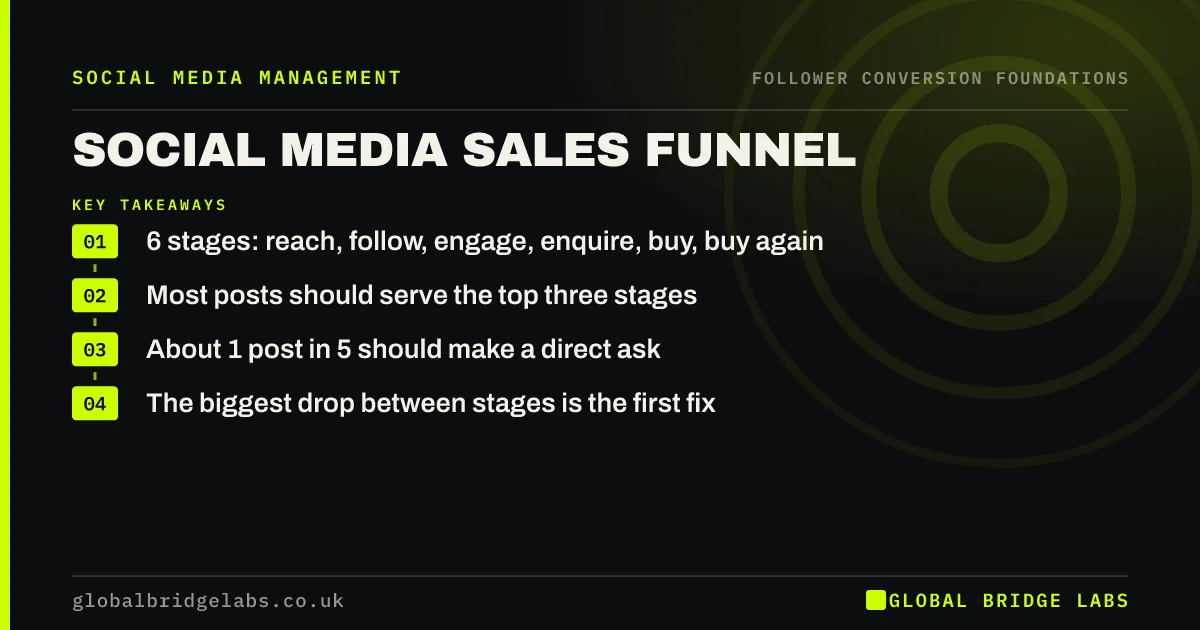
A social media sales funnel is the set of stages a person passes through from first seeing your post to buying: reach, follow, engage, enquire, buy and buy again. Each stage needs a different kind of content and a different ask. Measure the drop between stages to find where to work.
- 6 stages: reach, follow, engage, enquire, buy, buy again.
- Most posts should serve the top three stages.
- About 1 post in 5 should make a direct ask.
- The biggest drop between stages is the first fix.
Want your funnel mapped? Message us on WhatsApp.
Chat on WhatsApp →What is a social media sales funnel?
A social media sales funnel is a model of the steps between a stranger seeing a business's content and becoming a paying customer, with fewer people at each step. It helps a business match content and offers to how ready people are, and shows where potential customers are being lost.
What are the stages of a social media funnel?
A practical funnel for a small business has six stages. Real buyers do not move in a straight line, and some skip stages entirely after a recommendation, but the stages make it possible to count and improve.
- 1. Reach: they see a post, advert or share.
- 2. Follow: they follow, save or visit the profile.
- 3. Engage: they watch, comment, reply or click.
- 4. Enquire: they message, book or fill in a form.
- 5. Buy: they pay or sign.
- 6. Buy again: they return or refer someone.
What content belongs at each stage?
Content at the top of the funnel should be useful or interesting to your buyers without asking anything. Content in the middle should prove you can solve their problem. Content at the bottom should make the offer and remove the last doubts. Most small businesses have plenty of the first and almost none of the last.
- Reach and follow: tips, opinions, behind the scenes, local news.
- Engage: before and after, case studies, FAQs, short demos.
- Enquire and buy: the offer, prices or ranges, reviews, how to book.
- Buy again: care tips, new services, referral reminders.
How often should posts ask for the sale?
As a working rule of thumb, about one post in five should make a direct ask: an offer, a booking link or a price. Fewer, and followers who are ready do not know how to act. More, and followers who are not ready learn to scroll past. Stories and pinned posts can carry the ask more often, because they reach people already interested.
How do you measure a social media funnel?
Measure the funnel with one number per stage, taken from the same period. Reach and profile visits come from platform insights. Clicks come from link tracking. Enquiries come from your inbox, forms and Google Analytics 4 (GA4). Sales come from your records. Then divide each stage by the one before it.
- Illustrative month: 10,000 reach, 400 profile visits, 20 enquiries, 5 customers.
- Reach to visit: 4%. Visit to enquiry: 5%. Enquiry to sale: 25%.
- The weakest ratio compared with your past months is the one to work on.
- Social media conversion rate: calculate it and improve it
- Set up UTM tracking for social media
- How to forecast sales from your social media activity
Cannot get the numbers to line up? Message us on WhatsApp and we will discuss your requirements.
Chat on WhatsApp →Where does paid social fit in the funnel?
Paid social fits at two points. At the top, it extends reach to new people who match your buyer. At the bottom, retargeting shows the offer to people who already engaged. For small budgets the bottom is usually the better first spend, because those audiences are small, warm and cheap to reach.
When does the funnel model mislead?
The funnel misleads when it is treated as the whole story. Many buyers see a post, say nothing, and search your name weeks later, so the sale looks like it came from search. Referrals jump straight to enquiry. Use the funnel to find weak steps, and ask customers how they found you to fill the gaps.
What does this look like in practice?
A pattern we see: a business posts well at the top of the funnel and has nothing at the bottom. No pinned offer, no price guidance, no booking link. Adding three bottom-of-funnel posts a month and pinning them often lifts enquiries without any change in reach.
Funnel checklist
- Write down your six stages and one number for each.
- Calculate the ratio between each pair.
- Check you have content for every stage.
- Make a direct ask in about one post in five.
- Pin your offer and your best proof.
- Review the ratios monthly.
Next step
Fill in last month's numbers for each stage and circle the weakest ratio.
Message us on WhatsApp with your funnel numbers and we will suggest the first fix, or book a 30-minute consultation.
Chat on WhatsApp →Sources and further reading
- About key events · Google Analytics Help
- URL builders: collect campaign data with custom URLs · Google Analytics Help
- Meta Business Help Centre · Meta
Frequently asked questions
What is a social media sales funnel?
It is the series of stages between someone first seeing your content and buying: reach, follow, engage, enquire, buy and buy again. Fewer people reach each stage. Mapping it shows which content and offer suit each stage and where most potential customers drop out.
How do I build a sales funnel on Instagram?
Post useful content to attract the right followers, proof content to build trust, and offer posts with a clear booking or message link to convert. Pin your offer and best proof, point your bio link at a page about the offer, and reply to messages quickly.
What is a good conversion rate for a social media funnel?
There is no reliable universal benchmark, because it varies by price, sector and how enquiries are counted. Compare each stage with your own past months and with other channels in GA4. A falling ratio between two stages is more useful than any industry average.
Written by

Global Bridge Labs (GBL) is a UK–Sri Lanka partner for social media, websites and BPO. Everything here comes from client delivery, not theory.