On this page
- 01Key takeaways
- 02What is a money-back guarantee?
- 03Why does a guarantee help convert followers?
- 04How does a guarantee fit with UK consumer law?
- 05How should you word a guarantee?
- 06What does a guarantee cost?
- 07When should you not offer a guarantee?
- 08What does this look like in practice?
- 09Guarantee checklist
- 10Next step
- 11Sources and further reading
- 12Frequently asked questions
Key takeaways
A money-back guarantee lowers the risk a new customer takes, which helps followers who like your work but have never bought from you. It must add to, not replace, statutory consumer rights. Word it plainly, set clear conditions, and price in the few customers who will use it.
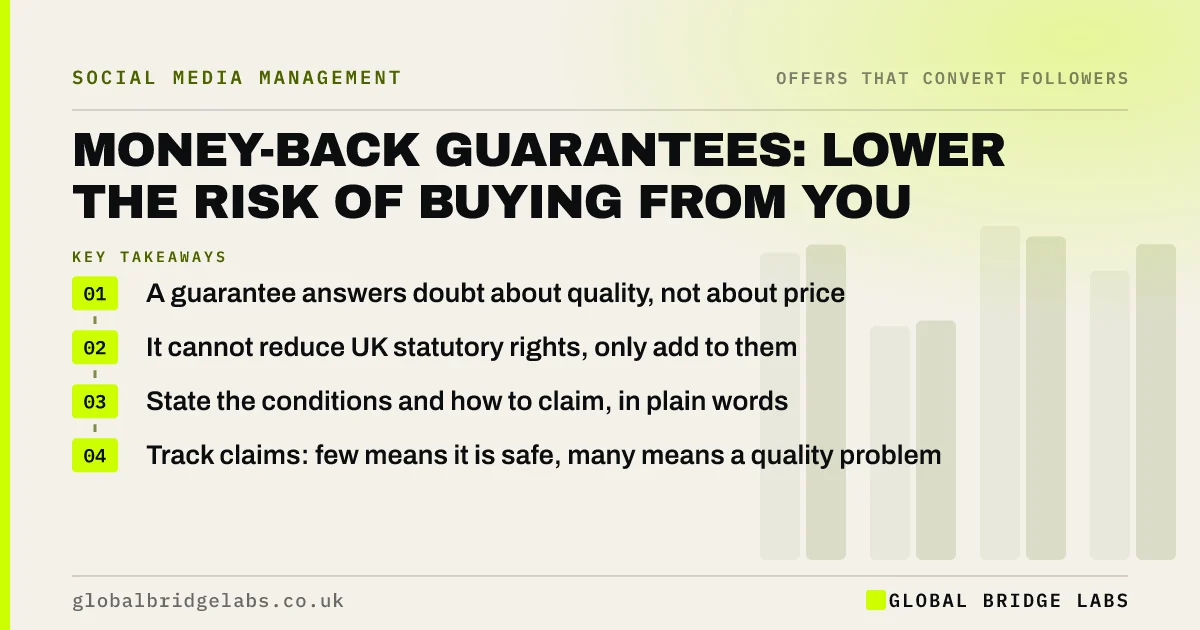
- A guarantee answers doubt about quality, not about price.
- It cannot reduce UK statutory rights, only add to them.
- State the conditions and how to claim, in plain words.
- Track claims: few means it is safe, many means a quality problem.
Want your guarantee wording reviewed? Message us on WhatsApp.
Chat on WhatsApp →What is a money-back guarantee?
A money-back guarantee is a promise to refund some or all of the price if the customer is not satisfied or the product does not do what was promised, under stated conditions. In marketing it is called risk reversal: the business takes on the risk that would otherwise stop a first-time buyer.
Why does a guarantee help convert followers?
A guarantee helps because the main doubt of a follower who has never bought is whether you will deliver. Proof answers part of that. A guarantee answers the rest, by showing confidence and limiting the downside. It works best on higher-priced first purchases and new services without many reviews yet.
How does a guarantee fit with UK consumer law?
Consumers already have statutory rights under the Consumer Rights Act 2015: goods must be of satisfactory quality and as described, and services must be performed with reasonable care and skill. Online buyers usually also have a 14-day right to cancel. A guarantee must be extra to these rights and must not suggest it replaces them. Say so in the wording.
How should you word a guarantee?
Word the guarantee in one plain sentence, then the conditions. Say what is guaranteed, for how long, what the customer gets back and how to claim. The CAP Code expects the significant terms of a guarantee to be clear in the advert or easily available.
- "If the first clean is not up to standard, we will redo it free or refund you."
- "Claim within 7 days by message with a photo."
- "This is in addition to your legal rights."
Want help wording a guarantee? Message us on WhatsApp and we will discuss your requirements.
Chat on WhatsApp →What does a guarantee cost?
A guarantee costs the refunds or re-work you provide, minus the extra sales it wins. An illustrative example: if a guarantee lifts first-time bookings from 20 to 25 a month and two customers a month claim on a £120 service, it costs £240 and earns £600 in extra sales, before repeat business.
When should you not offer a guarantee?
Do not offer a guarantee when results depend on things you cannot control, such as a client following advice, or in regulated sectors where outcome guarantees are restricted, such as many healthcare and financial services. A guarantee on effort or process, such as a free redo, is often safer than one on outcome.
What does this look like in practice?
A pattern we see: a business is confident in its work and already redoes poor jobs without fuss, but never says so. Turning that habit into a stated guarantee, pinned on the profile, gives hesitant followers a reason to try.
Guarantee checklist
- Decide what you are guaranteeing: outcome, process or satisfaction.
- Set a time limit and a claim route.
- Say it is in addition to legal rights.
- Put the main terms in the post or one tap away.
- Price in expected claims.
- Track claims and their reasons.
Next step
Write down what you already do when a customer is unhappy. That is probably your guarantee; now say it publicly.
Message us on WhatsApp and we will help word your guarantee, or book a 30-minute consultation.
Chat on WhatsApp →Sources and further reading
- Consumer Rights Act 2015 · legislation.gov.uk
- Consumer Contracts (Information, Cancellation and Additional Charges) Regulations 2013 · legislation.gov.uk
- Accepting returns and giving refunds · GOV.UK
- UK Code of Non-broadcast Advertising and Direct & Promotional Marketing (CAP Code) · ASA / CAP
Frequently asked questions
Should a small business offer a money-back guarantee?
Often yes, if quality is consistent and the main doubt stopping first purchases is whether you will deliver. Keep the conditions clear, make it extra to statutory rights and track claims. Avoid outcome guarantees in regulated sectors or where results depend on the customer.
Does a guarantee replace consumer rights?
No. Under the Consumer Rights Act 2015 and the Consumer Contracts Regulations, consumers keep their statutory rights whatever you offer. A guarantee must be in addition to them and should say so. Wording that suggests it replaces legal rights can be misleading.
Will people abuse a money-back guarantee?
A few may, but in most small businesses claims are rare when the work is good. Clear conditions, a time limit and a simple claim route keep it fair. If claims rise, treat it as a quality signal before blaming customers.
Written by

Global Bridge Labs (GBL) is a UK–Sri Lanka partner for social media, websites and BPO. Everything here comes from client delivery, not theory.