On this page
- 01Key takeaways
- 02What is social media conversion rate?
- 03How do you calculate it?
- 04Which conversion rate should a small business track?
- 05What is a good social media conversion rate?
- 06How do you improve it?
- 07When does a higher rate not mean more customers?
- 08What does this look like in practice?
- 09Conversion rate checklist
- 10Next step
- 11Sources and further reading
- 12Frequently asked questions
Key takeaways
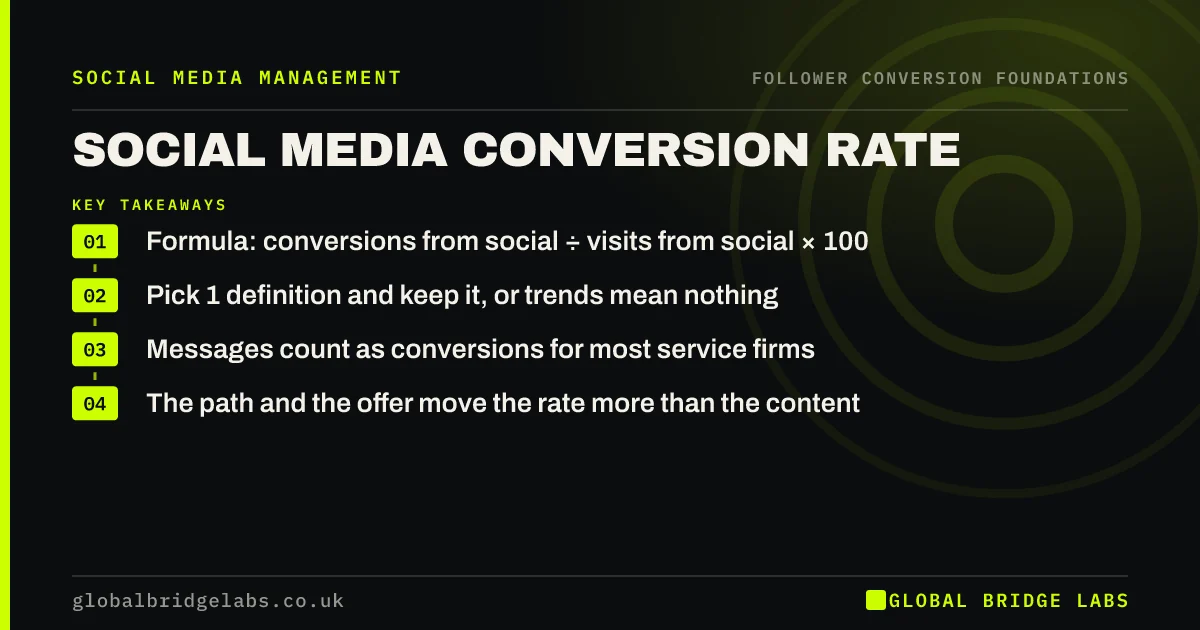
Social media conversion rate is the share of people arriving from social media who complete a goal, such as an enquiry or a purchase. Calculate it as conversions divided by visits or clicks from social, times 100. Track it against your own past months, because published averages mix sectors and definitions.
- Formula: conversions from social ÷ visits from social × 100.
- Pick 1 definition and keep it, or trends mean nothing.
- Messages count as conversions for most service firms.
- The path and the offer move the rate more than the content.
Want your rate calculated properly? Message us on WhatsApp.
Chat on WhatsApp →What is social media conversion rate?
Social media conversion rate is the percentage of visitors or clicks from social platforms that complete a defined action, such as a purchase, booking, form or message. It measures how well the path after the click works, not how good the content is at getting attention.
How do you calculate it?
Calculate it by dividing conversions from social media by visits or clicks from social media over the same period, then multiplying by 100. In Google Analytics 4 (GA4), filter to the Organic Social and Paid Social channel groups and use session key event rate. For messages, divide enquiries received in the inbox by profile visits.
- Website: 12 enquiries ÷ 480 social sessions × 100 = 2.5%.
- Inbox: 15 messages ÷ 600 profile visits × 100 = 2.5%.
- Follower to customer: 30 customers ÷ 3,000 followers × 100 = 1% a year.
- All three figures are illustrative.
Which conversion rate should a small business track?
Track the one closest to money that you can count reliably. An online shop should track purchases from social sessions. A service business should track enquiries, counting messages, calls and forms together, then the enquiry-to-customer rate separately. Pick one and write the definition down, so next month's figure is comparable.
What is a good social media conversion rate?
A good social media conversion rate is one that is rising against your own baseline at a cost you can afford. Published averages combine shops and services, paid and unpaid traffic, and different definitions of a conversion, so they rarely apply to one business. Social traffic often converts lower than search traffic, because people were browsing rather than looking.
How do you improve it?
Improve it by making the step after the click match the post that earned it. Send people to a page about the offer they saw, cut form fields, show the price or range, add proof near the button and make the page fast on a phone. Then speed up replies, because a slow reply loses enquiries already won.
- Link each post to a matching page, not the home page.
- Keep forms to three to five fields.
- Put a review or result next to the action.
- Offer a message or WhatsApp option as well as a form.
Social visitors leaving without enquiring? Message us on WhatsApp and we will discuss your requirements.
Chat on WhatsApp →When does a higher rate not mean more customers?
A higher rate can hide a worse result. Cutting reach to only warm followers raises the rate but can lower total enquiries. A giveaway can raise form fills that never buy. Always read conversion rate next to the number of conversions and the number that became paying customers.
What does this look like in practice?
A pattern we see: a business tracks link clicks and calls them conversions, so the rate looks healthy while sales stay flat. Changing the definition to enquiries, and counting messages as well as forms, usually shows the real picture and makes the next fix obvious.
Conversion rate checklist
- Write down one definition of a conversion.
- Set up the goal as a key event in GA4.
- Tag social links with UTM parameters.
- Count messages and calls, not only forms.
- Record the rate monthly alongside the count.
- Track enquiry-to-customer rate separately.
Next step
Write your definition of a conversion today and record last month's rate as your baseline.
Message us on WhatsApp and we will help set up the tracking, or book a 30-minute consultation.
Chat on WhatsApp →Sources and further reading
- About key events · Google Analytics Help
- URL builders: collect campaign data with custom URLs · Google Analytics Help
- Get started with attribution · Google Analytics Help
Frequently asked questions
How do you calculate social media conversion rate?
Divide the number of conversions from social media by the number of visits or clicks from social media in the same period, then multiply by 100. For example, 12 enquiries from 480 social sessions is 2.5%. Use the same definition of a conversion every month.
What is the average social media conversion rate?
Published averages vary widely because they mix sectors, paid and unpaid traffic, and different goals. They are a poor guide for one business. A more useful benchmark is your own rate over the last six months and the rate for other channels, such as search, in your own analytics.
Why is my social media conversion rate so low?
The common causes are links to a generic home page, long forms, no visible price, slow mobile pages, and an offer that does not match the post. Social visitors are often browsing, so the next step must be short and obvious. Check the path on your own phone first.
Written by

Global Bridge Labs (GBL) is a UK–Sri Lanka partner for social media, websites and BPO. Everything here comes from client delivery, not theory.