On this page
- 01Short answer
- 02Why do businesses get reach but no leads?
- 03What are the three conversion paths?
- 04How do you lower the commitment of the ask?
- 05What does the destination page need?
- 06How do you track which posts produce leads?
- 07What does this look like in practice?
- 08How do you handle an enquiry once it arrives?
- 09Next step
- 10Sources and further reading
- 11Frequently asked questions
Short answer
Social media produces enquiries through three paths: a message, a link to a page that converts, and a phone call from a profile. Most small businesses optimise the post and neglect all three. Fix the destination first, make the ask small, and answer quickly.
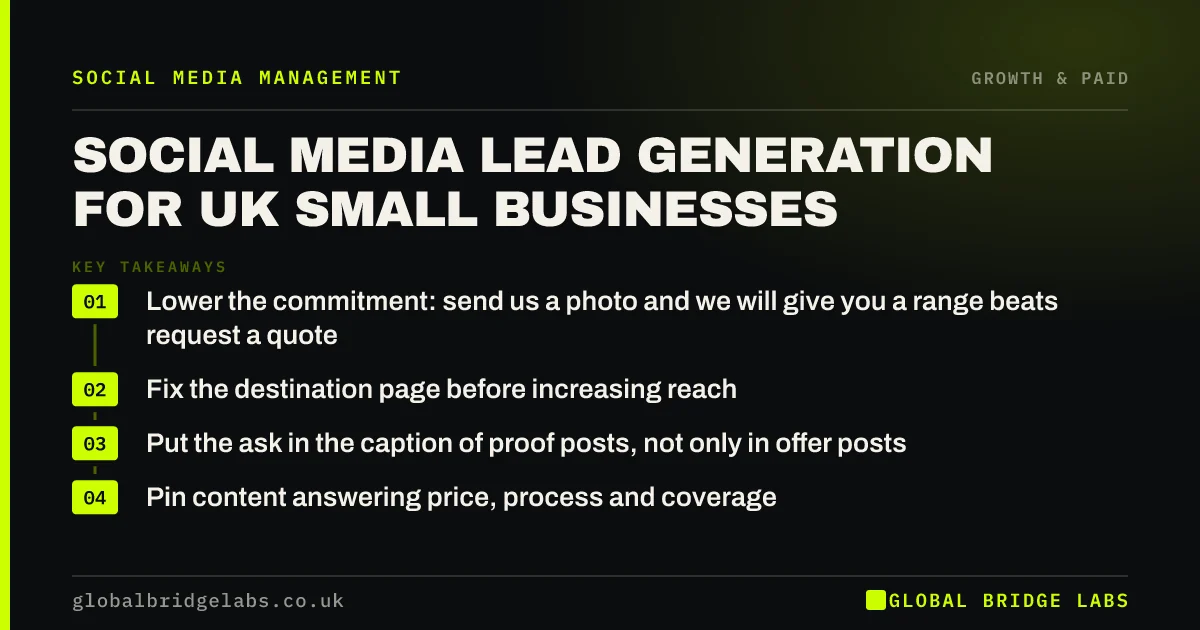
- Lower the commitment: send us a photo and we will give you a range beats request a quote.
- Fix the destination page before increasing reach. Traffic to a weak page is wasted budget.
- Put the ask in the caption of proof posts, not only in offer posts.
- Pin content answering price, process and coverage. Most visitors arrive with those questions.
- Response time is a conversion lever. Four working hours is the standard to hold.
Want a conversion review of your social profiles and landing page? Message us on WhatsApp.
Chat on WhatsApp →Why do businesses get reach but no leads?
Because reach and conversion are separate problems, and the second one is usually not on social media at all.
When we audit accounts with this symptom, the cause is nearly always one of three things: the destination page does not answer the questions the post raised, there is no explicit ask anywhere, or messages are answered too slowly. Producing more content fixes none of them.
What are the three conversion paths?
Understanding which one your buyers prefer determines where you should invest.
- Message: highest volume for local services, hospitality and trades. Lowest friction, fastest decay.
- Link to a page: best for considered purchases, e-commerce and B2B, where people want to read first.
- Call from profile: still dominant for urgent services. Make the number tappable and the hours accurate.
How do you lower the commitment of the ask?
Replace the request for a decision with a request for information. Request a quote asks someone to enter a sales process. Send us a photo of your space and we will give you a rough range asks for thirty seconds and gives something back.
This single change typically produces more enquiries than any content improvement, because it matches where the buyer actually is. They are not ready to commit; they are trying to find out whether you are worth talking to.
- Send a photo and we will give you a range.
- Tell us your postcode and we will confirm we cover you.
- Message us the date and we will check availability.
- Reply with your question and we will answer it here, no obligation.
We will rewrite your asks and test them. Message us on WhatsApp.
Chat on WhatsApp →What does the destination page need?
Four things above the fold on a phone: what you do, who for, an indication of cost, and one obvious action. Most small business pages manage the first and skip the rest.
We publish a 2.4x enquiry rate after website rebuilds, and that figure comes overwhelmingly from clarity rather than design. The pages that convert answer the buying questions immediately instead of describing the company.
How do you track which posts produce leads?
UTM tags on every link, a required source field on your enquiry form, and a note in your CRM when a conversation starts in messages. All three, because none of them sees the whole picture.
Then keep a simple monthly list of which posts generated conversations. After a quarter that list tells you what to make more of, and it is more useful than any platform analytics view.
What does this look like in practice?
A pattern in professional services: steady reach, a healthy following, and roughly one enquiry a month. The call to action on every post is get in touch, linking to a contact page with a form asking for nine fields.
Changing the ask to a specific question people can answer in a sentence, cutting the form to three fields and setting a four-hour response standard typically leaves reach untouched and moves enquiries substantially, entirely through changes downstream of the content.
How do you handle an enquiry once it arrives?
The first reply decides most of it. A reply that answers the question and asks exactly one thing back converts far better than one that redirects the person into a form or asks for a phone call before anything has been established.
Use a consistent structure: answer what was asked, give the range or the relevant constraint, ask the one thing you need to go further, and state what happens next. Four sentences.
Then track the handover. Enquiries lost between the social conversation and the quote are invisible in every analytics tool, and in most small businesses they are a larger leak than anything happening before the enquiry.
- Answer the question before asking for anything.
- Give a range or a constraint, not it depends.
- Ask exactly one thing back.
- State what happens next, with a timescale.
- Track where enquiries are lost between conversation and quote.
Next step
If you have attention and no enquiries, the fix is almost never more content. It is the ask, the destination and the response time.
Message us on WhatsApp for a conversion review of your social media and landing pages.
Chat on WhatsApp →Sources and further reading
- Meta Business Help Centre · Meta
- URL builders: collect campaign data with custom URLs · Google Analytics Help
Frequently asked questions
How do I get leads from social media?
Make the ask small, fix the page people land on, and reply within four working hours. Most businesses with reach but no enquiries have a weak destination or no explicit ask, neither of which is solved by producing more content.
What is the best call to action for social media?
One that asks for information rather than a decision, such as sending a photo for a rough price range or a postcode to confirm coverage. It matches where the buyer actually is, which is finding out whether you are worth talking to.
Should I send social traffic to my homepage?
No. Send it to a page that answers the question the post raised, with an indication of cost and one obvious action above the fold on a phone. Homepages describe the company; buyers arriving from social want the specific answer.
How do I know which posts generated enquiries?
Use UTM tags on links, a required source field on your enquiry form, and a CRM note when a conversation starts in messages. Expect the three to disagree, since self-reported attribution consistently credits social more than analytics can see.
Written by

Global Bridge Labs (GBL) is a UK–Sri Lanka partner for social media, websites and BPO. Everything here comes from client delivery, not theory.