On this page
- 01Key takeaways
- 02What are you paying an influencer for?
- 03How much do UK micro influencers charge?
- 04What does an agency charge to manage influencers?
- 05What are usage rights and why do they cost extra?
- 06What are the UK rules on paid influencer posts?
- 07When is influencer spend not worth it?
- 08What does this look like in practice?
- 09Influencer budget checklist
- 10Next step
- 11Sources and further reading
- 12Frequently asked questions
Key takeaways
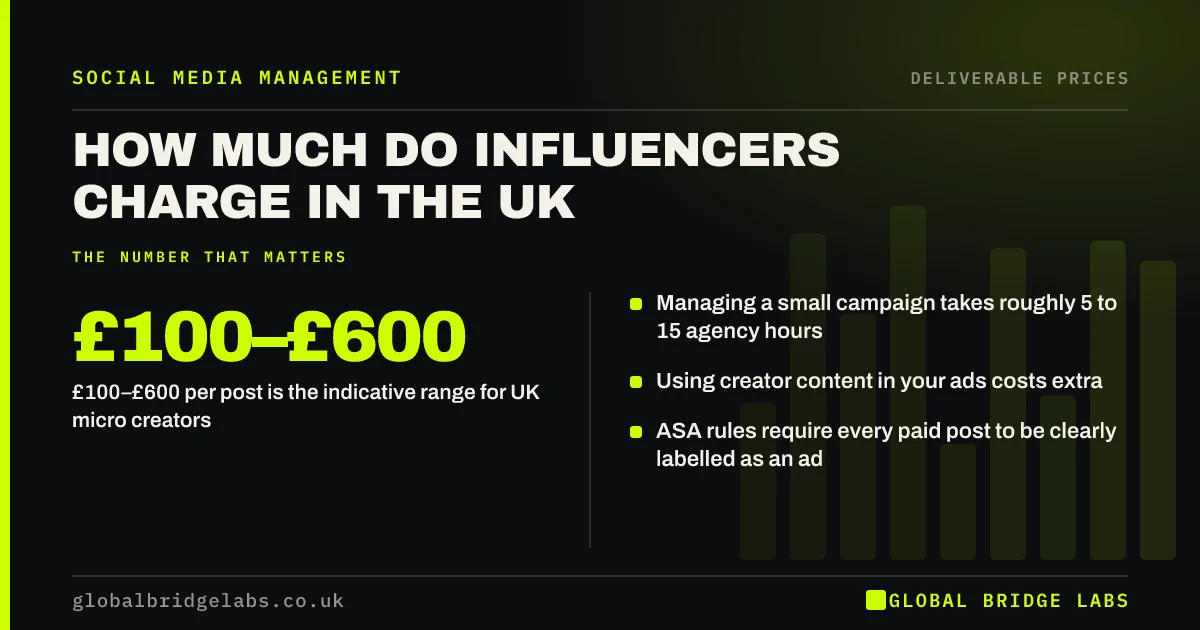
How much influencers charge in the UK depends on audience size, format and usage rights. As an indicative range, micro creators charge about £100–£600 per post. Fees rise steeply with audience size. An agency managing the campaign typically adds 5 to 15 hours of work, about £375–£1,500.
- £100–£600 per post is the indicative range for UK micro creators.
- Managing a small campaign takes roughly 5 to 15 agency hours.
- Using creator content in your ads costs extra.
- ASA rules require every paid post to be clearly labelled as an ad.
Want an influencer test costed for your budget? Message us on WhatsApp.
Chat on WhatsApp →What are you paying an influencer for?
An influencer fee pays for three things: making the content, posting it to their audience, and any right for you to reuse it. Many small businesses only need the first two. Reusing the content in your own ads or website is a separate licence and should be priced separately.
How much do UK micro influencers charge?
Micro creators, usually with a few thousand to a few tens of thousands of engaged followers, charge an indicative £100–£600 per post in the UK. Local creators with a tight audience are often at the lower end. Short video usually costs more than a photo post because it takes longer to make.
- Local micro creator, single photo post: indicative £100–£300.
- Micro creator, short video: indicative £250–£600.
- Story sets and extra posts: often bundled at a discount.
- Gifted product only: common for very small creators.
Want a creator shortlist priced for your area? Send us your brief on WhatsApp and we will discuss your requirements.
Chat on WhatsApp →What does an agency charge to manage influencers?
Managing a small influencer campaign means finding creators, checking their audience, briefing them, agreeing contracts, approving content and reporting results. For three to five creators that is roughly 5 to 15 hours, about £375–£1,500 at the £75–£100 an hour implied by typical UK retainers. Creator fees are on top.
- Creator research and audience checks.
- Briefs, contracts and ad labelling checks.
- Content approval and posting schedule.
- Tracking links, discount codes and a results report.
What are usage rights and why do they cost extra?
Usage rights let you reuse a creator's content outside their own feed, for example in your paid ads or on your website. Creators price this separately because it extends the value of their work. Agree the channels, the length of time and whether paid ads are included before the content is made.
What are the UK rules on paid influencer posts?
The Advertising Standards Authority (ASA) requires paid or gifted influencer posts to be obviously identifiable as ads, usually with a clear label such as "Ad" at the start. The business is responsible as well as the creator. Build the labelling into the brief and check every post before it goes live.
When is influencer spend not worth it?
Influencer spend is rarely worth it when the creator's audience does not match your buyers, or when you have no way to track results. A large national audience is wasted on a local plumber. Start with two or three local or niche creators, a tracking code each and a clear offer.
What does this look like in practice?
A pattern we see with UK hospitality and e-commerce clients: a small test with a handful of local micro creators, each with their own code, shows quickly which audience responds. Global Bridge Labs (GBL) briefs the creators, checks the ad labels and reports codes used, so the next round goes to the creators who brought customers.
Influencer budget checklist
Agree these before you pay any creator.
- Creator fee per post and what format it covers.
- Whether usage rights and paid ads are included.
- Ad labelling wording, checked before posting.
- A tracking link or code for each creator.
- Payment terms and what happens if a post is late.
Next step
Tell us your product, your area and your budget. We will tell you whether creators are a sensible test and what a first round should cost.
Message us on WhatsApp for an influencer test plan, or book a 30-minute consultation.
Chat on WhatsApp →Sources and further reading
- Influencers' guide to making clear that ads are ads · ASA / CAP
- Recognising ads: social media and influencer marketing · ASA / CAP
- Unfair commercial practices guidance (CMA207) · Competition and Markets Authority
Frequently asked questions
How much does a micro influencer charge in the UK?
As an indicative range, UK micro creators charge about £100–£600 per post. Local creators with smaller audiences sit at the lower end, and short video usually costs more than a photo post. Usage rights for your own ads are normally priced on top.
Do I have to label influencer posts as ads?
Yes. Under ASA rules, any post the creator is paid for, or given products or other benefits for, must be obviously identifiable as an ad. A clear label such as "Ad" at the start of the post is the safest approach. The business shares responsibility with the creator.
Is gifting cheaper than paying influencers?
Gifting can work with very small creators, but it is still advertising if you have control over the post, so labelling rules still apply. Gifting also gives you less control over timing and content. A small paid fee with a clear brief is often more reliable.
How do I measure influencer marketing results?
Give each creator their own tracking link or discount code, then compare clicks, code use and enquiries by creator. Reach and likes are easy to report but do not show sales. Judge the test on cost per customer, not cost per view.
Written by

Global Bridge Labs (GBL) is a UK–Sri Lanka partner for social media, websites and BPO. Everything here comes from client delivery, not theory.