On this page
- 01Key takeaways
- 02Why move followers on to an email list?
- 03What should you offer for an email address?
- 04Where should you ask followers to sign up?
- 05What are the UK consent rules?
- 06What should you send once they join?
- 07How many followers will sign up?
- 08When is an email list not worth building?
- 09What does this look like in practice?
- 10Email sign-up checklist
- 11Next step
- 12Sources and further reading
- 13Frequently asked questions
Key takeaways
To turn social media followers into email subscribers, offer something specific in return for an email address, ask in your bio, posts and stories, collect clear consent, and send something useful within minutes of sign-up. An email list lets you reach followers when you choose, instead of when the algorithm shows them a post.
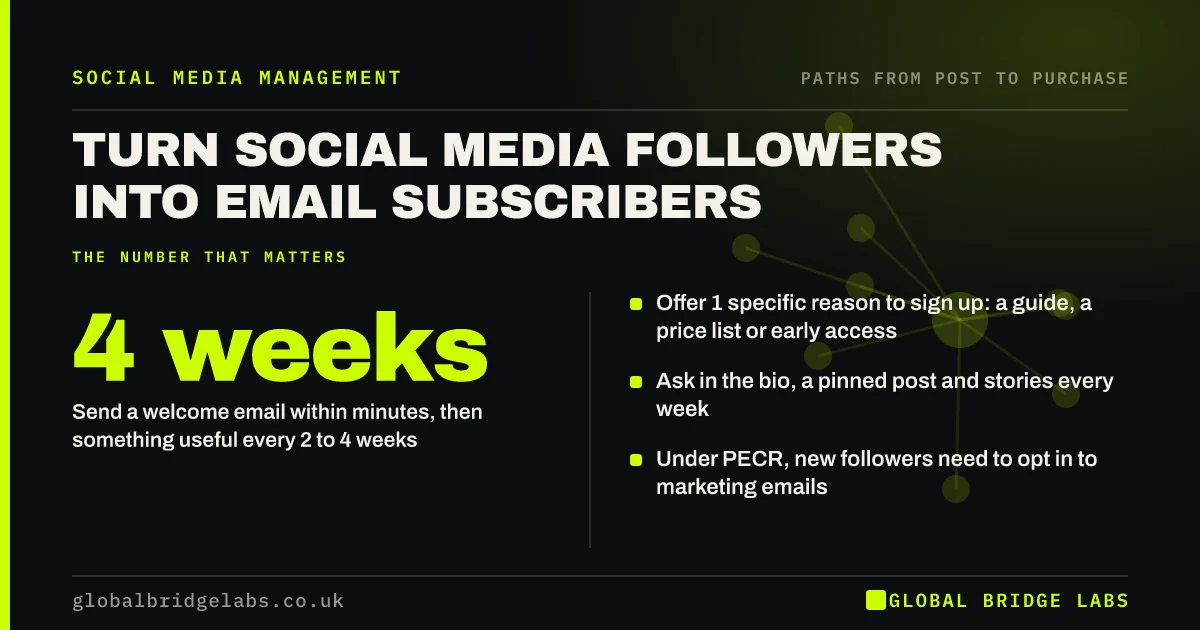
- Offer 1 specific reason to sign up: a guide, a price list or early access.
- Ask in the bio, a pinned post and stories every week.
- Under PECR, new followers need to opt in to marketing emails.
- Send a welcome email within minutes, then something useful every 2 to 4 weeks.
Want a sign-up offer and welcome sequence planned? Message us on WhatsApp.
Chat on WhatsApp →Why move followers on to an email list?
Move followers on to an email list because you own the list and rent the platform. Social platforms decide how many followers see each post and can change the rules or restrict an account. An email list reaches every subscriber who has not unsubscribed, at the moment you choose, which matters most for launches and offers.
What should you offer for an email address?
Offer something your buyer wants and that relates to what you sell: a price guide, a checklist, a short how-to, a seasonal planner, first access to new stock or a members-only offer. The more closely it matches the paid service, the more likely subscribers are to become customers later.
Where should you ask followers to sign up?
Ask where interested followers already look: the bio link, a pinned post, story highlights and the end of your most useful posts. Mention it in a story at least weekly. On Instagram, a comment keyword that sends the link by message works well, provided it follows Meta's messaging rules.
What are the UK consent rules?
Under the Privacy and Electronic Communications Regulations (PECR), you generally need consent to send marketing emails to individuals. The "soft opt-in" only applies to people who have bought from you or negotiated to buy, and only for similar products. So a follower who downloads a guide must clearly agree to receive marketing, by an unticked box or equivalent, and you must record when.
Tell people what you will send and how often, link to your privacy notice, and make it easy to unsubscribe in every email.
Unsure whether your sign-up form is compliant? Message us on WhatsApp and we will discuss your requirements.
Chat on WhatsApp →What should you send once they join?
Send the promised item straight away, then a short welcome sequence of two or three emails over the following week: who you are, a result for a customer like them, and your first offer. After that, send something useful every two to four weeks, with an offer in roughly one email in three.
How many followers will sign up?
Expect a small share. As an illustrative example, a business with 4,000 followers that promotes a useful guide every week might add 40 to 80 subscribers a month. That sounds modest, but each is someone you can reach directly and who has shown interest. Measure how many subscribers become customers, not just how many join.
When is an email list not worth building?
An email list is not worth building if you will not send anything, if your buyers decide in minutes at the point of need, or if a WhatsApp list suits your customers better. A list that is never emailed decays, and a sudden email after a year is often marked as spam.
What does this look like in practice?
A pattern we see: thousands of followers, no list, and a launch that reaches a fraction of them. A simple guide offered in the bio, with a two-email welcome sequence, gives the next launch a group of people who asked to hear about it.
Email sign-up checklist
- Create one sign-up offer that matches what you sell.
- Build a short form with clear consent wording.
- Link it from your bio and a pinned post.
- Mention it in a story every week.
- Send the welcome email within minutes.
- Track subscribers who become customers.
Next step
Pick the question customers ask most often and turn the answer into a one-page guide. That is your sign-up offer.
Message us on WhatsApp and we will help set up the sign-up and welcome emails, or book a 30-minute consultation.
Chat on WhatsApp →Sources and further reading
- Electronic and telephone marketing under PECR · Information Commissioner's Office
- What is valid consent? · Information Commissioner's Office
- Direct marketing and privacy and electronic communications · Information Commissioner's Office
- Right to be informed (privacy information) · Information Commissioner's Office
Frequently asked questions
How do I get my followers to join my email list?
Offer something specific and useful in return, such as a guide, price list or early access, and ask in your bio, a pinned post and weekly stories. Make sign-up a short form with clear consent, and deliver the promised item immediately so people trust the list.
Do I need consent to email people who follow me?
Yes. Following you on social media is not consent to marketing emails. Under PECR, individuals generally need to opt in. The soft opt-in only covers existing customers or people who negotiated to buy, for similar products. Record when and how each subscriber agreed.
How often should I email subscribers from social media?
Every two to four weeks suits most small businesses, after a short welcome sequence. Send something useful each time and make an offer in roughly one email in three. Long silences followed by sudden offers tend to increase unsubscribes and spam complaints.
Written by

Global Bridge Labs (GBL) is a UK–Sri Lanka partner for social media, websites and BPO. Everything here comes from client delivery, not theory.