
On this page
- 01Key takeaways
- 02Where do office costs come from in logistics?
- 03What does the office workload look like in numbers?
- 04What should you fix first?
- 05What does the saving look like?
- 06Which work can a managed team take?
- 07What are the risks?
- 08What does this look like in practice?
- 09Logistics admin checklist
- 10Next step
- 11Sources and further reading
- 12Frequently asked questions
Key takeaways
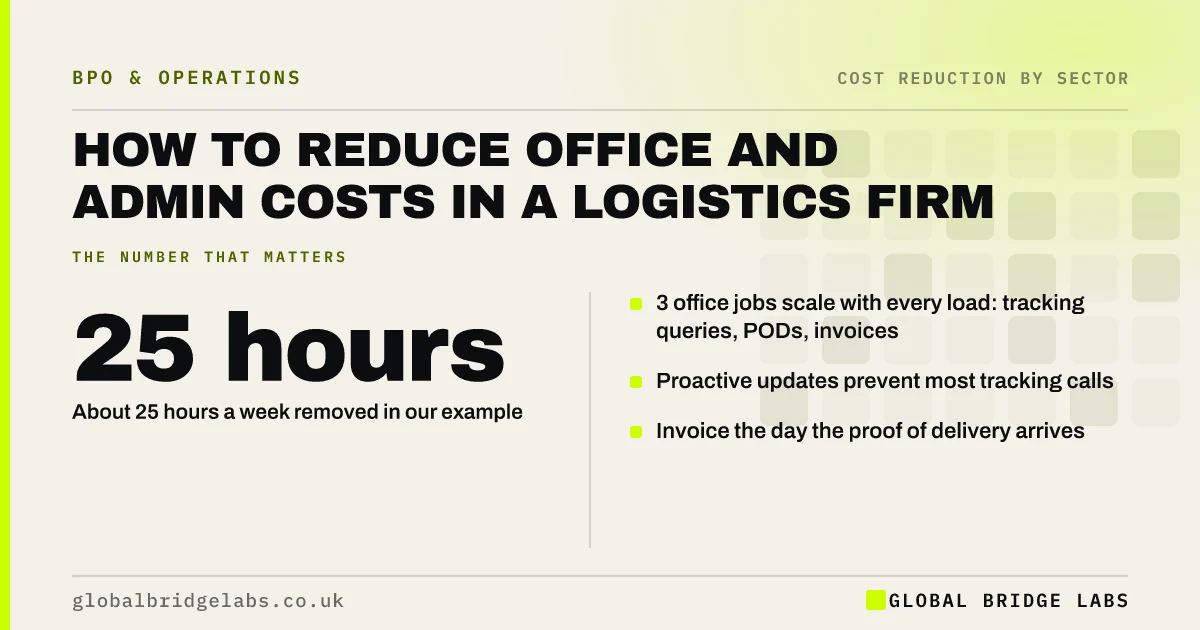
To reduce logistics admin costs, target the three jobs that fill a transport office: answering where-is-my-delivery queries, processing proof-of-delivery paperwork and raising invoices. All three scale with job numbers. In our example, proactive status updates and next-day invoicing remove about 25 hours a week of office work and bring cash in a week sooner.
- 3 office jobs scale with every load: tracking queries, PODs, invoices.
- About 25 hours a week removed in our example.
- Proactive updates prevent most tracking calls.
- Invoice the day the proof of delivery arrives.
Want your office workload per job calculated? Message us on WhatsApp with your weekly job count.
Chat on WhatsApp →Where do office costs come from in logistics?
Office costs in logistics come from the administration attached to every job: booking it, planning it, telling the customer where it is, collecting the proof of delivery (POD), raising the invoice and dealing with anything that went wrong. Margins per job are thin, so a few extra minutes of admin on each one matters.
What does the office workload look like in numbers?
Take an illustrative firm running 500 jobs a week. Tracking queries arrive on 30% of jobs, 150 a week at 5 minutes: 12.5 hours. POD handling takes 3 minutes a job: 25 hours. Invoicing takes 4 minutes a job: about 33 hours. Exceptions affect 6% of jobs, 30 at 30 minutes: 15 hours.
That is about 86 hours a week, more than two full-time roles, before booking and planning. At a loaded £19.81 per worked hour it is roughly £88,400 a year.
- Tracking queries: 12.5 hours a week.
- POD handling: 25 hours a week.
- Invoicing: about 33 hours a week.
- Exceptions: 15 hours a week.
What should you fix first?
Fix the queries that should not exist and the delays that hold up cash. Customers who are told when a delivery is out and when it has arrived do not ring to ask. PODs captured electronically do not need chasing or retyping.
- 1. Send automatic collected, out-for-delivery and delivered messages.
- 2. Capture PODs on a phone at the point of delivery.
- 3. Raise invoices the day the POD arrives.
- 4. Log every exception with a reason.
- 5. Give customers a tracking link.
What does the saving look like?
In the same illustrative firm, proactive updates halve tracking queries, saving about 6 hours a week. Electronic PODs cut handling from 3 minutes to 1, saving about 17 hours. Together that is roughly 23 hours, and trimming exceptions adds a couple more: about 25 hours a week.
The remaining office work, about 61 hours a week, can then be compared in-house and with a managed team. Invoicing a week sooner on £60,000 of weekly billing also releases around £60,000 of cash, once.
- How to reduce debtor days and the cost of waiting for cash
- Process cycle time: how to measure and shorten it
Want these numbers run for your operation? Send us your job volumes on WhatsApp and we will discuss your requirements.
Chat on WhatsApp →Which work can a managed team take?
A managed team can take customer tracking queries, booking confirmations, POD checking and filing, invoice preparation, statement reconciliation and payment chasing. A team in an earlier time zone can process the day's PODs overnight so invoices are ready by morning. Planning, driver management and commercial decisions stay with your own people.
What are the risks?
The risks are handing over exceptions nobody has documented and giving wide access to customer and consignment data. Start with routine queries and paperwork. Keep damage claims, disputes and anything involving a customer's commercial terms in-house until playbooks exist. Under UK GDPR, a written processor contract is required.
What does this look like in practice?
A pattern we see in transport offices: the phones are busiest in mid-afternoon, with customers asking whether a delivery has been made, at the moment the team is trying to plan the next day. The same people do both jobs badly. A message sent when each delivery completes quietens the phones and gives planning its time back.
Logistics admin checklist
Measure these over two typical weeks.
- Count tracking queries per 100 jobs.
- Time POD handling per job.
- Measure days from delivery to invoice.
- Log exceptions by reason.
- Calculate office hours per 100 jobs.
- Calculate debtor days.
Next step
Send us your weekly job count and how your office time splits between queries, paperwork and invoicing. We will show you what could be removed and what could be run at a lower cost per job.
Message us on WhatsApp for a logistics admin review, or book a 30-minute consultation.
Chat on WhatsApp →Sources and further reading
- Late commercial payments: charging interest and debt recovery · GOV.UK
- Contracts and liabilities between controllers and processors · Information Commissioner's Office
- National Minimum Wage and National Living Wage rates · GOV.UK
Frequently asked questions
How can a logistics company reduce administrative costs?
Send proactive delivery updates to prevent tracking queries, capture proof of delivery electronically, invoice as soon as the POD arrives and log exceptions by reason. Then compare the cost of the remaining office work in-house and with a managed team.
What back-office tasks can a haulage firm outsource?
Customer tracking queries, booking confirmations, POD checking and filing, invoice preparation, statement reconciliation and payment chasing are commonly outsourced. Route planning, driver management, claims and commercial negotiations usually stay in-house. Start with routine queries and paperwork, and add more as playbooks are written.
Why does late invoicing cost a logistics firm money?
Because payment terms start when the invoice is sent. If PODs take a week to reach the office and be processed, every customer effectively gets an extra week of credit. On thin margins, the financing cost and cash strain are significant.
How do you reduce where-is-my-delivery calls?
Tell customers before they ask. Automatic messages at collection, out for delivery and delivered, plus a tracking link, remove most status calls. Tag the calls that remain by reason to find what the messages are not covering.
Written by

Global Bridge Labs (GBL) is a UK–Sri Lanka partner for social media, websites and BPO. Everything here comes from client delivery, not theory.


