
On this page
- 01Key takeaways
- 02What is the follow-the-sun model?
- 03How does the time difference work in practice?
- 04What does it save?
- 05Which work suits an overnight handover?
- 06Where does the model not fit?
- 07What must be in place for it to work?
- 08What does this look like in practice?
- 09Follow-the-sun checklist
- 10Next step
- 11Sources and further reading
- 12Frequently asked questions
Key takeaways
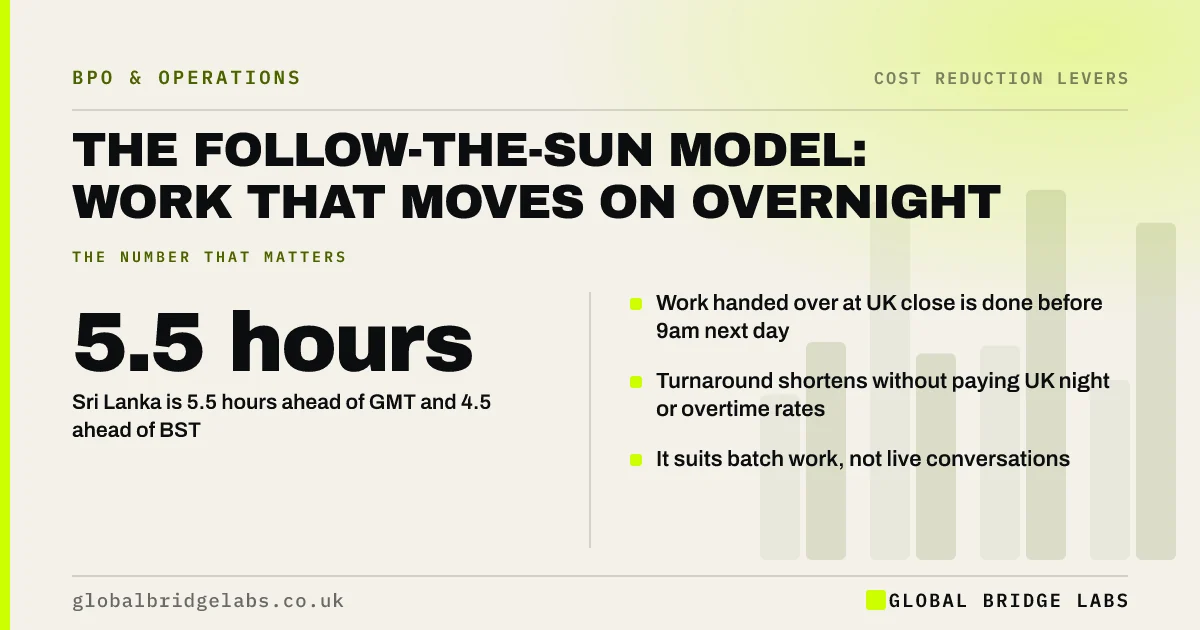
The follow the sun model passes work between teams in different time zones so it progresses while one location sleeps. For a UK business with a team in Sri Lanka, which is 5.5 hours ahead of GMT, work left at close of day can be finished before the UK office opens. The gain is shorter turnaround without night-shift pay.
- Work handed over at UK close is done before 9am next day.
- Sri Lanka is 5.5 hours ahead of GMT and 4.5 ahead of BST.
- Turnaround shortens without paying UK night or overtime rates.
- It suits batch work, not live conversations.
Want to see which of your work could move on overnight? Message us on WhatsApp with your daily cut-off times.
Chat on WhatsApp →What is the follow-the-sun model?
The follow-the-sun model is a way of organising work so that it is handed from one location to another as each working day ends, giving continuous progress across time zones. Large companies use it for round-the-clock support. A small business can use a simpler version: one handover, each evening, to a team that starts earlier.
How does the time difference work in practice?
Sri Lanka is 5 hours 30 minutes ahead of Greenwich Mean Time and 4 hours 30 minutes ahead of British Summer Time. A team starting at 8am in Colombo is at work from 2.30am UK time in winter. Anything queued by UK staff at 5.30pm is waiting when that team starts, and can be complete by the time the UK office opens at 9am.
The UK and Sri Lankan working days also overlap for several hours each morning, which leaves time for questions and handback in real time.
What does it save?
It saves elapsed time first and money second. A task that would wait overnight is done by morning, so orders ship a day sooner, invoices go out a day earlier and customers who emailed in the evening have an answer at breakfast. The money comes from not paying overtime or a UK evening shift to achieve the same thing.
Take an illustrative firm that keeps one employee back for two hours each evening to clear the day's orders. At time and a half on a loaded £19.81, that is about £29.70 an hour, or roughly £15,400 a year for 520 hours. The same hours at an indicative £12 cost £6,240, done in normal working time for the team concerned.
- Rising overtime costs: when outsourcing is cheaper
- Process cycle time: how to measure and shorten it
- Cost of delay: what waiting costs a small business
Want your overtime compared with an overnight handover? Send us the hours on WhatsApp.
Chat on WhatsApp →Which work suits an overnight handover?
Work suits an overnight handover when it can be queued, done without asking anyone, and checked in the morning. It needs a clear cut-off and a clear definition of finished.
- Order entry and dispatch paperwork.
- Invoice raising, matching and reconciliation.
- Data entry and CRM updates from the day's activity.
- Replies to email received after UK closing time.
- Daily reports ready for the morning meeting.
Where does the model not fit?
The model does not fit work that needs a live conversation with a UK customer during UK hours, a decision from someone who is asleep, or physical presence. It also fails when handover notes are poor. If the overnight team has to guess, the work comes back wrong and the day gained is lost.
What must be in place for it to work?
Three things: a written process, a handover routine and a safe way to share data. Under UK GDPR, sending personal data to a team outside the UK is an international transfer and needs an appropriate safeguard and a written contract with the provider. Working hours matter too. A reputable provider schedules ordinary day shifts, not permanent nights.
- A daily cut-off time and a shared queue.
- Handover notes in one agreed format.
- Named contact for morning queries.
- A processor contract and transfer safeguard.
What does this look like in practice?
A pattern we see in firms that take orders all day: the last hour of the afternoon is a rush to clear the queue, errors rise, and whatever is left greets the team in the morning. Moving the queue to a team that works while the UK sleeps turns the morning from catching up into starting fresh.
Follow-the-sun checklist
Check these before setting up an overnight handover.
- The work can be queued and done without questions.
- A daily cut-off time is agreed.
- Handover notes follow one template.
- Finished is defined for each task.
- Morning overlap is used for queries.
- Data transfer safeguards are in place.
Next step
Tell us what is usually left undone at the end of your working day. We will show you which of it could be finished overnight and what the handover would need.
Message us on WhatsApp to plan an overnight handover, or book a 30-minute consultation.
Chat on WhatsApp →Sources and further reading
- International transfers of personal data · Information Commissioner's Office
- Overtime: your rights · GOV.UK
- Maximum weekly working hours · GOV.UK
Frequently asked questions
What does follow the sun mean in business?
Follow the sun means passing work between teams in different time zones so that someone is always working on it during their normal day. As one office closes, another takes over. It shortens turnaround and provides longer service hours without night shifts.
Can a small business use a follow-the-sun model?
Yes, in a simple form. A small business does not need three global offices. One evening handover to a managed team in an earlier time zone is enough to have orders, invoices or email replies completed before the UK working day begins.
What is the time difference between the UK and Sri Lanka?
Sri Lanka is 5 hours 30 minutes ahead of the UK in winter, when the UK is on Greenwich Mean Time, and 4 hours 30 minutes ahead in summer, during British Summer Time. Sri Lanka does not change its clocks.
What are the risks of follow-the-sun working?
The main risks are poor handovers, work done on wrong assumptions because nobody was available to ask, and data shared without proper safeguards. Each is controlled with a written process, a standard handover note, a morning overlap for queries and a compliant data transfer arrangement.
Written by

Global Bridge Labs (GBL) is a UK–Sri Lanka partner for social media, websites and BPO. Everything here comes from client delivery, not theory.


