
On this page
- 01Key takeaways
- 02What is process cycle time?
- 03How is cycle time different from lead time?
- 04Why does a long cycle time cost money?
- 05How do you measure it?
- 06How do you shorten cycle time?
- 07How can a managed team help?
- 08When is faster not better?
- 09What does this look like in practice?
- 10Cycle time checklist
- 11Next step
- 12Sources and further reading
- 13Frequently asked questions
Key takeaways
Process cycle time is how long one item takes to pass through a process from start to finish. It matters to cost because delay creates work: chasing, status queries and re-reading. Most cycle time is waiting, so the way to shorten it is to remove queues and handoffs, not to ask people to work faster.
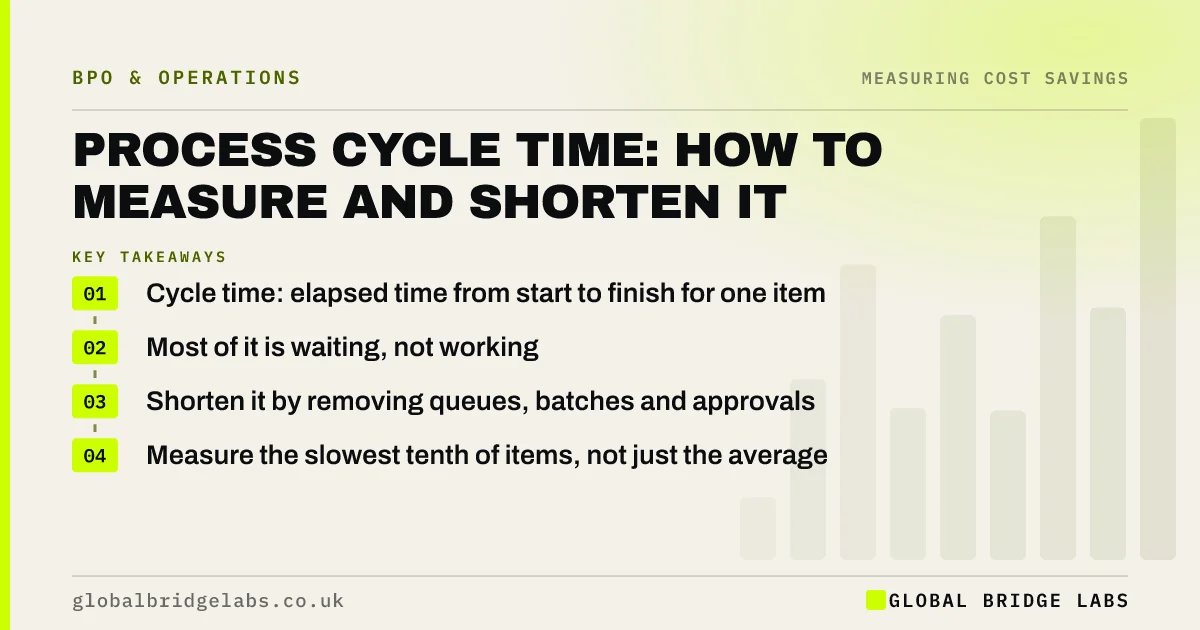
- Cycle time: elapsed time from start to finish for one item.
- Most of it is waiting, not working.
- Shorten it by removing queues, batches and approvals.
- Measure the slowest tenth of items, not just the average.
Want one of your processes timed end to end? Message us on WhatsApp with the process.
Chat on WhatsApp →What is process cycle time?
Process cycle time is the total elapsed time taken to complete one unit of work, measured from the moment work begins to the moment it is finished. It includes both the time someone is working on the item and the time it sits waiting.
How is cycle time different from lead time?
Lead time is what the customer experiences: from making the request to receiving the result. Cycle time is what the business does: from starting the work to finishing it. The gap between them is the time a request waits before anyone begins. Touch time is the portion of cycle time when work is really being done.
- Lead time: request received to result delivered.
- Cycle time: work started to work finished.
- Touch time: minutes of real work within the cycle.
Why does a long cycle time cost money?
A long cycle time costs money because waiting generates work. Customers ask for updates. Staff reopen the case and re-read it. Information goes stale and has to be checked again. Cash arrives later. None of that would exist if the item had been finished in one sitting.
How do you measure it?
Measure it from timestamps your systems already record: when a ticket was opened and closed, when an order was placed and dispatched, when a job finished and its invoice was sent. Take a month of items and calculate the average, the median and the time within which 90% were completed.
In an illustrative month of 300 quotes, the average is 3.2 days, the median is 2 and the 90th percentile is 8. The average looks acceptable. One customer in ten waits more than a week.
- Cost baseline: measure today's cost before you change it
- Cost reduction KPIs: the numbers that prove savings are real
Want your cycle time calculated from system data? Send us an export on WhatsApp.
Chat on WhatsApp →How do you shorten cycle time?
Shorten it by removing the waits. Look at where items sit between steps and ask why. The common causes are batching, approvals, handoffs and missing information.
- 1. Process items as they arrive instead of in batches.
- 2. Replace approvals with value limits.
- 3. Let one person complete what several used to share.
- 4. Collect all required information at the start.
- 5. Add capacity at the step where work queues.
How can a managed team help?
A managed team helps in two ways. It adds capacity at the step where work is queuing, and a team in an earlier time zone can complete work overnight so it does not wait until morning. Neither helps if the delay is an approval sitting in the owner's inbox. Find the queue first.
When is faster not better?
Faster is not better when speed is bought with errors, or when the customer does not value it. Rushing a complex quote to save a day can lose the job. For some work, a reliable date matters more than an early one. Aim for consistency first, then speed.
What does this look like in practice?
A pattern we see with quotes and proposals: the work itself takes under an hour, and customers wait most of a week. The quote is drafted on Monday, waits for a price check until Wednesday and for sign-off until Friday. Two approvals, neither of which changes anything most of the time, account for almost all of it.
Cycle time checklist
Use this for any customer-facing process.
- Start and end points are defined.
- A month of timestamps is collected.
- Average, median and 90th percentile are known.
- The longest waits are identified.
- One wait is removed this month.
- Error rate is tracked alongside.
Next step
Tell us which process your customers say is slow. We will help you time it properly and find the wait that is worth removing first.
Message us on WhatsApp to shorten a slow process, or book a 30-minute consultation.
Chat on WhatsApp →Sources and further reading
- Labour productivity · Office for National Statistics
- UK Customer Satisfaction Index · Institute of Customer Service
Frequently asked questions
What is cycle time in a business process?
Cycle time is the elapsed time from when work starts on an item to when it is completed. It includes time spent working and time spent waiting between steps. It is a core measure of process speed and a strong indicator of hidden delay.
What is the difference between cycle time and lead time?
Lead time runs from the customer's request to delivery. Cycle time runs from when work begins to when it ends. Lead time is always equal to or longer than cycle time, because it includes any wait before the work starts.
How can cycle time be reduced?
Remove waiting. Process items as they arrive instead of in batches, replace approvals with limits, reduce handoffs, gather complete information at the start and add capacity at the step where work queues. Working faster on individual steps usually makes little difference.
Why look at the 90th percentile and not the average?
The average hides the worst cases. If most items take two days and one in ten takes over a week, the average looks fine while a tenth of customers have a poor experience. The 90th percentile shows what your slower cases feel like.
Written by

Global Bridge Labs (GBL) is a UK–Sri Lanka partner for social media, websites and BPO. Everything here comes from client delivery, not theory.


