On this page
- 01Key takeaways
- 02What is outsourced credit control?
- 03Why do small businesses struggle to get paid on time?
- 04What does an outsourced credit control team do?
- 05What does UK law say about late payment?
- 06What does outsourced credit control cost?
- 07How do you keep customer relationships intact?
- 08What data and security controls are needed?
- 09When should credit control stay in-house?
- 10What does this look like in practice?
- 11Checklist: set up credit control
- 12Next step
- 13Sources and further reading
- 14Frequently asked questions
Key takeaways
Outsourced credit control in the UK means a managed team raises your invoices on time and runs a polite, consistent chasing sequence until they are paid, escalating disputes and long-overdue accounts to you. It suits businesses where invoices go out late and chasing happens only when cash gets tight.
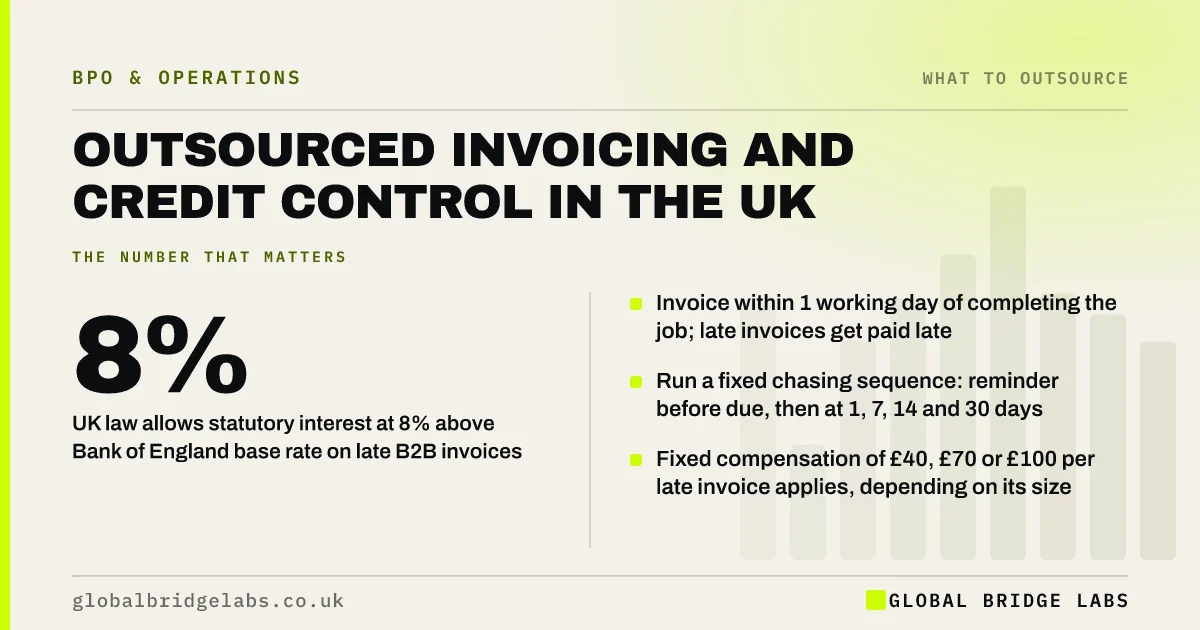
- UK law allows statutory interest at 8% above Bank of England base rate on late B2B invoices.
- Invoice within 1 working day of completing the job; late invoices get paid late.
- Run a fixed chasing sequence: reminder before due, then at 1, 7, 14 and 30 days overdue.
- Fixed compensation of £40, £70 or £100 per late invoice applies, depending on its size.
- Keep disputes, payment plans and legal action decisions in-house.
Owed more than you should be? Message us on WhatsApp with your debtor days and we will tell you what a chasing routine would change.
Chat on WhatsApp →What is outsourced credit control?
Outsourced credit control is a back-office business process outsourcing (BPO) service in which a provider's team manages the steps between completing work and getting paid: raising invoices, sending statements, chasing overdue payments, logging promises to pay and reconciling receipts, under your procedures and in your name.
It is not debt collection. The team acts as your accounts department, maintaining the customer relationship, rather than as a third-party agency that takes over the debt.
Why do small businesses struggle to get paid on time?
Small businesses struggle because invoicing and chasing compete with delivering the work, and delivering the work always wins. Invoices go out days or weeks after the job, reminders are sent when someone remembers, and awkward phone calls get put off.
Customers notice which suppliers chase and which do not, and pay the ones that chase first. A consistent routine is often enough to change the order.
What does an outsourced credit control team do?
The team runs the routine every working day, so nothing depends on someone finding time.
- Raise invoices from job sheets, timesheets or completed orders.
- Send polite reminders before the due date.
- Chase overdue invoices by email and phone to a fixed sequence.
- Log promises to pay and follow up if they are missed.
- Reconcile payments received against invoices.
- Report aged debt weekly and flag disputes to you.
What does UK law say about late payment?
Under the Late Payment of Commercial Debts (Interest) Act 1998, businesses can claim statutory interest on late payments from other businesses at 8% above the Bank of England base rate, plus fixed compensation of £40 for debts under £1,000, £70 for £1,000 to £9,999.99, and £100 for £10,000 or more.
GOV.UK guidance says that where no payment date is agreed, payment is late 30 days after the customer receives the invoice or the goods or service are delivered, whichever is later. Business-to-business payment terms should usually be no longer than 60 days. These rights do not apply to consumers. Whether to claim them is a commercial decision that should stay with you.
What does outsourced credit control cost?
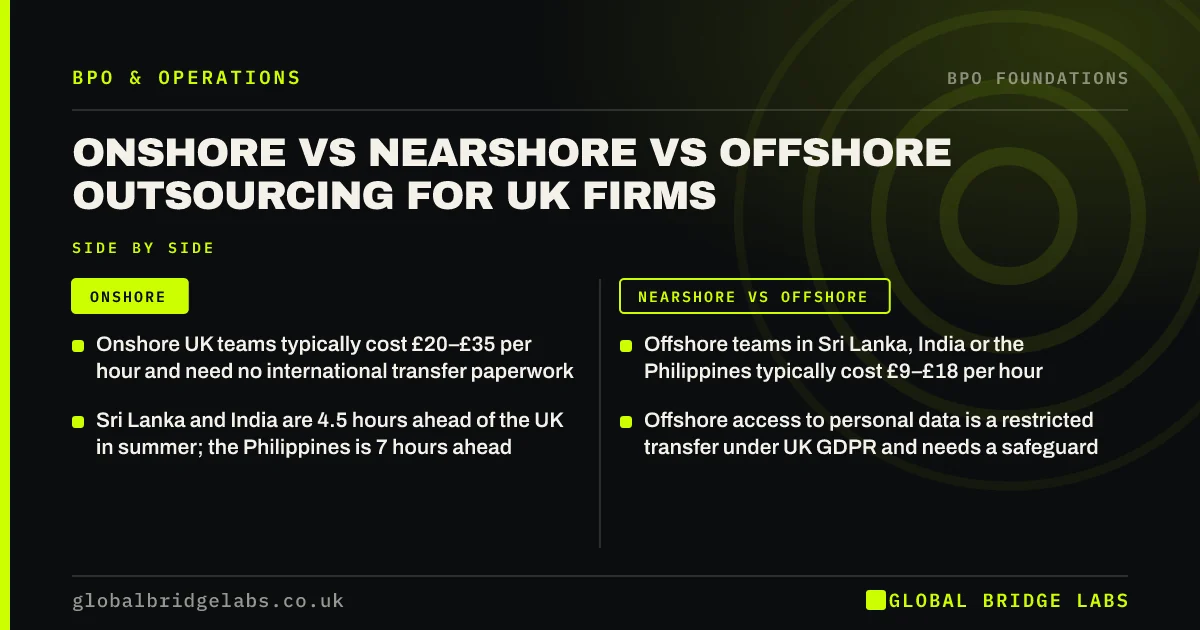
As indicative market ranges, managed offshore finance admin costs around £9–£18 per hour and onshore UK credit control specialists around £20–£35. Many SMEs need a part-time seat. Some UK providers charge a percentage of collected debt instead, which suits one-off recovery more than an ongoing routine.
The return is measured in debtor days: the average time customers take to pay. Bringing cash in faster reduces overdraft costs and the risk of bad debts, and it usually outweighs the cost of the seat.
Want a costed plan for invoicing and chasing? Send us your monthly invoice count on WhatsApp and we will discuss your requirements.
Chat on WhatsApp →How do you keep customer relationships intact?
Keep relationships intact by chasing politely, consistently and in your name. Write the templates yourself, set the tone for each stage, and flag key accounts that should be handled differently. Customers rarely object to a friendly reminder; they object to surprise demands after weeks of silence.
Make escalation clear. Disputes, requests for payment plans and anything that might end in legal action go to you with the full history.
What data and security controls are needed?
Finance data needs tight controls. Give the team access to invoicing and accounts software with permissions limited to what they need: raising invoices, viewing receipts and sending reminders, but not changing bank details or making payments. A processor contract is required, and if the team is offshore, a UK GDPR transfer safeguard.
Invoice fraud through changed bank details is a common scam. Never let bank details be changed on an email request; confirm by phone with a known contact.
When should credit control stay in-house?
Keep it in-house if you have a handful of large clients whose payments are tied to relationship conversations, or if most invoices involve complex disputes. You can still outsource invoice preparation and reconciliation.
What does this look like in practice?
A pattern we see in construction and professional services: invoices raised in batches at month end, no reminders, and the owner phoning customers when the bank balance dips. A daily invoicing routine and a five-step chasing sequence, run by a team, usually shortens payment times without a single difficult conversation.
Checklist: set up credit control
Prepare these before handing over.
- Measure current debtor days and aged debt.
- Set an invoicing deadline after job completion.
- Write templates for each stage of the chasing sequence.
- List key accounts with special handling.
- Define what the team escalates and to whom.
- Limit software permissions; block bank detail changes.
- Review aged debt weekly with the team.
Next step
Tell us your invoice volumes and debtor days and we will design the invoicing and chasing routine, with the cost. 30 minutes, no pitch.
Message us on WhatsApp for a credit control plan, or book a 30-minute consultation.
Chat on WhatsApp →Sources and further reading
- Late commercial payments: charging interest and debt recovery · GOV.UK
- Contracts and liabilities between controllers and processors · Information Commissioner's Office
- Cyber security breaches survey 2025/2026 · DSIT and Home Office
Frequently asked questions
What is the difference between credit control and debt collection?
Credit control is the routine of invoicing and chasing your own customers, in your name, to keep payments on time and relationships intact. Debt collection is recovery of seriously overdue debts, often by a third-party agency or through legal steps. Outsourced credit control is designed to stop debts reaching collection.
Can I charge interest on late invoices in the UK?
Yes, for business-to-business debts. The Late Payment of Commercial Debts (Interest) Act 1998 allows statutory interest at 8% above the Bank of England base rate, plus fixed compensation of £40, £70 or £100 depending on the debt size. It does not apply to consumer debts.
How often should overdue invoices be chased?
Use a fixed sequence: a reminder a few days before the due date, then contact on the due date or day after, then at around 7, 14 and 30 days overdue, moving from email to phone. Consistency matters more than frequency. Escalate disputes to the owner quickly.
Is it safe to outsource invoicing?
Yes, with limited permissions: the team should raise invoices, see receipts and send reminders but not change bank details or make payments. Use individual logins, multi-factor authentication and a processor contract, plus a transfer safeguard if the team is outside the UK.
Written by

Global Bridge Labs (GBL) is a UK–Sri Lanka partner for social media, websites and BPO. Everything here comes from client delivery, not theory.