
On this page
- 01Key takeaways
- 02What is a process exception?
- 03Why do exceptions cost so much?
- 04How do you measure exceptions?
- 05How do you reduce exceptions?
- 06How do you handle the ones that remain?
- 07Can an outsourced team handle exceptions?
- 08What does this look like in practice?
- 09Exception handling checklist
- 10Next step
- 11Sources and further reading
- 12Frequently asked questions
Key takeaways
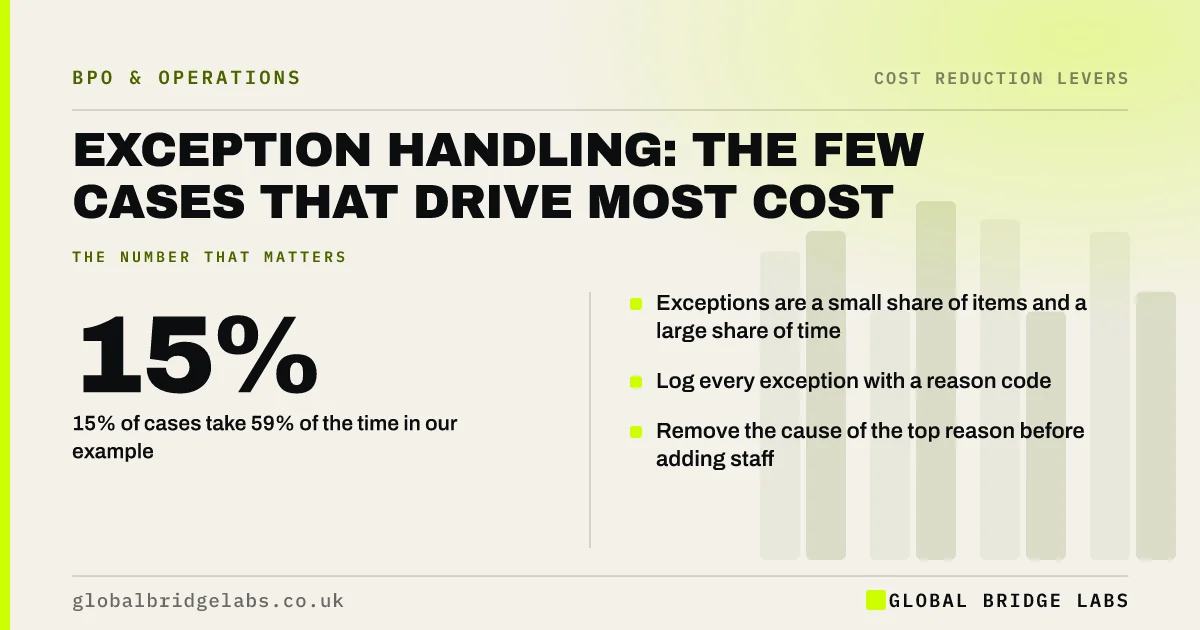
Exception handling in business processes is how a team deals with items that do not fit the standard route. Exceptions are a minority of volume and a majority of effort. In our example, 15% of cases take 59% of the time. Designing a clear route for them, and removing the causes of the commonest, lowers cost faster than speeding up routine work.
- Exceptions are a small share of items and a large share of time.
- 15% of cases take 59% of the time in our example.
- Log every exception with a reason code.
- Remove the cause of the top reason before adding staff.
Want to find out what exceptions cost you? Message us on WhatsApp with the process.
Chat on WhatsApp →What is a process exception?
A process exception is any item that cannot be completed by following the standard steps. It might have missing information, an unusual request, a mismatch between two records, or a rule that does not cover it. Someone has to stop, investigate and decide what to do.
Why do exceptions cost so much?
Exceptions cost so much because they need investigation and usually a more senior person. A routine item follows a script. An exception needs someone to find out what happened, contact a customer or colleague, wait for an answer and then decide. The handling time is many times longer and the item often changes hands.
Take an illustrative 1,000 cases a month where a routine case takes 5 minutes and an exception takes 40. With 150 exceptions, routine work uses about 71 hours and exceptions use 100. Fifteen per cent of the cases consume 59% of the time.
- 850 routine cases at 5 minutes: about 71 hours.
- 150 exceptions at 40 minutes: 100 hours.
- Exceptions: 15% of volume, 59% of time.
How do you measure exceptions?
Measure exceptions by logging each one with a reason code, the time it took and who resolved it. A simple shared sheet is enough. After a month, the reasons will cluster. Three or four causes typically account for most of the list, and each points to a fix upstream.
- 1. Define what counts as an exception.
- 2. Agree six to ten reason codes.
- 3. Log every exception for a month.
- 4. Rank reasons by total time, not count.
- 5. Trace the top reason to its source.
How do you reduce exceptions?
Reduce exceptions by fixing what creates them. Missing information is solved at the form or the brief. Mismatched records are solved by connecting systems. Unusual requests are solved by a clearer offer or a price for the non-standard option. An exception that keeps recurring should become a rule.
- The cost of complexity: when variety eats your margin
- Double data entry: what rekeying costs and how to stop it
- Process standardisation: one best way, lower cost per task
Want help ranking your exceptions by cost? Send us a week of examples on WhatsApp.
Chat on WhatsApp →How do you handle the ones that remain?
Handle the remainder with a separate, deliberate route. Take exceptions out of the main flow so they do not block routine items. Give the handler authority to decide within set limits. Write a short playbook for each common type, and set a time limit after which the case is escalated.
- A separate queue so routine work keeps moving.
- Clear authority limits for the handler.
- A one-page playbook per common exception.
- An escalation rule with a time limit.
Can an outsourced team handle exceptions?
An outsourced team can handle exceptions that have a playbook and clear limits, and should escalate the rest. Trying to hand over every exception on day one usually fails, because the knowledge to resolve them has never been written down. Start with routine volume, log exceptions together, and move each type across as its playbook is written.
What does this look like in practice?
A pattern we see in finance and order admin: the most experienced person spends most of the week on problem cases, and is seen as indispensable because only they know how to resolve them. Logging those cases for a month shows a handful of recurring types. Once each has a written route, the knowledge is no longer in one head.
Exception handling checklist
Use this to bring exceptions under control.
- Exceptions are defined and logged.
- Each has a reason code and a time.
- The top three reasons have an upstream owner.
- Exceptions run in a separate queue.
- Handlers have written authority limits.
- Common types have a playbook.
- The exception rate is reported monthly.
Next step
Tell us which process generates the most problem cases. We will help you set up a simple exception log and work out what the top causes are costing.
Message us on WhatsApp for an exception review, or book a 30-minute consultation.
Chat on WhatsApp →Sources and further reading
- Labour productivity · Office for National Statistics
- UK Customer Satisfaction Index · Institute of Customer Service
Frequently asked questions
What is exception handling in a business process?
Exception handling is the way a business deals with cases that fall outside the standard process, such as an order with missing details or an invoice that does not match. It covers how exceptions are identified, who resolves them, what authority they have and when a case is escalated.
What is a normal exception rate?
It depends on the process and how well input is controlled, so there is no reliable universal figure. Measure your own rate, then judge the trend. What matters more than the rate is the share of total time exceptions consume, which is usually far higher than their share of volume.
Should exceptions be automated?
Rarely at first. Exceptions are the cases rules did not anticipate, so they need judgement. Once a type recurs often enough to have a clear answer, it can be turned into a rule and automated. Until then, a trained person with a playbook is the reliable option.
Who should handle process exceptions?
Someone with enough knowledge and authority to resolve them without several referrals. In a small business that is often a senior person by default. Writing playbooks for the common types lets less senior staff or a managed team take them, leaving only the truly unusual cases for escalation.
Written by

Global Bridge Labs (GBL) is a UK–Sri Lanka partner for social media, websites and BPO. Everything here comes from client delivery, not theory.


