
On this page
- 01Key takeaways
- 02What is straight-through processing?
- 03Why do touches cost so much?
- 04How do you measure your straight-through rate?
- 05How do you raise the rate?
- 06Where should people stay involved?
- 07How does a managed team fit?
- 08What does this look like in practice?
- 09Straight-through processing checklist
- 10Next step
- 11Sources and further reading
- 12Frequently asked questions
Key takeaways
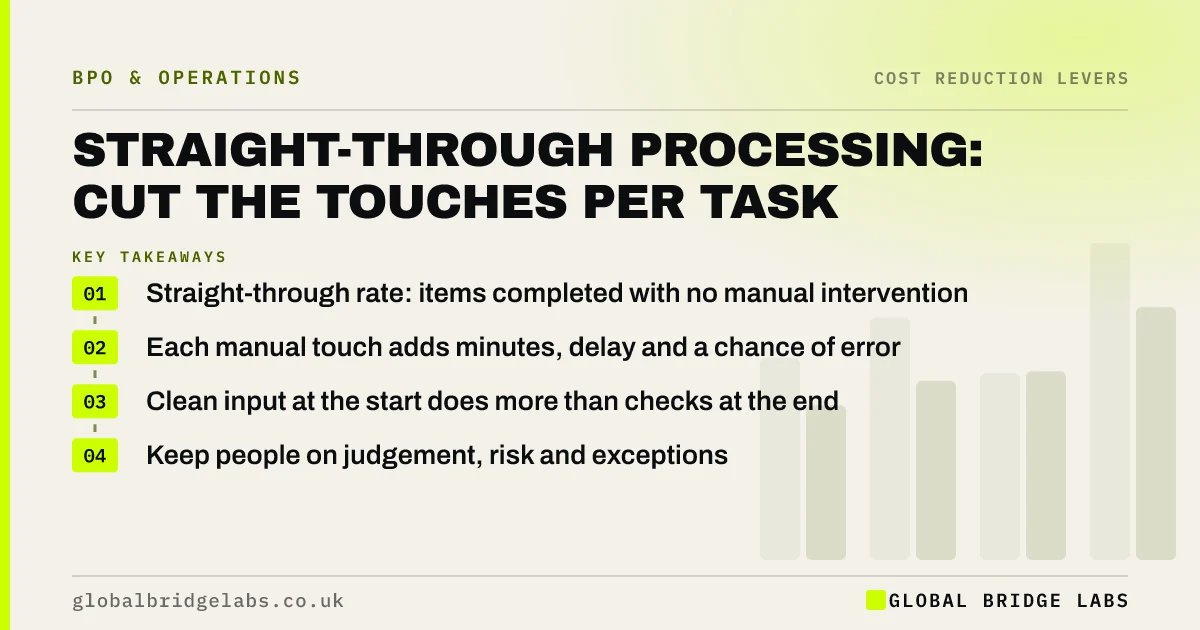
Straight-through processing means an item passes from start to finish without anyone having to stop and fix, check or retype it. The share of items that do so is the straight-through rate. Raising it is one of the surest ways to cut operating cost, because the items that need manual touches consume most of a team's time.
- Straight-through rate: items completed with no manual intervention.
- Each manual touch adds minutes, delay and a chance of error.
- Clean input at the start does more than checks at the end.
- Keep people on judgement, risk and exceptions.
Want your straight-through rate measured? Message us on WhatsApp with the process and monthly volume.
Chat on WhatsApp →What is straight-through processing?
Straight-through processing (STP) is the handling of a transaction from entry to completion without manual intervention. The term comes from financial services, where it describes payments and trades that settle automatically. In a small business it applies to orders, invoices, bookings and forms that flow through without anyone correcting them.
Why do touches cost so much?
Touches cost so much because each one is an interruption, not just a task. Someone has to notice the item, open it, work out what is wrong, find the missing information and restart the process. The few minutes of correction sit inside a much longer delay while the item waits its turn.
How do you measure your straight-through rate?
Count the items that completed without any manual correction or query and divide by the total. Use a month of data. Then list why the others needed a touch. In an illustrative firm processing 500 web orders a month, 350 go straight through and 150 need attention: a 70% straight-through rate.
If a clean order takes 2 minutes of handling and a touched one takes 14, the 350 clean orders use about 12 hours and the 150 touched ones use 35. Less than a third of the orders take three-quarters of the time.
- Straight-through rate: 70%.
- Clean orders: 350 at 2 minutes, about 12 hours.
- Touched orders: 150 at 14 minutes, 35 hours.
- Cost baseline: measure today's cost before you change it
- Right first time rate: the quality number that cuts cost
Want this split calculated for your orders or invoices? Send us a month of figures on WhatsApp.
Chat on WhatsApp →How do you raise the rate?
Raise the rate by fixing input before it enters the process. Most touches come from missing or inconsistent information: an address without a postcode, an invoice without an order number, a form with a free-text field where a choice was needed. Required fields, validation and clear instructions prevent them.
- Make essential fields compulsory at the point of entry.
- Replace free text with choices where answers repeat.
- Validate formats such as postcodes and reference numbers.
- Connect systems so data is entered once.
- Set rules for auto-approval below a threshold.
Where should people stay involved?
People should stay involved wherever judgement, risk or a customer relationship is at stake: large payments, unusual orders, complaints, anything with legal weight. Full automation of those invites expensive mistakes. The aim is that people handle the cases that need a person, not that nobody handles anything.
How does a managed team fit?
A managed team is the practical way to handle the items that do not go straight through, at a lower cost and with the reasons recorded. A good team reports each week why items needed a touch, which gives you the list of fixes that will raise the rate. Automation takes the clean cases. People take the rest.
What does this look like in practice?
A pattern we see in order processing: the team is busy all day and most of that time goes on a minority of orders with something missing. Adding two required fields to the order form removes a large share of them. Nobody worked faster. The work simply stopped arriving broken.
Straight-through processing checklist
Apply this to one high-volume process.
- Count items in and items touched for one month.
- Calculate the straight-through rate.
- List the top five reasons for a touch.
- Fix the input that causes the top reason.
- Set approval thresholds for low-risk items.
- Re-measure the rate monthly.
Next step
Tell us which process has the most items coming back for correction. We will help you measure the straight-through rate and find the input fixes that raise it.
Message us on WhatsApp to raise your straight-through rate, or book a 30-minute consultation.
Chat on WhatsApp →Sources and further reading
- Labour productivity · Office for National Statistics
- Running a limited company: company and accounting records · GOV.UK
Frequently asked questions
What does straight-through processing mean?
Straight-through processing means a transaction is completed from start to finish without manual intervention. Data entered once flows through every step. The phrase originated in banking and now describes any order, invoice or form that needs no one to stop and correct it.
What is a good straight-through processing rate?
There is no universal figure, because it depends on how varied the work is. A simple web order process should aim high. A process with many legitimate special cases will sit lower. The useful target is a steady rise from your own starting point.
Is straight-through processing the same as automation?
Not quite. Automation is one way to achieve it. A process can also flow straight through because the input is clean and the steps are simple, even with a person doing them. The measure is the absence of rework and queries, whoever or whatever does the work.
Why do items fail to go straight through?
Most fail because of input problems: missing information, inconsistent formats, duplicate records or details that do not match another system. A smaller share fail for good reasons, such as an unusual request or a risk check. Fix the first group and route the second to people.
Written by

Global Bridge Labs (GBL) is a UK–Sri Lanka partner for social media, websites and BPO. Everything here comes from client delivery, not theory.


