On this page
- 01Key takeaways
- 02What is outsourced customer support?
- 03Why do UK SMEs outsource customer support?
- 04Which channels can an outsourced team cover?
- 05What service levels should you expect?
- 06How much does it cost to outsource customer support in the UK?
- 07How do you keep your brand voice?
- 08When should support stay in-house?
- 09What does this look like in practice?
- 10Checklist: outsource your support
- 11Next step
- 12Sources and further reading
- 13Frequently asked questions
Key takeaways
Outsourced customer support for UK SMEs means a managed team answers your customers by email, phone, live chat and WhatsApp, in your brand voice, during your trading hours, and escalates anything commercial to you. It suits businesses where replies are slow, owners answer messages at night, or one person holds the whole inbox.
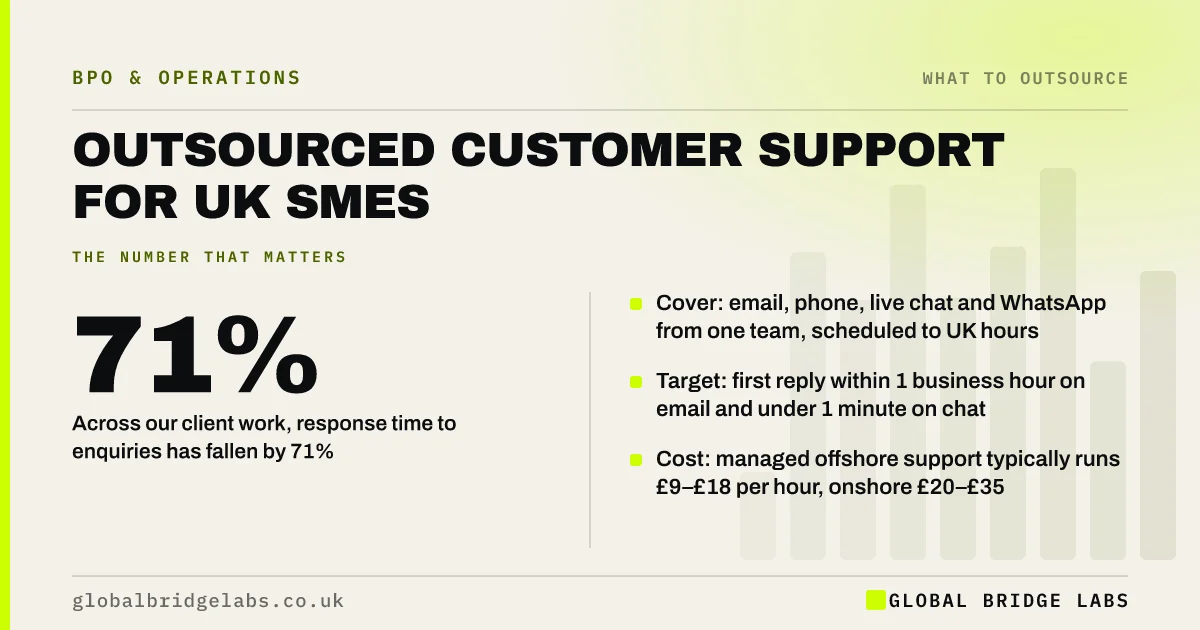
- Across our client work, response time to enquiries has fallen by 71%.
- Cover: email, phone, live chat and WhatsApp from one team, scheduled to UK hours.
- Target: first reply within 1 business hour on email and under 1 minute on chat.
- Cost: managed offshore support typically runs £9–£18 per hour, onshore £20–£35.
- Keep refunds above a threshold, serious complaints and key accounts with your staff.
Want to know what a support team would look like for your volumes? Message us on WhatsApp with your weekly contacts and channels.
Chat on WhatsApp →What is outsourced customer support?
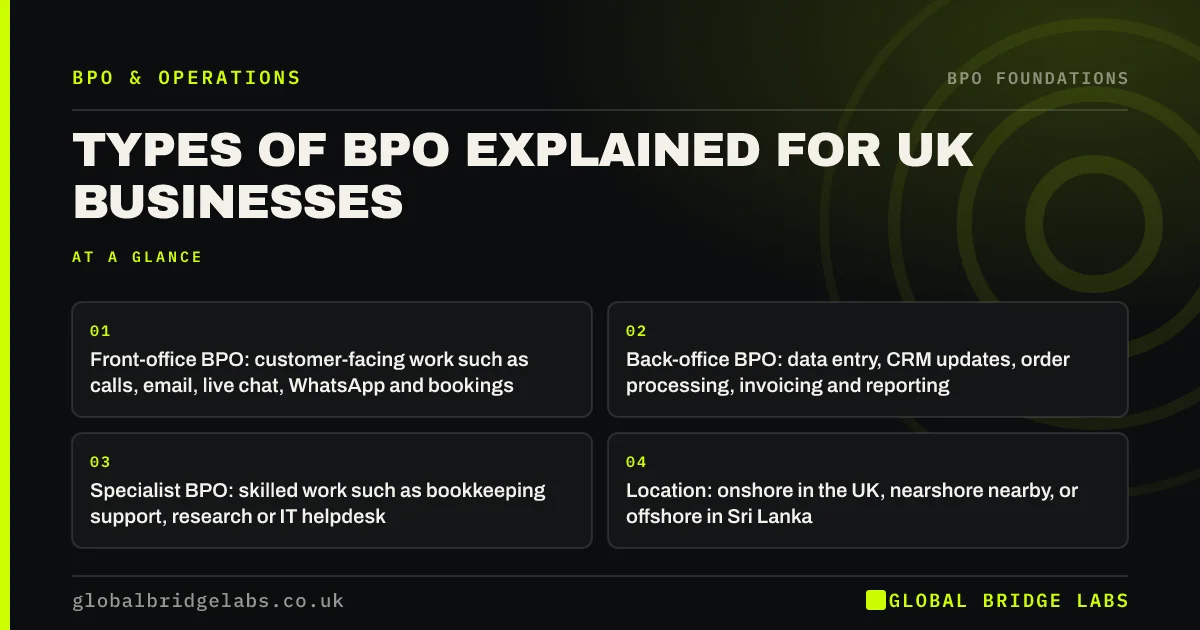
Outsourced customer support is a form of business process outsourcing (BPO) in which a provider staffs and manages the team that answers your customers, working to your procedures, tone and service levels, usually inside your own helpdesk and CRM.
For an SME it replaces the situation where support is everyone's second job. Instead of the owner, a salesperson and an office manager all dipping into the inbox, a trained team owns it, logs every contact and hands commercial decisions back to the right person.
Why do UK SMEs outsource customer support?
UK SMEs outsource support because customers expect fast answers on several channels and a small team cannot cover them all day without dropping other work. The Institute of Customer Service's UK Customer Satisfaction Index was 78.3 out of 100 in July 2026, and the organisations that score highest are those that respond quickly and resolve issues first time.
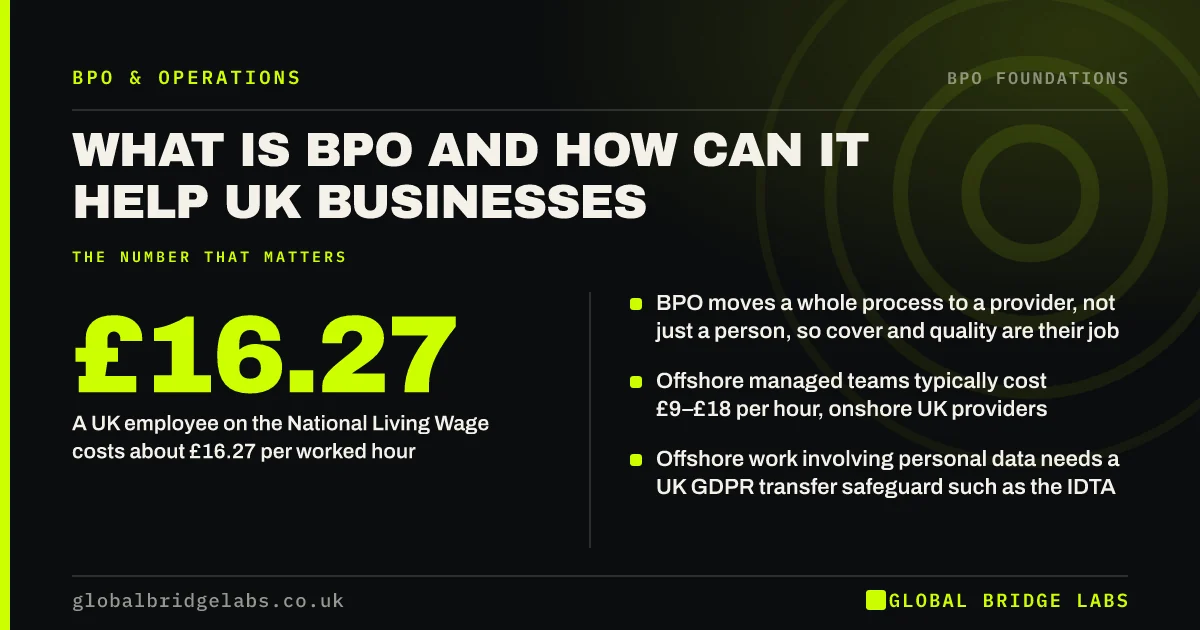
Hiring is the other route, but a single hire does not cover lunch, holidays or sickness, and a rota of three is beyond most small firms. From April 2026 the National Living Wage is £12.71 an hour and employer National Insurance is 15% above £5,000, so even a minimum-wage employee costs about £16.27 per worked hour before overheads.
Which channels can an outsourced team cover?
A managed support team can cover every channel your customers use, from one shared queue so nothing is answered twice or missed. Most SMEs start with email and one real-time channel, then add others once quality holds.
- Email and helpdesk tickets, including order and account queries.
- Inbound phone calls, with call-backs logged and booked.
- Live chat on your website, with handover to email outside hours.
- WhatsApp Business and social media direct messages.
- Review responses on Google and other platforms, drafted for approval.
What service levels should you expect?
Expect written service levels for each channel, measured and reported monthly. Reasonable starting targets for a UK SME are first reply to email within one business hour, chat answered within a minute, calls answered within five rings, and 70% or more of contacts resolved without escalation.
Set targets you can check in your own tools. A service level nobody can measure is only a promise.
How much does it cost to outsource customer support in the UK?
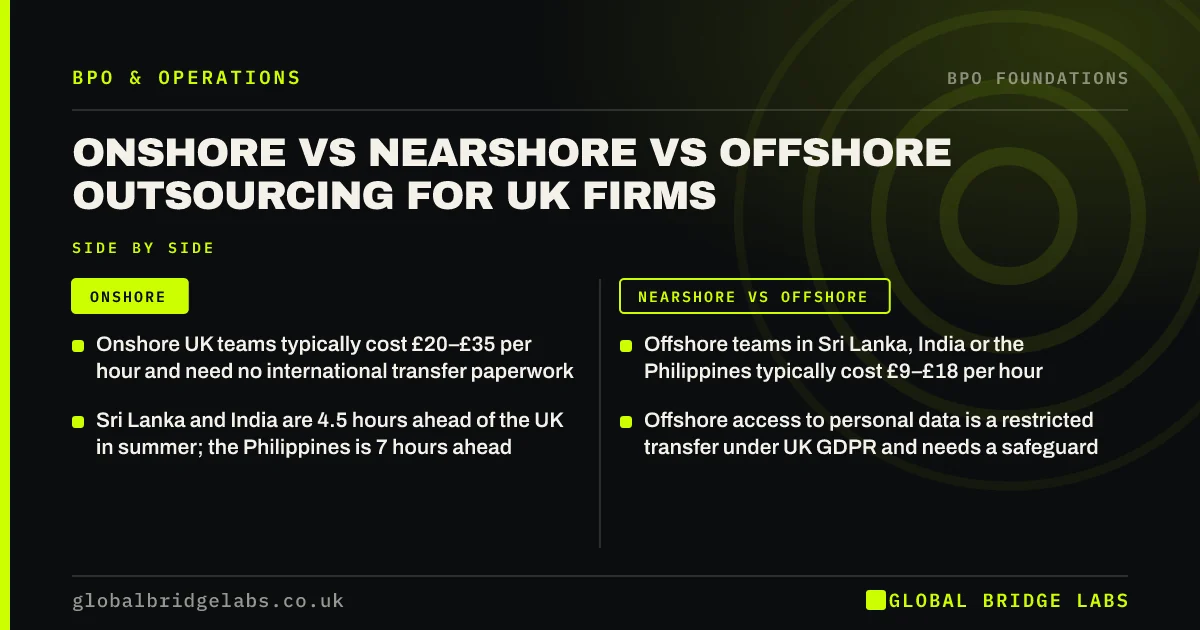
As indicative market ranges, managed offshore customer support costs around £9–£18 per hour per seat and onshore UK providers around £20–£35. Pay-per-contact pricing is also common for low or unpredictable volumes. The rate should include recruitment, training, supervision, quality checks and holiday cover.
Compare it with the fully loaded in-house cost, not the salary. A full-time support employee on £26,000 costs about £29,743 a year after 15% employer National Insurance and the 3% pension contribution, or about £17.09 per worked hour after 28 days of holiday, before equipment, software and management.
Want a costed plan for your support volumes and hours? Send us your weekly contacts by channel on WhatsApp and we will discuss your requirements.
Chat on WhatsApp →How do you keep your brand voice?
Keep your brand voice by writing it down and checking it. A one-page tone guide with words you use and avoid, ten model replies for your most common questions, and a weekly review of sampled conversations will keep an outsourced team sounding like you.
Give the team authority to solve common problems without asking, such as resending an order or rebooking an appointment. Customers judge tone less than they judge whether the problem was fixed.
When should support stay in-house?
Keep support in-house when every contact needs deep technical or regulated knowledge, when the volume is a few messages a day, or when support is the main way you sell to a small number of high-value clients. In those cases, outsource the overflow and out-of-hours cover rather than the whole function.
What does this look like in practice?
A public example on our projects page is a vehicle service centre whose missed calls were costing bookings. Its founder describes a contact centre that answers with the business's brand, cuts wait times and turns price checks into diary slots.
The pattern repeats across SMEs: once one team owns every channel with a clear escalation route, fewer contacts slip through and the owner stops being the backstop. Across our client work, response time to enquiries has fallen by 71%.
Checklist: outsource your support
Prepare these before you ask for quotes.
- Count weekly contacts by channel and by hour of day.
- Decide the hours of cover, including weekends.
- Write service levels for each channel.
- Write a one-page tone guide and ten model replies.
- List what the team can resolve alone and what it must escalate.
- Give the team access to your helpdesk, CRM and order system.
- Agree a weekly QA sample and a monthly scorecard.
Next step
Tell us your channels and volumes and we will design the team, the hours and the service levels, with a cost comparison against hiring. 30 minutes, no pitch.
Message us on WhatsApp for a support team plan, or book a 30-minute consultation.
Chat on WhatsApp →Sources and further reading
- UK Customer Satisfaction Index · Institute of Customer Service
- National Minimum Wage and National Living Wage rates · GOV.UK
- Rates and thresholds for employers 2026 to 2027 · HM Revenue & Customs
Frequently asked questions
Is outsourced customer support good for small businesses?
Yes, when replies are slow or the owner is covering the inbox. A managed team covers all trading hours, handles holidays and sickness, and works to written service levels. Small businesses gain the most because they cannot staff a full rota themselves. Keep complex complaints and key accounts in-house.
Can an outsourced team access our order system?
Yes, and it should, so it can resolve issues rather than just take messages. Give each team member an individual login with only the permissions they need, multi-factor authentication and activity logging. Put a processor contract in place and, if the team is offshore, a UK GDPR transfer safeguard.
What hours can outsourced support cover?
Any hours you need. Most UK SMEs start with their own trading hours, such as 8:00 to 18:00 on weekdays, then add evenings or weekends if demand justifies it. Offshore teams in Sri Lanka cover UK hours on an afternoon-to-evening shift.
How do I know the outsourced team is doing a good job?
Agree a monthly scorecard covering response times, resolution rate, quality score from sampled conversations and customer satisfaction. Review sampled conversations yourself in the first weeks. A good provider shares the raw data and flags problems before you find them.
Written by

Global Bridge Labs (GBL) is a UK–Sri Lanka partner for social media, websites and BPO. Everything here comes from client delivery, not theory.