On this page
- 01Key takeaways
- 02What is a tiered support model?
- 03What are the tiers?
- 04How does tiering lower costs?
- 05What does shift left mean?
- 06When do tiers make service worse?
- 07Where does a managed team fit?
- 08What does this look like in practice?
- 09Tiered support checklist
- 10Next step
- 11Sources and further reading
- 12Frequently asked questions
Key takeaways
A tiered support model sorts customer queries by difficulty and sends each to the least expensive level that can resolve it. Self-service takes the simplest, a first-line team takes routine questions, and specialists see only what needs them. The saving comes from stopping senior people answering questions that a page or a trained generalist could handle.
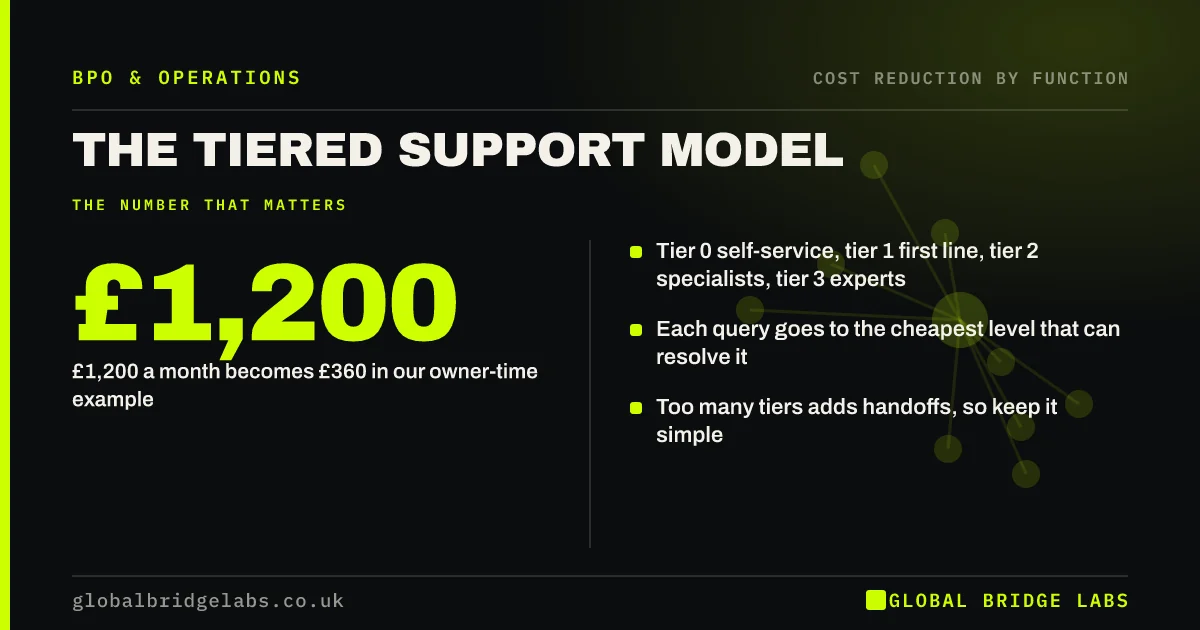
- Tier 0 self-service, tier 1 first line, tier 2 specialists, tier 3 experts.
- Each query goes to the cheapest level that can resolve it.
- £1,200 a month becomes £360 in our owner-time example.
- Too many tiers adds handoffs, so keep it simple.
Want help deciding which queries belong at which tier? Message us on WhatsApp with your commonest questions.
Chat on WhatsApp →What is a tiered support model?
A tiered support model is a way of organising customer service into levels of increasing expertise, with rules for when a query moves up. It ensures that simple questions are resolved quickly and cheaply, and that scarce expert time is kept for problems that need it.
What are the tiers?
Most models use four levels. A small business does not need four teams. One person may cover two tiers. What matters is knowing which queries belong where.
- Tier 0: self-service, such as FAQs, order tracking and help pages.
- Tier 1: first-line handlers resolving routine queries from a playbook.
- Tier 2: specialists handling complex or account-specific issues.
- Tier 3: experts, managers or the owner, for rare and high-risk cases.
How does tiering lower costs?
Tiering lowers costs by matching the cost of the person to the difficulty of the question. In many small businesses the owner or a senior specialist answers everything, because they know the answer. That prices every delivery query at the highest rate in the building.
Take an illustrative owner whose time is valued at £40 an hour, answering 300 routine queries a month at 6 minutes each. That is 30 hours and £1,200. Handled by a first-line team at an indicative £12 an hour, the same queries cost £360, and the owner gets 30 hours back.
- The cost lever scorecard: find savings process by process
- Cost per contact: compare in-house and outsourced support
Want to see what your senior people spend on routine queries? Send us the numbers on WhatsApp.
Chat on WhatsApp →What does shift left mean?
Shift left means moving the resolution of a query to a lower, cheaper tier. A question that used to need a specialist is documented so first-line staff can answer it. A question first-line staff answer every day is published so customers can find it themselves. Each move lowers cost and usually speeds up the answer.
- 1. List the queries each tier handles most.
- 2. Ask what the tier below would need to resolve them.
- 3. Write the playbook or help page.
- 4. Move the query down and measure resolution.
When do tiers make service worse?
Tiers make service worse when they become a wall. If first-line staff have no authority and escalate half of what they receive, the customer waits twice and explains twice. The test is the share of contacts resolved at first line. If it is low, widen their authority and access before adding people.
Where does a managed team fit?
A managed team is most often used for tier 1, working from your playbooks and macros, with clear rules for what goes up to your in-house specialists. This keeps product knowledge and judgement with you and moves the volume to a lower cost. As playbooks improve, more queries can be resolved at first line.
What does this look like in practice?
A pattern we see in technical and professional firms: the most qualified person is also the support desk, because customers ask for them by name. Their real work is done in the evenings. Putting a trained first line in front, with a promise that complex matters reach the expert the same day, protects both the relationship and the expert's time.
Tiered support checklist
Set up tiers with these steps.
- Tag a month of queries by difficulty.
- Decide which are self-service, first line and specialist.
- Write playbooks for first-line queries.
- Set authority limits for refunds and decisions.
- Define escalation rules and response times.
- Track the share resolved at each tier.
Next step
Tell us who answers customer queries today and which questions take the most senior time. We will sketch a tier structure that fits a business your size.
Message us on WhatsApp to design your support tiers, or book a 30-minute consultation.
Chat on WhatsApp →Sources and further reading
- UK Customer Satisfaction Index · Institute of Customer Service
- Labour productivity · Office for National Statistics
Frequently asked questions
What are tier 1, tier 2 and tier 3 support?
Tier 1 is first-line support that resolves routine queries from documented answers. Tier 2 is specialist support for complex or account-specific problems. Tier 3 is expert support, often engineers, senior managers or the owner, for rare and difficult cases. Tier 0 refers to self-service.
Does a small business need support tiers?
A small business benefits from the idea even without separate teams. Deciding which queries a help page can answer, which a trained generalist can handle and which need a specialist stops expensive people doing routine work. One person can cover more than one tier.
What is shift left in customer support?
Shift left means resolving queries at a lower tier than before. Knowledge moves from specialists into playbooks for first-line staff, and from first-line staff into self-service content. It lowers cost per contact and often shortens the time customers wait for an answer.
What is a good first-line resolution rate?
It varies with how technical the product is, so compare against your own trend. If first-line staff escalate a large share of what they receive, they probably lack authority, access or documentation. Fix those before judging the model.
Written by

Global Bridge Labs (GBL) is a UK–Sri Lanka partner for social media, websites and BPO. Everything here comes from client delivery, not theory.