
On this page
- 01Key takeaways
- 02Why is a pound saved worth more than a pound sold?
- 03When should cost reduction come first?
- 04When should revenue growth come first?
- 05Can you do both at once?
- 06Which costs should never be cut to save money?
- 07What does this look like in practice?
- 08Decision checklist
- 09Next step
- 10Sources and further reading
- 11Frequently asked questions
Key takeaways
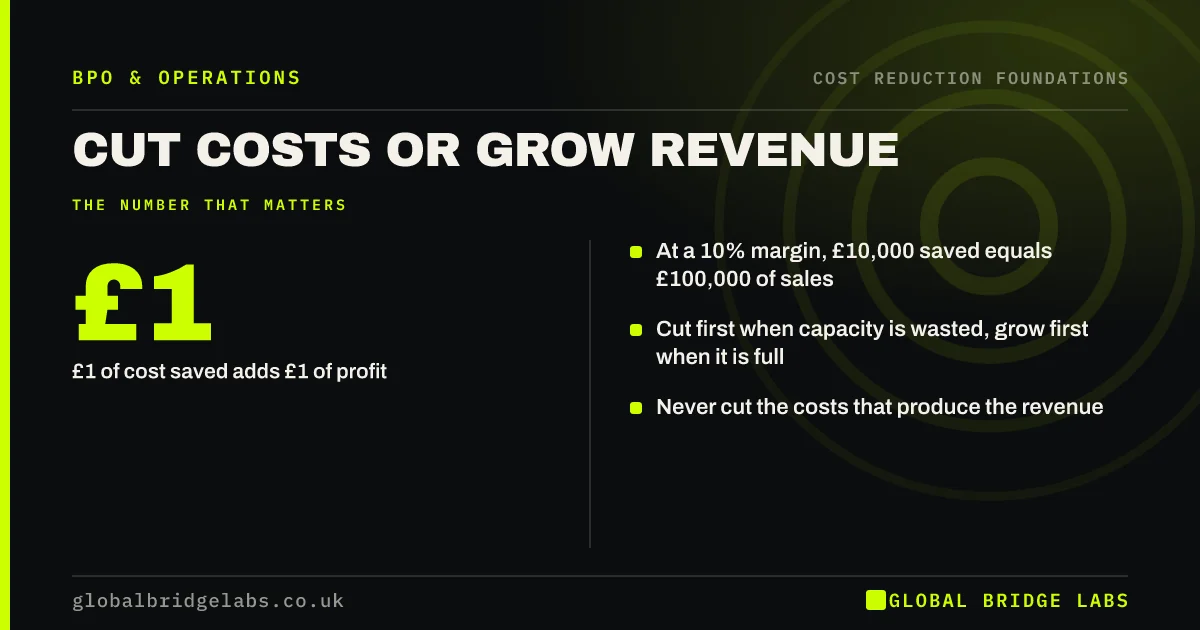
Whether to cut costs or grow revenue depends on your margin and your spare capacity. A pound of cost saved is a full pound of profit, while a pound of revenue is worth only your margin. At a 10% net margin, £10,000 saved equals £100,000 of new sales. But cost reduction has a floor, and revenue does not.
- £1 of cost saved adds £1 of profit.
- At a 10% margin, £10,000 saved equals £100,000 of sales.
- Cut first when capacity is wasted, grow first when it is full.
- Never cut the costs that produce the revenue.
Not sure which lever to pull first? Message us on WhatsApp with your margin and how busy the team is.
Chat on WhatsApp →Why is a pound saved worth more than a pound sold?
A pound saved is worth more because it reaches profit whole. A pound of revenue first pays for the product, the people who deliver it and the overheads, and only the remainder is profit. The lower your margin, the more sales it takes to match a saving.
In an illustrative business with a 10% net margin, removing £10,000 of wasted cost adds the same profit as winning £100,000 of new sales. At a 20% margin the equivalent is £50,000.
When should cost reduction come first?
Cost reduction should come first when the business has waste it can see: under-used roles, repeated work, senior people on routine tasks, or operating costs growing faster than sales. It should also come first when cash is tight, because savings arrive faster and more certainly than new customers.
- Operating costs rising faster than revenue.
- Routine work done by expensive people.
- Frequent rework and correction.
- Cash under pressure this quarter.
When should revenue growth come first?
Revenue growth should come first when the operation is already lean, margins are healthy and demand is the constraint. Cutting in that position weakens the very thing that could grow. It also comes first when a fixed cost base is under-used: filling spare capacity with sales lowers cost per unit without any cuts.
Can you do both at once?
You can do both when the saving comes from routine work and the growth comes from the people it frees. Moving 20 hours a week of admin off a salesperson lowers the cost of that admin and returns 20 hours of selling time. This is the strongest case for a managed team: one change that helps both lines.
Across our client work, owners have got 31 hours a week back. What those hours are spent on decides whether the result is only a saving or also growth.
- What to do with cost savings: reinvest, keep or pass on?
- How outsourcing helps small businesses scale without hiring
Want to see which roles could give you both? Send us your team list on WhatsApp.
Chat on WhatsApp →Which costs should never be cut to save money?
Do not cut the costs that produce or protect revenue: response speed to enquiries, the quality customers pay for, and the people who hold key relationships. Savings there show up as lost sales a quarter later, where they are harder to trace back to the decision.
What does this look like in practice?
A pattern we see in owner-led firms: the plan for the year is to grow sales by a fifth, and the owner is the best salesperson. The owner is also spending two days a week on quoting, invoicing and chasing. No growth plan works until that time is released, and releasing it also happens to lower the cost of the admin.
Decision checklist
Answer these before setting next year's priorities.
- What is your net margin?
- How much revenue equals a £10,000 saving at that margin?
- Is the team at capacity or under-used?
- Are operating costs growing faster than sales?
- Which costs directly produce revenue?
- Which people could sell or deliver more if freed from admin?
Next step
Send us your margin, your headcount and where the owner's week goes. We will tell you which lever is likely to move profit faster and what it would take.
Message us on WhatsApp to weigh up costs against growth, or book a 30-minute consultation.
Chat on WhatsApp →Sources and further reading
- Business population estimates for the UK and regions 2025 · Department for Business and Trade
- Labour productivity · Office for National Statistics
Frequently asked questions
Is it better to cut costs or increase sales?
It depends on margin and capacity. Cutting waste raises profit pound for pound and quickly, so it is better when margins are thin or cash is tight. Increasing sales is better when the operation is already lean and has room to take more work without adding cost.
How much revenue equals a cost saving?
Divide the saving by your net profit margin. At a 10% margin, a £10,000 saving equals £100,000 of extra sales. At 5% it equals £200,000. This is why removing waste is so valuable in low-margin businesses.
Can cost cutting hurt growth?
Yes, when it removes capacity that customers rely on. Cutting sales support, slowing replies to enquiries or reducing quality saves money now and loses revenue later. Target costs that produce nothing, and lower the unit cost of work that must continue.
What is the limit of cost reduction?
Costs can only be reduced to the level needed to deliver the product well. Beyond that point every further cut removes capability. Revenue has no such floor, which is why sustained profit growth eventually has to come from sales, with an efficient cost base underneath.
Written by

Global Bridge Labs (GBL) is a UK–Sri Lanka partner for social media, websites and BPO. Everything here comes from client delivery, not theory.


