
On this page
- 01Key takeaways
- 02What is gainshare?
- 03Why would you use it?
- 04How does it work in numbers?
- 05What conditions does it need?
- 06What are the pitfalls?
- 07Is there a simpler alternative?
- 08What does this look like in practice?
- 09Gainshare checklist
- 10Next step
- 11Sources and further reading
- 12Frequently asked questions
Key takeaways
Gainshare outsourcing is a commercial arrangement in which the provider earns a share of the savings or improvements it delivers beyond an agreed baseline. It rewards the provider for making your process cheaper, which ordinary hourly pricing does not. It only works with a trusted baseline, a simple formula and savings both sides can verify.
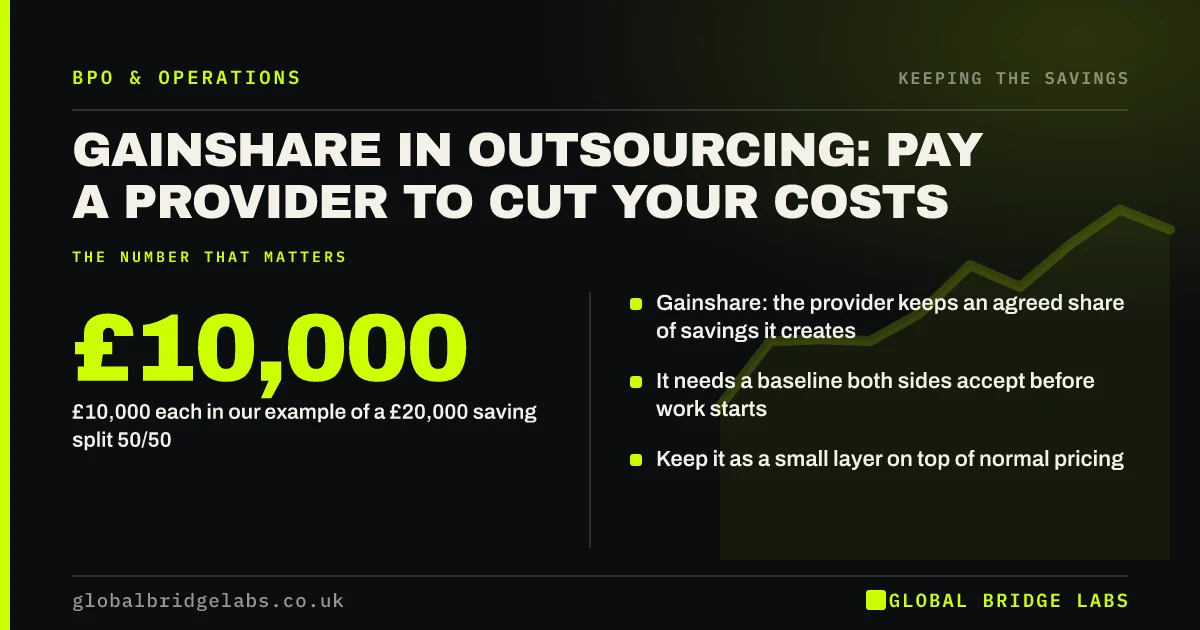
- Gainshare: the provider keeps an agreed share of savings it creates.
- £10,000 each in our example of a £20,000 saving split 50/50.
- It needs a baseline both sides accept before work starts.
- Keep it as a small layer on top of normal pricing.
Want to know whether gainshare suits your contract? Message us on WhatsApp with the process and its current cost.
Chat on WhatsApp →What is gainshare?
Gainshare is a contract mechanism under which a supplier and a client share the financial benefit of improvements the supplier makes. The client pays less than before, and the supplier receives a percentage of the difference. It aligns the provider's income with your cost falling.
Why would you use it?
You would use it because standard pricing gives a provider no reason to shrink its own invoice. Paid per hour, it earns more when the work takes longer. Paid per contact, it earns more when customers contact you more. Gainshare gives it a reason to remove hours and contacts.
How does it work in numbers?
Take an illustrative process with an agreed baseline cost of £100,000 a year. The provider proposes changes that bring the cost of delivering it to £80,000, a saving of £20,000. Under a 50/50 gainshare, you pay £80,000 plus £10,000, and your net saving is £10,000 a year.
The share normally applies for a fixed period, often one to two years, after which the full saving passes to you. Without the incentive, the £20,000 improvement might never have been proposed.
- Baseline: £100,000 a year.
- New cost of delivery: £80,000.
- Provider's share: £10,000.
- Your net saving: £10,000 a year, rising to £20,000 when the share ends.
- Run-rate savings vs one-off savings: count them correctly
- Cost baseline: measure today's cost before you change it
Want a gainshare formula sketched for your process? Send us the baseline on WhatsApp.
Chat on WhatsApp →What conditions does it need?
Gainshare needs four conditions. Without them it produces arguments instead of savings.
- A baseline measured and signed off before the contract starts.
- A formula simple enough to explain in two sentences.
- Quality and service conditions, so savings cannot come from cutting corners.
- A rule for volume changes, so growth is not mistaken for inefficiency.
What are the pitfalls?
The pitfalls are disputed baselines, gaming and complexity. A provider may inflate the starting figure to make later savings look larger. Savings may be claimed for changes you made yourself. And a formula with many adjustments costs more to administer than it yields. For small contracts, the administration can outweigh the benefit.
Is there a simpler alternative?
Yes. A small business can get most of the effect with a plain commitment: the provider proposes at least two costed improvements each quarter, and an agreed share of any resulting saving is paid as a one-off bonus. It keeps the incentive and drops the formula.
The UK government's Sourcing Playbook encourages payment mechanisms that reward the outcomes a buyer wants, and the same principle scales down.
What does this look like in practice?
A pattern we see in long-running contracts: the provider's team knows exactly which steps are pointless, because they perform them every day. Nobody asks, and nothing in the contract rewards them for saying so. A modest reward for costed suggestions tends to release a list that has been sitting unspoken for a year.
Gainshare checklist
Agree these before signing.
- Baseline cost and method, signed by both sides.
- Share percentage and how long it lasts.
- Quality and service floor that must be met.
- How volume changes are treated.
- Who verifies the saving and how often.
- What counts as the provider's idea.
Next step
Tell us what your outsourced or in-house process costs today and how it is priced. We will say whether a gainshare, a simpler improvement bonus or neither makes sense.
Message us on WhatsApp to discuss improvement incentives, or book a 30-minute consultation.
Chat on WhatsApp →Sources and further reading
- The Sourcing and Consultancy Playbooks · Cabinet Office
- The Green Book: appraisal and evaluation in central government · HM Treasury
Frequently asked questions
What is a gainshare agreement?
A gainshare agreement is a contract term under which a supplier receives a share of the savings or benefits it generates for a client beyond an agreed baseline. It is used to give the supplier a financial reason to improve efficiency instead of simply delivering the specified service.
How is gainshare calculated?
Subtract the new cost of delivering the service from the agreed baseline cost to find the saving, then apply the agreed percentage split. With a £20,000 saving and a 50/50 split, the supplier receives £10,000 and the client keeps £10,000.
Is gainshare suitable for small contracts?
A formal gainshare is often too complex for small contracts, because measuring and verifying savings takes effort. A simpler improvement bonus, paid for costed suggestions that are adopted, gives a similar incentive with far less administration.
What is the main risk of gainshare?
The main risk is an unreliable baseline. If the starting cost is overstated or cannot be verified, the supplier is paid for savings that are not real. Measure and agree the baseline before the contract starts, and include quality conditions.
Written by

Global Bridge Labs (GBL) is a UK–Sri Lanka partner for social media, websites and BPO. Everything here comes from client delivery, not theory.


